This is a little late. You might say I've been recovering.
(Magnet Hospital designation call, 1 p.m. on August 16, 2010, Bon Secours St. Francis Hospital, Charleston, South Carolina - film credit to the fabulous Lee Bastian)
Thursday, August 19, 2010


Sunday, August 01, 2010
They Stood As If Every Man was a Hero
In the afternoon after a blistering morning at the Chickamauga battlefield, I went back up to the relative cool of Lookout Mountain and the three of us - Jenbach, Isabella, and myself - went over to Point Park, a strategic location overlooking Chattanooga held by the Confederates during the siege of Chattanooga.

At 4:00 AM on the morning of September 8, 1863, Company A of the Kentucky 23rd Infantry started up Lookout Mountain on a reconnaissance, arriving at Point Lookout about 11:30 AM. "we found no enemy in force on the mountain, and now from this point could be distinctly seen the dust from the enemy's column moving out from Chattanooga". I wonder if our second great grandfather, George Caseman, would have thought three of his granddaughters would be looking at the same view from the same location a hundred and sixty four years later.
Eleven days later, brothers George, Jacob, and Foster Caseman were fighting in the bloody battle at Chickamauga, a few miles south of Chattanooga. From their brigade commander's report at Chickamauga, "they stood as if every man was a hero... I ordered my men to rise up and open fire, which they did with a cheer. The Twenty-fourth Ohio halted in our rear, and now, side by side and shoulder to shoulder, did the Twenty-fourth Ohio and Twenty-third Kentucky stand up and successively repulse the enemy in all his attacks...the fire now was very hot...it appeared to me as though every third man in the regiment was struck". Of the brothers, only George and Jacob would survive to retreat with the Union Army to Chattanooga. On the first day of battle, young Foster, age 21, was killed in action.
Later in the evening we walked downtown Chattanooga, found Orchard Knob which I had to climb, closed to the public or not,
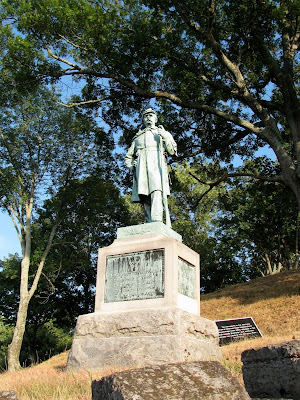
and drove a bit east to Missionary Ridge.
Here the Kentucky 23rd was part of the famous charge up Missionary Ridge on November 25, 1863. Ordered to only make a "demonstration" at the bottom of Missionary Ridge, the 18,000 enlisted men on their own and without orders from General Grant, smarting from the defeat at Chickamauga, one by one or in small groups of two to three, gradually rose to their feet and charged up the steep slopes of the ridge toward the rebel's fortified position chanting "Chickamauga, Chickamauga".
"At the center of this unplanned and unordered attack was Arthur MacArthur and the 24th Wisconsin. MacArthur’s color bearer had been killed during the fighting for the rifle pits and, as men began to clamber out of the trenches and up the hill, his replacement was decapitated by a round of solid shot from a Confederate gun above. MacArthur himself was wounded but still standing. When the colors went down a second time, he climbed out of the trench, grabbed them, and turned to his men, who were still cowering in the rifle pits. Raising the now ragged, battle-scarred flag high above his head, he shouted "On Wisconsin!" and moved quickly up the ridge.
In one of those rare moments when men are moved from terror to bravery, the men of the 24th Wisconsin rose up and began to follow Little Mac up the steep slope amid a hail of enemy rifle and artillery fire. As the Union soldiers up and down the line moved closer, the Confederate defenders abandoned their positions at the crest in disorganized panic. As Arthur MacArthur reached the summit of Missionary Ridge, he firmly planted the staff of the bullet-riddled flag in the ground for all to see. MacArthur, the 24th Wisconsin, and the Army of the Cumberland, who Grant had feared would not leave their trenches, smashed Bragg’s center in six places, sending the Southern army into full retreat. The siege of Chattanooga was broken."
Young Arthur was an 18 year old lieutenant with a command in the Wisconsin 24th, a Scotsman, of course, father of General Douglas MacArthur of World War II fame, and inspiration for the "On, Wisconsin" fight song. I wonder if most University of Wisconsin freshmen know this?
Tomorrow, we start our "March Through Georgia", by car of course.

At 4:00 AM on the morning of September 8, 1863, Company A of the Kentucky 23rd Infantry started up Lookout Mountain on a reconnaissance, arriving at Point Lookout about 11:30 AM. "we found no enemy in force on the mountain, and now from this point could be distinctly seen the dust from the enemy's column moving out from Chattanooga". I wonder if our second great grandfather, George Caseman, would have thought three of his granddaughters would be looking at the same view from the same location a hundred and sixty four years later.
Eleven days later, brothers George, Jacob, and Foster Caseman were fighting in the bloody battle at Chickamauga, a few miles south of Chattanooga. From their brigade commander's report at Chickamauga, "they stood as if every man was a hero... I ordered my men to rise up and open fire, which they did with a cheer. The Twenty-fourth Ohio halted in our rear, and now, side by side and shoulder to shoulder, did the Twenty-fourth Ohio and Twenty-third Kentucky stand up and successively repulse the enemy in all his attacks...the fire now was very hot...it appeared to me as though every third man in the regiment was struck". Of the brothers, only George and Jacob would survive to retreat with the Union Army to Chattanooga. On the first day of battle, young Foster, age 21, was killed in action.
Later in the evening we walked downtown Chattanooga, found Orchard Knob which I had to climb, closed to the public or not,

and drove a bit east to Missionary Ridge.
Here the Kentucky 23rd was part of the famous charge up Missionary Ridge on November 25, 1863. Ordered to only make a "demonstration" at the bottom of Missionary Ridge, the 18,000 enlisted men on their own and without orders from General Grant, smarting from the defeat at Chickamauga, one by one or in small groups of two to three, gradually rose to their feet and charged up the steep slopes of the ridge toward the rebel's fortified position chanting "Chickamauga, Chickamauga".
"At the center of this unplanned and unordered attack was Arthur MacArthur and the 24th Wisconsin. MacArthur’s color bearer had been killed during the fighting for the rifle pits and, as men began to clamber out of the trenches and up the hill, his replacement was decapitated by a round of solid shot from a Confederate gun above. MacArthur himself was wounded but still standing. When the colors went down a second time, he climbed out of the trench, grabbed them, and turned to his men, who were still cowering in the rifle pits. Raising the now ragged, battle-scarred flag high above his head, he shouted "On Wisconsin!" and moved quickly up the ridge.
In one of those rare moments when men are moved from terror to bravery, the men of the 24th Wisconsin rose up and began to follow Little Mac up the steep slope amid a hail of enemy rifle and artillery fire. As the Union soldiers up and down the line moved closer, the Confederate defenders abandoned their positions at the crest in disorganized panic. As Arthur MacArthur reached the summit of Missionary Ridge, he firmly planted the staff of the bullet-riddled flag in the ground for all to see. MacArthur, the 24th Wisconsin, and the Army of the Cumberland, who Grant had feared would not leave their trenches, smashed Bragg’s center in six places, sending the Southern army into full retreat. The siege of Chattanooga was broken."
Young Arthur was an 18 year old lieutenant with a command in the Wisconsin 24th, a Scotsman, of course, father of General Douglas MacArthur of World War II fame, and inspiration for the "On, Wisconsin" fight song. I wonder if most University of Wisconsin freshmen know this?
Tomorrow, we start our "March Through Georgia", by car of course.
Sunday, July 18, 2010
The Killing Fields of Chickamauga
After leaving the Cousins Reunion in Athens, we three generations - 8 yr old Isabella, 40-something mom Jennifer, and the ageless Ouma - headed north to the Tennessee border to Chattanooga and Lookout Mountain with a plan to trace Sherman's 1864 March through Georgia. This was a week I'd planned to do by myself since tracking Civil War history is not exactly appealing to most people, but Jennifer always figures where her mom goes there must be adventure. With the pot sweetened by the beautiful state of Georgia, some peaches and lakes and lofts thrown in, it was a pretty good deal for everyone. Even some history was learned.
No sweetening is enticing enough to endure the blistering hot one hundred degree battle field of Chickamauga just outside Chattanooga, but walking these places is what I set out to do. I was alone on this one. With the two youngsters ensconced at the Thomas Kincaidish Chanticleer Inn on Lookout Mountain, I set off for what I knew would be a sobering day.
Chickamauga was one of the bloodiest battles of the Civil War, more than 30,000 casualties. In a nutshell, the Union Army of the Cumberland with 60,000 men went against 65,000 men in the Confederate Army. The prize - for the North geographic access into Georgia and control of the rail lines, for the South protecting the Homeland that hadn’t seen action in its interior. On September 19-20, 1863, 125,000 men and countless cannons, rifles, infantry and cavalry went at each other, often hand to hand, stretching over a battle line of more than 4 miles. At times the fields were so littered, they could be crossed only by walking on fallen soldiers.

The battle site covering a huge area of fields and forests has been a national park since 1895. Even with the scorching heat and no water bottle, I set out to walk the areas I could, and drive the sections in between. The battle field holds 1400 monuments and markers, 600 put up for the various brigades and regiments for where they saw action. I was determined to check out as many as I could, and to walk those areas of action I knew about, like Longtreet's break through the Union line.
Some stand in the beauty of an open field,

others line the woods where soldiers did their best to put up some type of defense,


and the tallest of all for the state of Georgia.

A cannonball pyramid is erected wherever a commander fell, the higher up the officer the bigger his pyramid.

I climbed Wilder's monument honoring his legendary Lightening Brigade with their repeating Spencer rifles.

The view over the battlefield from Wilder's tower would have been bucolically beautiful if not for my mind's eye seeing the tens of thousands of young men killed and wounded across the landscape.

Overwhelmed by the heat and reality of the battle field, I finally found Snodgrass Hill where General George H. Thomas, the "Rock of Chickamauga", held off the Confederates while the Union Army retreated back to Chattanooga for a good siege. Yes, kids, the North lost this one.

In October of 1861, three brothers from Pendleton County enlisted in Kentucky 23rd Infantry, all in Company D. They were farmers, second generation German stock, two come from Pennsylvania with their mother and the third born in Kentucky. George Caseman at 33 years was old for a soldier, by now married with two young children but with Kentucky threatened by incursions from the Confederate Army, he enlisted in the Union Army. His 4 years younger brother, Jacob, was newly married with a young son, working on a farm. The youngest, Foster, was just 18 when the war broke out and he was the first to sign up with the 23rd. Who knows what Lydia felt when her three boys went off to war, all with the 23rd, Company D, the boys from Pendleton County, but I doubt it was much different from other mothers over the history of mankind's making war on each other.
The three young men fought with the 23rd into Chattanooga and from there to Chickamauga. Foster, age 20, was killed in action the first day of Chickamauga, on September 19, and is buried at the Chattanooga National Cemetery.
Jacob was wounded two weeks after the Battle at Chickamauga. The Union Army had retreated to Chattanooga and Jacob was accidentally shot by a drunken guard in the barracks, requiring amputation of his arm at the elbow.
He returned home to his family and farm and died ten years later at the age of 43.
Only George remained with the Kentucky 23rd whose boys endured the starving siege of Chattanooga and under General Grant made the ferocious charge up Missionary Hill, and followed Sherman on the march through Georgia to take Atlanta. He mustered out of the 23rd and returned home in early 1865. He had another six children and lived to an old age of 85.
George's first child, Mary Jane, born before he went off to war, is our great grandmother. George is our second great grandfather, and Jacob and Foster our uncles.
Every soldier on the field has a story, and a life, as rich as those of George and Jacob and Foster. That is the magnitude of it all.
No sweetening is enticing enough to endure the blistering hot one hundred degree battle field of Chickamauga just outside Chattanooga, but walking these places is what I set out to do. I was alone on this one. With the two youngsters ensconced at the Thomas Kincaidish Chanticleer Inn on Lookout Mountain, I set off for what I knew would be a sobering day.
Chickamauga was one of the bloodiest battles of the Civil War, more than 30,000 casualties. In a nutshell, the Union Army of the Cumberland with 60,000 men went against 65,000 men in the Confederate Army. The prize - for the North geographic access into Georgia and control of the rail lines, for the South protecting the Homeland that hadn’t seen action in its interior. On September 19-20, 1863, 125,000 men and countless cannons, rifles, infantry and cavalry went at each other, often hand to hand, stretching over a battle line of more than 4 miles. At times the fields were so littered, they could be crossed only by walking on fallen soldiers.

The battle site covering a huge area of fields and forests has been a national park since 1895. Even with the scorching heat and no water bottle, I set out to walk the areas I could, and drive the sections in between. The battle field holds 1400 monuments and markers, 600 put up for the various brigades and regiments for where they saw action. I was determined to check out as many as I could, and to walk those areas of action I knew about, like Longtreet's break through the Union line.
Some stand in the beauty of an open field,
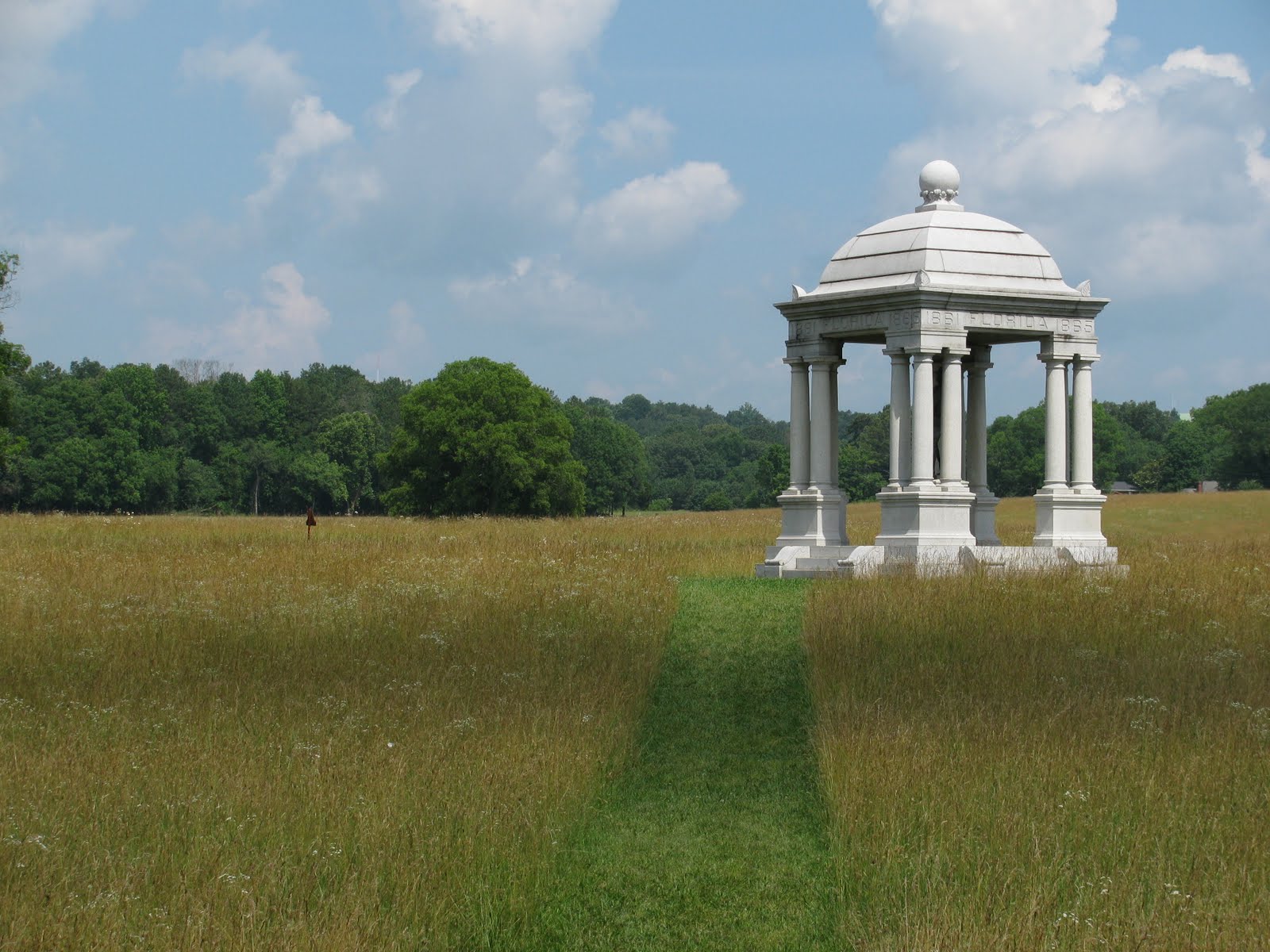
others line the woods where soldiers did their best to put up some type of defense,


and the tallest of all for the state of Georgia.

A cannonball pyramid is erected wherever a commander fell, the higher up the officer the bigger his pyramid.

I climbed Wilder's monument honoring his legendary Lightening Brigade with their repeating Spencer rifles.

The view over the battlefield from Wilder's tower would have been bucolically beautiful if not for my mind's eye seeing the tens of thousands of young men killed and wounded across the landscape.

Overwhelmed by the heat and reality of the battle field, I finally found Snodgrass Hill where General George H. Thomas, the "Rock of Chickamauga", held off the Confederates while the Union Army retreated back to Chattanooga for a good siege. Yes, kids, the North lost this one.

In October of 1861, three brothers from Pendleton County enlisted in Kentucky 23rd Infantry, all in Company D. They were farmers, second generation German stock, two come from Pennsylvania with their mother and the third born in Kentucky. George Caseman at 33 years was old for a soldier, by now married with two young children but with Kentucky threatened by incursions from the Confederate Army, he enlisted in the Union Army. His 4 years younger brother, Jacob, was newly married with a young son, working on a farm. The youngest, Foster, was just 18 when the war broke out and he was the first to sign up with the 23rd. Who knows what Lydia felt when her three boys went off to war, all with the 23rd, Company D, the boys from Pendleton County, but I doubt it was much different from other mothers over the history of mankind's making war on each other.
The three young men fought with the 23rd into Chattanooga and from there to Chickamauga. Foster, age 20, was killed in action the first day of Chickamauga, on September 19, and is buried at the Chattanooga National Cemetery.
Jacob was wounded two weeks after the Battle at Chickamauga. The Union Army had retreated to Chattanooga and Jacob was accidentally shot by a drunken guard in the barracks, requiring amputation of his arm at the elbow.
He returned home to his family and farm and died ten years later at the age of 43.
Only George remained with the Kentucky 23rd whose boys endured the starving siege of Chattanooga and under General Grant made the ferocious charge up Missionary Hill, and followed Sherman on the march through Georgia to take Atlanta. He mustered out of the 23rd and returned home in early 1865. He had another six children and lived to an old age of 85.
George's first child, Mary Jane, born before he went off to war, is our great grandmother. George is our second great grandfather, and Jacob and Foster our uncles.
Every soldier on the field has a story, and a life, as rich as those of George and Jacob and Foster. That is the magnitude of it all.
Friday, July 02, 2010
Wounded Warriors
Let it be known that he who wears the military order of the purple heart has given of his blood in the defense of his homeland and shall forever be revered by his fellow countrymen.
George Washington, commander of Continental Army, 1782
Once a month, some of us ladies from the Daughters of the American Revolution go up to Camp Pendleton to make a home cooked meal for the wounded warriors. The new barracks house 200 wounded warriors and, overlooking a lake and surrounding mountains, it is gorgeous. Even though it has a nice kitchen where the guys and girls - yes, there are wounded women Marines - could cook for themselves, most walk down the road to the hospital cafeteria for meals. So a home cooked meal is a treat, especially with a bunch of mother types cooking and serving.
This week was special as we were invited to a Purple Heart ceremony for Sargent Gonzales, wounded in combat in Iraq five years ago as a Marine in the Third Battalion, 1st Marine Expeditionary force, and now a member of the Wounded Warrior Battalion at Camp Pendleton.


A Marine officer spoke to Sgt. Gonzales' bravery and dedication as a satchel demolition expert in Fallujah, but also to the "we are your family", no Marine left behind philosophy. This ideal extends to wounded Marines who can remain active duty while they recover and either return to their unit or transition into civilian life. About half stay in the Marine Corps, some returning for another tour of duty in Iraq or Afghanistan.
Finally, Sgt. Gonzales took the podium and gave an amazing speech. More so, as he came into the kitchen later and told us one of his injuries was TBI (traumatic brain injury) and he had been very anxious for a couple weeks about having to talk in front of a crowd.

I noticed tattooed on his right forearm "NO SACRIFICE" and on his left "NO VICTORY".
Just as amazing were the Marines sitting at attention, hands on knees, pretty much motionless, on the hot tarmac for the entire ceremony. I suspected their third grade teachers would have seen very different behaviors.

After the ceremony, while the sargent's comrades lined up to speak with him, his two boys played basketball,

and got some coaching from another Marine.

My D.A.R. buddies and I headed into the kitchen to make and serve dinner.

Sometimes the warrior's wounds are evident - the missing hand or leg, the cane, the way he/she walks, the surgical scar across the skull. At other times, they're not - the abdominal wounds covered by the uniform, the TBI's, the psychic injury. Always, though, they come into the kitchen to thank us for making their dinner. They, who have given so much.
Happy 4th of July! It's about more than beach and fireworks and picnics. Remember those back to the 1700's who have made your Fourth possible!
APPENDIX
NO SACRIFICE

NO VICTORY

George Washington, commander of Continental Army, 1782
Once a month, some of us ladies from the Daughters of the American Revolution go up to Camp Pendleton to make a home cooked meal for the wounded warriors. The new barracks house 200 wounded warriors and, overlooking a lake and surrounding mountains, it is gorgeous. Even though it has a nice kitchen where the guys and girls - yes, there are wounded women Marines - could cook for themselves, most walk down the road to the hospital cafeteria for meals. So a home cooked meal is a treat, especially with a bunch of mother types cooking and serving.
This week was special as we were invited to a Purple Heart ceremony for Sargent Gonzales, wounded in combat in Iraq five years ago as a Marine in the Third Battalion, 1st Marine Expeditionary force, and now a member of the Wounded Warrior Battalion at Camp Pendleton.


A Marine officer spoke to Sgt. Gonzales' bravery and dedication as a satchel demolition expert in Fallujah, but also to the "we are your family", no Marine left behind philosophy. This ideal extends to wounded Marines who can remain active duty while they recover and either return to their unit or transition into civilian life. About half stay in the Marine Corps, some returning for another tour of duty in Iraq or Afghanistan.
Finally, Sgt. Gonzales took the podium and gave an amazing speech. More so, as he came into the kitchen later and told us one of his injuries was TBI (traumatic brain injury) and he had been very anxious for a couple weeks about having to talk in front of a crowd.

I noticed tattooed on his right forearm "NO SACRIFICE" and on his left "NO VICTORY".
Just as amazing were the Marines sitting at attention, hands on knees, pretty much motionless, on the hot tarmac for the entire ceremony. I suspected their third grade teachers would have seen very different behaviors.

After the ceremony, while the sargent's comrades lined up to speak with him, his two boys played basketball,

and got some coaching from another Marine.

My D.A.R. buddies and I headed into the kitchen to make and serve dinner.

Sometimes the warrior's wounds are evident - the missing hand or leg, the cane, the way he/she walks, the surgical scar across the skull. At other times, they're not - the abdominal wounds covered by the uniform, the TBI's, the psychic injury. Always, though, they come into the kitchen to thank us for making their dinner. They, who have given so much.
Happy 4th of July! It's about more than beach and fireworks and picnics. Remember those back to the 1700's who have made your Fourth possible!
APPENDIX
NO SACRIFICE

NO VICTORY

Thursday, June 24, 2010
The World's 10 Most Magnificent Trees
Our Tree that Owns Itself didn't make the world's ten most magnificent trees list, but it did get on the bonus list. And what incredible trees these are - a cutting started in 288 BC from the original fig tree under which the Buddha became enlightened in the 6th century and which may take a total of 3000 years to be fully grown, the Methuselah tree documented to be 4,838 years old, Utah's quaking aspen with a colony covering 107 acres, an 80,000 year old organism! This could be a destination list were it not that the location of some of the trees is not given for their own security. Seems that a scientist cut down another 5000 year old Methuselah tree just to determine its age, and a drunk Libyan driver mowed down the Tenere tree, a sole desert survivor when the Saharan desert dried up.
Patty and I stopped by the Monterrey Lone Cypress in 1977 when she was a cold war warrior.

She's probably reading this and thinking, "I was that skinny once?!"

Sixteen years later, in 1993, a buddy and I went cross country skiing into the sequoias looking for the General Sherman tree, the world's largest tree at 6000 pounds and 220 years old.

Jonathan was dwarfed next to the roots of one of these big guys fallen over.

We had to leave the trail to find the General and at one point Jonathan stopped in a mountain meadow to have his picture taken. As I was putting my camera away, I glanced up to see Jonathan taking off his skiis.

"No-o-o-o, Jonathan, don't take off your skis, you'll... I yelled, just as he sank almost up to his waist. I knew this would happen in deep meadow snow from my own experience sinking a snowmobile at night in the Rockies.
I pulled him out and we skied on, naturally being lost for a while, wondering if those large paw tracks were bear, and finally found the tree named after the general who made Georgia "howl" and then wired Lincoln, "I beg to present you as a Christmas gift the city of Savannah".

Two down, eight to go.
Patty and I stopped by the Monterrey Lone Cypress in 1977 when she was a cold war warrior.

She's probably reading this and thinking, "I was that skinny once?!"

Sixteen years later, in 1993, a buddy and I went cross country skiing into the sequoias looking for the General Sherman tree, the world's largest tree at 6000 pounds and 220 years old.

Jonathan was dwarfed next to the roots of one of these big guys fallen over.

We had to leave the trail to find the General and at one point Jonathan stopped in a mountain meadow to have his picture taken. As I was putting my camera away, I glanced up to see Jonathan taking off his skiis.

"No-o-o-o, Jonathan, don't take off your skis, you'll... I yelled, just as he sank almost up to his waist. I knew this would happen in deep meadow snow from my own experience sinking a snowmobile at night in the Rockies.
I pulled him out and we skied on, naturally being lost for a while, wondering if those large paw tracks were bear, and finally found the tree named after the general who made Georgia "howl" and then wired Lincoln, "I beg to present you as a Christmas gift the city of Savannah".

Two down, eight to go.
Tuesday, June 22, 2010
The Tree That Owns Itself
Notwithstanding the heat of an Athens afternoon, our hostess, Jane, was willing to take some cousins to check out the historic houses built during the 1800's. We walked down Dearing Street trying to figure out the Federal, Victorian, Greek Revival, and Italiante style houses, many of them dragged up the hill to Dearing in lieu of tearing them down when the more commercial areas were developed. Good for them! Athens was off the path of Sherman's scorched earth trek to the sea, no reason to have them then succumb to capitalism. I won't bore the reader with photos of the houses - Lord knows I have enough of those from Savannah - as a more famous sight lies at the end of the street where the cobblestones of Finley meet Deering, the tree that owns itself.

It seems this Athenian guy, Colonel William Jackson, deeded the white oak tree to itself in 1832 when he sold off the rest of the property.
The original tree was already at least a century old when it was deeded, growing before any of these houses were built, and in 1942 the tree died from old age, maybe helped along by a storm. The town planted an offspring grown from one of its acorns, cares and advocates for it, and doesn't collect any property taxes. The big guy is listed on the National Register of Historic Places, has his own Facebook page, YouTube video, and book by the same title.
We like quirky towns.

It seems this Athenian guy, Colonel William Jackson, deeded the white oak tree to itself in 1832 when he sold off the rest of the property.
For and in consideration of the great love I bear this tree and the great desire I have for its protection for all time, I convey entire possession of itself and all land within eight feet of the tree on all sides.Don't you wonder what happened here that the Colonel loved the tree this much, maybe something romantic, or was he just peculiar?
The original tree was already at least a century old when it was deeded, growing before any of these houses were built, and in 1942 the tree died from old age, maybe helped along by a storm. The town planted an offspring grown from one of its acorns, cares and advocates for it, and doesn't collect any property taxes. The big guy is listed on the National Register of Historic Places, has his own Facebook page, YouTube video, and book by the same title.
We like quirky towns.
Sunday, June 20, 2010
Cousins (Re)united!
I'm not much of a Facebooker but I have to admit it played a role in bringing the Nute cousins and childhood playmates to Athens, Georgia last weekend for the first gathering in about fifty years. Those were different times, when TV was black and white if you had one, families gathered on Sundays, and the kids played outdoors until after dark. Back then, we lived in rural and small town Ohio and Kentucky. Family counted on family, but these days we have scattered across the country, raised our families, had our careers.
Those of us gathering in Georgia were grandchildren of Raymond and Alice, both bluebloods from New England tracing their ancestry back to the Mayflower in 1620 and the Dover Colony in 1631, all spending their lives in New England until Raymond graduated from the Massachusetts Institute of Technology and the couple left for the Kentucky in about 1918 with my father in tow.

They had five children, one died in infancy, and the remaining four were our parents - Raymond Jr., Jeannette, Donald, and Barbara.
The siblings grew up in Valley Station, Kentucky, a very rural area of Kentucky. The life of a farmer and agricultural agent seemed to suit our grandfather well, but looking at my grandmother's scrapbooks and finery in photos I've wondered whether she didn't miss the society of Fall River, Massachusetts.
Raymond and Alice moved to Lewis County, Kentucky, in the late 1930's, and after the war Raymond, Jr., and Donald returned here, Barbara lived in northern Kentucky, and Jeannette married and settled in northern Ohio. The family of cousins was young, but growing.

Here in this photo, left to right, my brother Ray III, me, and our cousins George and Donald (sons of Jeannette), are already budding around. It was one of these times I put a bush berry up my nose, still a memorable event and probably my brother's idea.
Our father moved the family to northern Ohio close to Jeannette's family in 1950 when Kentucky didn't offer enough post-war job opportunities, but we had frequent family visits to Kentucky. Once the cousins left for colleges we all seemed to lose touch. I was the first to go away in 1960, age 16 - which seemed so old at the time.
Fast forward fifty years, we have reconnected and gathered at the home of Jane and Don Nute, named after his father, and not to be confused with Donald Vasbinder, whose mother Jeannette named him after her brother. It is also home to The Lake Town and Shire Garden Railroad, an amazing Lord of the Rings landscaped and railed back yard that was a hit with all of us, grown ups and kids alike.


Of the four original siblings - Raymond, Jeannette, Donald, and Barbara, only one is still living - Jeannette at age 89 and still sharp and quick at the wit as the family are wont to be. Our mother, Ramona, age 96, who had been married to Raymond was there. Both matriarchs came for the cousins' reunion.
Each of the four siblings had representative offspring - all four of Raymond's kids, including Patty and me, two of Jeannette's three children, one of Donald's two children, and Barbara's only child. And these offspring brought offspring who had more offspring. Cousins were coming out of the woodwork!
Grandchildren of Raymond and Alice, minus two - Alice Jane, daughter of Donald, and George, son of Jeannette:

Children of Raymond, including PatandKathie, in a rare total sibling photo as we are scattered from East to West Coast and in between.

We had an entire day of becoming reacquainted, letting the next two generations get to know each other, soaking in the southern hospitality of Don and Jane, and making plans for next year's gathering -- Alice Jane and George mark your books! We're going to Maryland, heart of the East Coast Civil War battles!
Those of us gathering in Georgia were grandchildren of Raymond and Alice, both bluebloods from New England tracing their ancestry back to the Mayflower in 1620 and the Dover Colony in 1631, all spending their lives in New England until Raymond graduated from the Massachusetts Institute of Technology and the couple left for the Kentucky in about 1918 with my father in tow.

They had five children, one died in infancy, and the remaining four were our parents - Raymond Jr., Jeannette, Donald, and Barbara.
The siblings grew up in Valley Station, Kentucky, a very rural area of Kentucky. The life of a farmer and agricultural agent seemed to suit our grandfather well, but looking at my grandmother's scrapbooks and finery in photos I've wondered whether she didn't miss the society of Fall River, Massachusetts.
Raymond and Alice moved to Lewis County, Kentucky, in the late 1930's, and after the war Raymond, Jr., and Donald returned here, Barbara lived in northern Kentucky, and Jeannette married and settled in northern Ohio. The family of cousins was young, but growing.

Here in this photo, left to right, my brother Ray III, me, and our cousins George and Donald (sons of Jeannette), are already budding around. It was one of these times I put a bush berry up my nose, still a memorable event and probably my brother's idea.
Our father moved the family to northern Ohio close to Jeannette's family in 1950 when Kentucky didn't offer enough post-war job opportunities, but we had frequent family visits to Kentucky. Once the cousins left for colleges we all seemed to lose touch. I was the first to go away in 1960, age 16 - which seemed so old at the time.
Fast forward fifty years, we have reconnected and gathered at the home of Jane and Don Nute, named after his father, and not to be confused with Donald Vasbinder, whose mother Jeannette named him after her brother. It is also home to The Lake Town and Shire Garden Railroad, an amazing Lord of the Rings landscaped and railed back yard that was a hit with all of us, grown ups and kids alike.


Of the four original siblings - Raymond, Jeannette, Donald, and Barbara, only one is still living - Jeannette at age 89 and still sharp and quick at the wit as the family are wont to be. Our mother, Ramona, age 96, who had been married to Raymond was there. Both matriarchs came for the cousins' reunion.
Each of the four siblings had representative offspring - all four of Raymond's kids, including Patty and me, two of Jeannette's three children, one of Donald's two children, and Barbara's only child. And these offspring brought offspring who had more offspring. Cousins were coming out of the woodwork!
Grandchildren of Raymond and Alice, minus two - Alice Jane, daughter of Donald, and George, son of Jeannette:

Children of Raymond, including PatandKathie, in a rare total sibling photo as we are scattered from East to West Coast and in between.

We had an entire day of becoming reacquainted, letting the next two generations get to know each other, soaking in the southern hospitality of Don and Jane, and making plans for next year's gathering -- Alice Jane and George mark your books! We're going to Maryland, heart of the East Coast Civil War battles!
Thursday, June 03, 2010
Rest in Peace, Bopeep.
 Fierce warrior princess, prize biscuit maker, Kelly's first kitty, sweet snuggly girl.
We'll miss you forever.
Bopeep, 1996? - 2010
Sunday, May 09, 2010
On Foot in San Diego: Rancho Santa Maria de los Pensquitos
My project to locate and walk the thirty San Diego ranchos listed in my Ranchos of San Diego County book is moving slowly. My friend, Pat, said she was tired of opening up the blog and seeing Kathy and Louis’ garden, so it’s time to get some writing done again.
I have walked Rancho Santa Maria de los Penasquitos just a couple miles south of my house many times since coming to San Diego, but I had to check it out again this week after the Union Tribune reported the Easter Sunday earthquake caused the artesian well to more than double its output. More on that later.
The canyon preserve is an idyllic six mile walk end to end through one of the largest urban parks in the US, about 4000 acres in all.

I have walked here with coyotes in early morning, watched the hawks on the hillside, given wide berth to snakes. When I first started walking the canyon twenty years ago, I could feel completely away from civilization. These days housing developments have been allowed on the ridge line.

A stream flows east to west across the canyon, crossing midway through rock cliffs (Penasquitos means "little cliffs") with a substantial waterfall in springtime.

I wasn't able to climb around for a picture of the falls, but there were other points of interest in my viewfinder.

You're walking a lot of history across this beautiful little canyon. The eastern part of the canyon was part of the first San Diego land grant, made by the governor of Mexico to the comandante of the Presidio, Captain Francisco Maria Ruiz, in 1823, one league in all (4439 acres), now the burg of Rancho Penasquitos. Before the Captain's grant, the land was used by the Mission padres for sheepfarming and orchards, and before them by Kumeyaay Indians going back 7000 years. Captain Ruiz asked for additional land and in 1834 he was given another league that extends westward almost to the I-5 and is most of our canyon.
The Captain was already in his 60's when he got this original land grant. He had a house in Old Town near the Presidio, but built a one room adobe house on the eastern end of the preserve for his visits to the ranch. When he died in 1839, the bachelor Captain passed the rancho to his grandnephew, Francisco Maria Alvarado, who lived both in Old Town and at the rancho with his family.
Francisco gave all his land to his son, Diego, who took over ranch operations in 1857 and built his house and ranch buildings at the western end of the canyon. Some ruins still stand but are enclosed by chain link making a good photo impossible. When I can resurrect one of my photos of the ruins from 20 years ago I will post as an addendum.
Francisco's beautiful daughter and Diego's sister, Estafana, married George Alonzo Johnson, a gringo from New York City. Read here for a fascinating personal account of Mr. Johnson's adventures before he met Estafana. After marrying Estafana, the couple bought property from Diego in the eastern end of the canyon to build their adobe, a wonderful house with veranda facing west across the canyon. What a view! Too bad the inheritance practices in those days gave all the land to the male heir, and Estafana had to buy her father's land back from Diego.
Three walls of the original adobe were incorporated into the new house, and the Johnson-Alvarado is the one standing today.

The front porch,

and back veranda facing the sunset.

Other history lives here in the canyon. The main road from Old Town San Diego to Yuma went through the canyon in the early to mid-1800's. In mid-December 1846 the 300 Army of the West soldiers surviving the Battle of San Pasqual were led through the canyon by General Kearny on their way to San Diego. Our guy, Mr. Johnson, fell on some hard financial times and the canyon was bought in 1880 by Colonel Jacob Shell Taylor, founder of Del Mar, who was going to sell it as subdivisions for development! Lucky for us, the bust of the late 1880's when the transcontinental rail failed to materialize for San Diego squashed that plan and the canyon continued as a working ranch for many decades, as late as the 1960's.
Back to the reason for this week's trek to the canyon, the artesian well just to the side of the Johnson-Alvarado adobe, inside this shelter.

The day after the Mexacali earthquake last month, water volume doubled from the well, likely from new fractures in the rock mass just below the ground.

A few more earthquakes like that and I could have my own personal hot springs right here in Del Mar.
I have walked Rancho Santa Maria de los Penasquitos just a couple miles south of my house many times since coming to San Diego, but I had to check it out again this week after the Union Tribune reported the Easter Sunday earthquake caused the artesian well to more than double its output. More on that later.
The canyon preserve is an idyllic six mile walk end to end through one of the largest urban parks in the US, about 4000 acres in all.

I have walked here with coyotes in early morning, watched the hawks on the hillside, given wide berth to snakes. When I first started walking the canyon twenty years ago, I could feel completely away from civilization. These days housing developments have been allowed on the ridge line.

A stream flows east to west across the canyon, crossing midway through rock cliffs (Penasquitos means "little cliffs") with a substantial waterfall in springtime.

I wasn't able to climb around for a picture of the falls, but there were other points of interest in my viewfinder.

You're walking a lot of history across this beautiful little canyon. The eastern part of the canyon was part of the first San Diego land grant, made by the governor of Mexico to the comandante of the Presidio, Captain Francisco Maria Ruiz, in 1823, one league in all (4439 acres), now the burg of Rancho Penasquitos. Before the Captain's grant, the land was used by the Mission padres for sheepfarming and orchards, and before them by Kumeyaay Indians going back 7000 years. Captain Ruiz asked for additional land and in 1834 he was given another league that extends westward almost to the I-5 and is most of our canyon.
The Captain was already in his 60's when he got this original land grant. He had a house in Old Town near the Presidio, but built a one room adobe house on the eastern end of the preserve for his visits to the ranch. When he died in 1839, the bachelor Captain passed the rancho to his grandnephew, Francisco Maria Alvarado, who lived both in Old Town and at the rancho with his family.
Francisco gave all his land to his son, Diego, who took over ranch operations in 1857 and built his house and ranch buildings at the western end of the canyon. Some ruins still stand but are enclosed by chain link making a good photo impossible. When I can resurrect one of my photos of the ruins from 20 years ago I will post as an addendum.
Francisco's beautiful daughter and Diego's sister, Estafana, married George Alonzo Johnson, a gringo from New York City. Read here for a fascinating personal account of Mr. Johnson's adventures before he met Estafana. After marrying Estafana, the couple bought property from Diego in the eastern end of the canyon to build their adobe, a wonderful house with veranda facing west across the canyon. What a view! Too bad the inheritance practices in those days gave all the land to the male heir, and Estafana had to buy her father's land back from Diego.
Three walls of the original adobe were incorporated into the new house, and the Johnson-Alvarado is the one standing today.

The front porch,

and back veranda facing the sunset.

Other history lives here in the canyon. The main road from Old Town San Diego to Yuma went through the canyon in the early to mid-1800's. In mid-December 1846 the 300 Army of the West soldiers surviving the Battle of San Pasqual were led through the canyon by General Kearny on their way to San Diego. Our guy, Mr. Johnson, fell on some hard financial times and the canyon was bought in 1880 by Colonel Jacob Shell Taylor, founder of Del Mar, who was going to sell it as subdivisions for development! Lucky for us, the bust of the late 1880's when the transcontinental rail failed to materialize for San Diego squashed that plan and the canyon continued as a working ranch for many decades, as late as the 1960's.
Back to the reason for this week's trek to the canyon, the artesian well just to the side of the Johnson-Alvarado adobe, inside this shelter.

The day after the Mexacali earthquake last month, water volume doubled from the well, likely from new fractures in the rock mass just below the ground.

A few more earthquakes like that and I could have my own personal hot springs right here in Del Mar.
Saturday, April 03, 2010
On Foot in San Diego: Louie and Kathi's Hidden Garden
Ocean Beach is a great place to take out of town guests, and last weekend with Jennifer and grandbaby Isabella visiting we all went down to check out the pier, Hodad's, and a spot I heard about on Noah Tofolla's KPBS Wonderland show - Louie and Kathi's Hidden Garden.
Louie and Kathi Williams bought this little place a few years ago, leveled the front and back yards and created gardens to rival those of Majorelle and the Encinitas Meditation Gardens. Where Jardin Majorelle has the elegance and sophistication of Yves St. Laurent and the Meditation gardens the serenity of the yogi, the Hidden Gardens are like comfort food. The xeriscaped front yard is whimsical and just a taste of what is to come.


So tempting for little fingers -

A sign directs visitors down a walk to the back yard,

to the Hidden Garden and a whole world of botanical and antiquey things opens up. Be prepared for a "wow!" moment.

This private garden is open and free to the public, although I did spot a little pot tucked into the garden where visitors were leaving donations.
There are little spots to sit and relax. The glass in the windows hung on the fence have been replaced with mirrors. Where do these guys get these ideas?

A second house sits in the back yard, hung with old things - Louie is a retired antiques dealer - and I think this is where Louie and Kathi live, and that a tenant lives in the front blue house. I imagined they get to peer out their windows and watch the visitors' delight.

A fantastical windmill, and the back of a garage has been hung with a faux door, window, house number and mailbox making it look like another little cottage.

Jennifer checked out a pretty healthy tomato plant. Mine are still sitting in their pots from the nursery.

More great stuff down this side yard,

artwork on the walls that reminds me of what Patty does inside her house. You never know what you'll find hanging on her walls when you visit, chairs, old dresses, even a tie from a young Turkish guy in Istanbul who closed up his rug shop and took us out for a night on the town. Don't ask how she got the tie, that's a story for another time. Yesterday she was painting the hanging light fixtures. Some brains are just different from the rest of us.

Fanciful surprises are tucked into the landscape.


a wee bird's nest resting on top of driftwood,

buried pots and pitchforks as art.

and my favorite, this metal bed and praying child.

Thank you Louie and Kathi for creating and sharing your Hidden Garden.

I'll be back. Now off to spiff up my own yard with new inspiration.
Louie and Kathi Williams bought this little place a few years ago, leveled the front and back yards and created gardens to rival those of Majorelle and the Encinitas Meditation Gardens. Where Jardin Majorelle has the elegance and sophistication of Yves St. Laurent and the Meditation gardens the serenity of the yogi, the Hidden Gardens are like comfort food. The xeriscaped front yard is whimsical and just a taste of what is to come.


So tempting for little fingers -

A sign directs visitors down a walk to the back yard,

to the Hidden Garden and a whole world of botanical and antiquey things opens up. Be prepared for a "wow!" moment.

This private garden is open and free to the public, although I did spot a little pot tucked into the garden where visitors were leaving donations.
There are little spots to sit and relax. The glass in the windows hung on the fence have been replaced with mirrors. Where do these guys get these ideas?

A second house sits in the back yard, hung with old things - Louie is a retired antiques dealer - and I think this is where Louie and Kathi live, and that a tenant lives in the front blue house. I imagined they get to peer out their windows and watch the visitors' delight.

A fantastical windmill, and the back of a garage has been hung with a faux door, window, house number and mailbox making it look like another little cottage.

Jennifer checked out a pretty healthy tomato plant. Mine are still sitting in their pots from the nursery.

More great stuff down this side yard,

artwork on the walls that reminds me of what Patty does inside her house. You never know what you'll find hanging on her walls when you visit, chairs, old dresses, even a tie from a young Turkish guy in Istanbul who closed up his rug shop and took us out for a night on the town. Don't ask how she got the tie, that's a story for another time. Yesterday she was painting the hanging light fixtures. Some brains are just different from the rest of us.

Fanciful surprises are tucked into the landscape.


a wee bird's nest resting on top of driftwood,

buried pots and pitchforks as art.

and my favorite, this metal bed and praying child.

Thank you Louie and Kathi for creating and sharing your Hidden Garden.

I'll be back. Now off to spiff up my own yard with new inspiration.
Subscribe to:
Posts (Atom)