Saturday, April 30, 2011

Thank God for Rancho Santa Margarita - She Saved Us from Los Angeles

There's something about summer coming that lights my fire to check out the missions and ranchos of San Diego. When I got a last minute invitation to the Wounded Warrior Battalion's changing of command this week at Camp Pendleton, I grabbed my camera out the door because I knew I could get in the West Gate and do a bit of exploring by myself on the way out. Between the Battalion and the West Gate are the historic buildings of Rancho Santa Margarita y Las Flores.

The Rancho has a complicated history from the time the San Luis Rey Mission friars used the land for sheep and cattle early in the 1800's. After the Spanish mission days, the land became a huge rancho owned by Pio Pico, the first governor of California, and changed hands several times over the next 100 years. Read here for a nice history of the Rancho lands.

The land of what is now Camp Pendleton - 123,00 + acres between Oceanside and San Clemente, and eastward -was bought from the last rancho owner by the US Navy for an aircraft field and access to the ocean in 1942 and is now occupied by the Marines. This little strip of land has saved us from the sprawl of Los Angeles and Orange Counties. If there's going to be sprawl, we want to do it ourselves. The Marines, bless their hearts, have made a commitment to preserve the rancho buildings in the middle of the base.

The ranch house is closed except the second Wednesday of month and no way I'll make it up there on a Wednesday. I thought I could at least take a look around, but when I arrived the gate was closed. I parked the car anyway, and started to look around. The first thing I came across was a stone marker,


Beneath a nearby sycamore tree
Two of Andres Pico's officers
Leonardo Cota and Jose Alipas
Planned their successful strategy
Against the American forces
They battled at San Pasqual on
December 6, 1846


Remember I told the reader about General Kearny's retreat from San Pasqual to San Diego, passing through the Los Penasquitos rancho?

Here is an excellent account of the Mexican and American conflict in San Diego. We tend to not be aware of how much history there is in our little town.

As Patty knows I would, I looked around for that sycamore tree - gotta stand just where this happened and get the vibes. Uttered a little expletive known to be used by just every pilot whose plane is going down. Not that I don't know a sycamore tree when I see one, but they were all over the place.


I gave up on trying to find which one of the sycamores might be 200 years old, and walked around the little chapel, originally a winery built by the friars in 1810. Yep, a winery up here in the middle of the padres' cow fields.


I was embolden by my foray around the chapel, and thought what could it hurt just to foray up the hill a little more to the bunkhouse and ranch house. If they bring out the Marines, I could always remind them "I cook for you guys every month!"

The bunk house, also from 1810, has those signature Spanish columns and outside hallway.


The ranch house sits up on a little hill, with a view out to the ocean. It was built in the 1840's by the Picos and added to by later owners.


I was this far and still not a soul in sight, I had the place to myself, so I wandered further, enjoying the wonderful breeze from the ocean. The ranch house had the same outdoor hallway. I understand the 31 rooms have no interior halls, just exterior halls and a central courtyard.


I walked down the porch/hall and a long set of steps with an overhead ranch bell,


out onto the grounds where I found a cannon and another bell. Hm-m-m. Wondered whether these were maybe from the Battle of San Pasqual, although there were some skirmishes at Rancho Las Flores nearby.


I came across some beautiful doors and arches and architectural details.


It was time to high tail it out of there. I'll have to wait until retirement to have a Wednesday free to see the courtyard and interior of the ranch house. Being in this historic spot totally alone was a different kind of experience. Imagine if you had Machu Picchu, or the pyramids, or the fields of Culloden totally to yourself. Where would you want to be, totally alone with history?

Thursday, March 31, 2011

Antidote for Horrific Newsstory Fatigue

Overwhelmed by the seemingly neverending stream of newsstories about mankind's seemingly neverending atrocities? Here's a fix I picked up from the Presurfer.


We should all be so loving to each other as these two are.

Sunday, March 27, 2011

Jacob With the Blue, Blue Eyes

I had only those few years to know our grandfather, from the time our family moved back to Kentucky after the war in 1946 until we migrated on to northern Ohio in 1950 looking for steady work for our father. Jacob had clear blue eyes, a gentle manner, and a way of gathering the grandchildren at his feet to listen to the Appalachian stories. I can hear him as though it were yesterday. 

With six children who made it to adulthood, married, and all had children, it was a good sized clan that got together at the old homestead on Sundays. The clan had been settled in Lewis County, Kentucky, for fifty years before our mother joined and married our father in Connecticut where he was building planes during World War II. They were all teachers, farmers, and factory workers - the salt of the Midwestern earth. 

The Civil War had left Kentucky poor. Previously a highly agricultural state, the size of farms dwindled, and the Great Depression took out many of the manufacturing jobs. By 1940 the per capita income had dropped to 54% of the national level. 

The patriarch of our clan was Jacob Dillow. He was born in 1875 in Greenup County, just east of Lewis County, the sixth of ten children of Abraham Dillow and Sarah Hall. Abraham's Scottish-Irish family had settled in frontier western Virginia in the 1700's, gradually making their way up to northeastern Kentucky over the next hundred years. Sarah's family was Pennsylvania Germans who followed the migration route of many Germans down the Ohio River Valley. Both families settled in East Little Sandy in Kentucky. Abraham and his three brothers went off to the Civil War, all on the Union side against their Virginia cousins on the Confederate side. More on Abraham and Sarah later. 

Jacob spent his first six years in Greenup, Daniel Boone country once inhabited by the Shawnee and the first white settlement in Kentucky. It would have been part of the bustling traffic on the Ohio River in the 1800s. His father, Abraham, was a farmer in Greenup; with his family of seven children, all under the age of 15, he pulled up stakes and moved the lot of them to Champaign, Illinois, in about 1881. 

Jacob grew up on the farm in Illinois, no doubt working the farm with his father, raising cattle and poultry in Illinois until he was 15 years old. Abraham again uprooted the family, by now with three more children, and moved all 10 children to Lewis County in 1891. Along the way, Jacob had been able to get some education, for by the time he was grown he was able to attend "Normal School" in Lewis County to get a teaching credential in the 1890s. A five-year older brother, Willard, died about this time at age 25, and three years later his next younger sister, Dolly, died at age 20. This must have been a difficult time for this family and for Jacob. Jacob taught school as an itinerant teacher through those years, going to live in a community that needed a teacher, often in a one room school house. One of his teaching assignments was at Clarksburg and one of his students there was Grace Martin, 8 years his junior. A Portsmouth Times article on December 8, 1902, announced "The Eloping Couple". Jacob Dillon, age 26, and Miss Grace Martin, age, 19, of near Vanceburg, Ky., were married at the probate office this afternoon by Rev. Henry W. Hargett. The bride was a handsome little woman. They ran away because her parents objected to the match. She left home ostensibly to go to Cincinnati, but instead joined her lover and came to this city. There will be some surprised parents at Vanceburg, tomorrow. Why did they have to run away? Grace was 19 by now, not too young to marry in those days. She wasn't pregnant - they didn't have their first child until 4 years later. He would have been on a social par with her family, respectable as a teacher. About this our mother says, "Mary Jane (Grace's mother) didn't want any man to have her". In any event, the eloped couple remained in Portsmouth for the next two years. He gave up teaching to work for two years in a steel mill and she worked in a shoe factory, saving their money until they could return to Lewis County. In 1909, Jacob bought a thirty acre farm with a brick farmhouse on Dry Run. "We had the only brick house around," says our mother. In 1912, Jacob bought another 25 acres from John Kline on Dry Run. Jacob went back to teaching and farming, mostly tobacco. Over the sixteen years from 1906 to 1922 they had seven children, all born at home with a midwife. One of the children, George, died in the home in 1925 at age 17 from diabetes and pneumonia, both treatable these days. I know this was tragic for the family; our mother, now 96, still talks of him. Five of the seven children, in 1918: About life at the farm, the oldest brother, Elwood, wrote to our mother, Ramona: I can remember my dad dismanteling an old barn between our garden and Dry Run. I also recall grandfather Martin with a slip scraper and team removing a bank in our front yard. I am almost certain that the barn was built after Pa bought the farm. During the 1913 flood, waters were in this barn and Pa had placed planking to reach the barn. He removed some second floor boards from the barn loft, built a Jon boat in which we boated across the backwater to grandparents’ home. Do you remember the foot log Pa built across Dry Run Creek? It was from this crude foot log that I fell with my bicycle on top of me. It was at the confluence of Gander Branch and Dry Run Creek that Pa lost his “9” Ford Coupe. This car was washed about two hundred yards down stream. Later, I bought the damaged Ford, put another body on it and had a serviceable auto. Was this that "9" Ford Coupe lost in the creek? Jacob passed an agricultural examination in May 1919, and continued to teach in one-room school houses. He taught at Quincy 1926-1930 and lived during the week with Lucy Marie Wooten Skeins while Grace maintained the farm on Dry Run. In the 1940 census, Jacob and Grace were living on the farm in Kentucky with young Ramona, Eloise, and Wilbur, but from about 1941-1945 during the war, the family including Jacob and Grace, Martin and his family, Eloise, and Wilbur lived in company trailers in Cleveland making shelling for WWII as there was no income from farming; they returned to Vanceburg in the other months. Ramona went to Connecticut in 1941 where she married our father, Raymond, then working at Pratt and Whitney building war planes.
 
Jacob died in 1953 with a heart attack, and Grace followed 15 years later from heart disease and pneumonia, both buried in Woodlawn Cemetery. Together they raised seven children who had 14 grandchildren. Jacob educated many of the children of Lewis County, Kentucky. All of his children but Ramona remained in the Lewis County area, though many of the grandchildren have scattered. The old homestead was torn down to put a freeway through, but I can still remember the grandfather with the blue, blue eyes, and the nights catching fireflies down the front lawn of the homestead with all the cousins.

Sunday, March 20, 2011

Japanese Cherry Blossom Festival 2011, San Diego

This weekend Jennifer and I headed down to Balboa Park's Cherry Blossom Festival to spend a day in Japanese culture and to be in solidarity with our Japanese brothers and sisters. We also have some friendly photo competition going on for spotting and capturing the best shot.

We share our day of Japanese adventure, starting with the Festival.

The Japanese Friendship Garden is a hidden jewel I hadn't visited until this day, 2 acres that will make you feel you are in Japan. Given the recent events, this was the perfect place to go. The festival celebrates the earth cycle that no matter how harsh the winter, spring will come and life is renewed.


Jennifer got the best cherry blossom shot.


the best sign of spring,


the best Zen garden,


the most creative bamboo dripper,


and most creative temple with reflections and her off center signature.


Read here about another Zen garden.

I'll claim the best temple composition,


Koi pond garden,


and people picture.


Jennifer's body language shows her determination to be a first rate photographer and film maker. And yes, Jennifer, Mr. Sidewalk Monitor was right. Your foot was off the rock.


We walked outside the Garden to catch a glimpse of the canyon where work is going on to add 14 acres to the current two acres. A pine tree will be planted as a memorial for those who lost their lives in the earthquake and tsunami, symbolically anchoring one side of a bridge across the canyon. We could already see many blooming cherry trees in the canyon. How beautiful this will be for the people of San Diego when finished!


We walked over to the Menghi to see the Maneki Neko exhibit. the Japanese beckoning cats. Jennifer and I couldn't figure out why all the cats had a raised paw, some left, some right pawed. Read here why.


We topped the adventure off with a late Japanese lunch at Katani's in Carmel Valley, Udon noodle soup, tempura, and some Japanese lessons from Jennifer. A great day, even if Jennifer did top me in the photography category.

Sunday, March 13, 2011

The Shoulders We Stand On

I thought this interest in gathering the family history was a late life phenomenon. I go to my genealogy classes and they are populated with older people, taught by even older people. Our great-grandfather documented all the descendants from his surname immigrant in New England, an indentured servant to the colony of Dover, New Hampshire in the early 1600's. But I recall even in my thirties looking in phone books for others with the same family names, even writing to them at times. Once I received a long letter back from a woman on a wheat farm in Montana who didn't know anything about the family. I figured she was just lonely out there and wanted to make a connection. In her younger years Patty spent time on the family tree after the Internet opened up information until she became so consumed that she had to pack everything up and mail it to me.


My foray back into the family history was inspired by wanting to be a D.A.R., a Daughter of the American Revolution, since I knew we must have at least one Revolution patriot, half blood New Englanders that we are. Saying you have one isn't enough, you have to "prove" it with documentation of every generation going back to the 1700's.

I took classes and got my D.A.R. through the New Hampshire patriot researched by our great grandfather, and along the way found other Revolution patriots as well as frontiersmen and women, migrations where no roads or rivers were evident, cousins fighting cousins on the same battlefields, tragic losses of children.

I found not all those searching for ancestors are late lifers. We just have more time. And so, I am looking for those not yet found, source documenting those we know, and I'll be putting up some of their stories here. It's the stories I wonder about. How did they live? Did they have enough to eat? What was it like learning the next settlement had just been massacred by Indians? What made them pick up and move on even further into the frontier? How did they have ten babies with no medical care and no help?

Tune in. If you are family, look to meet people you didn't know. And if you're not family, perhaps you'll be inspired to find your own.

Saturday, March 12, 2011

El MonteTrail, in La Canada de los Coches Country

My Gourmet Hiking Club buddies made a last minute change in plans to check out the newly opened El Monte Trail - just three weeks ago - and what a wonderful trail on a beautiful San Diego day. Two miles to the top of El Monte. Boulder free for a change, a bit of a luxury in hiking out here.

Not only that, but I checked off one of the Ranchos of San Diego County from my visit and hike all the San Diego ranchos and missions list. Back in the days of the missions, El Cajon in East County was pastures for the padres cattle and sheep, and pigs were raised in the the low hills to the east, now the town of Lakeside, in La Canada de los Coches, or “glen of the pigs”. In the years of the ranchos (about 1831-1848), La Canada de los Coches was granted so pigs could still be raised for the Mission. At only 28 acres, it was the smallest of the San Diego ranchos and entirely surrounded by the huge El Cajon rancho.

Our hike was in the Lakeside mountains but close enough I will count it as a rancho hike. Just a short distance up the trail we could see the valley laid out below, now mostly agricultural but the controversial Sunrise power line is going in through the valley.


Actually, we had two mountains to go up. The switchbacks on the far mountain will lead us up through the col between El Monte Valley and Blossom Valley.


See, no boulders or rocks on the trail. Yay!


We had a great view of El Capitan which Kathleen and I have said all winter that we were going to hike.


And finally, the goal of all this effort, a gourmet picnic in a gorgeous setting, accessible only on foot.


After all, we are the Gourmet Hiking Club.

Sunday, February 20, 2011

Oh, Google - How Could You?

You know how I can get on a roll, right? Well, that darned paper has got me going.

Some time ago, I started noticing that the Target cash register keeps spitting out Osteo Biflex coupons for me when I use my ATM card to pay for my purchases. It finally dawned on me that Target is tracking what I buy - not through a loyalty card or by asking my phone number, but through my ATM card. I'm now using cash at Target.

This morning I read on Floating Sheep (here) about Google "personalizing" our searches..."the basic point behind the tweaking of their interface was to allow results to incorporate information that your friends and contacts find relevant and share on platforms like Twitter, Linkedin and Facebook."

Huh.

Then I remembered this NYT article that I had found while preparing for that paper. On the second page, the author describes how an actual person decides what articles go on Yahoo's home page, whereas Google uses an algorithm to perform the same function.

Double huh. And I've always clicked over to Google to do my searches, forsaking the default (Bing) on my home page. Think I'll stop doing that.

I need some ice cream.

Saturday, February 19, 2011

Trying to Predict the Unpredictable: The Singularity is Near – Or Is It?

In case anyone's wondering what I've been up to since mid-January when I finished up the Camino series, here's the paper that I turned in this morning to my computer basics teacher at Trident Tech, sans footnotes and bibliography. (Hopefully our AI expert cousin doesn't catch wind of this - it is really VERY basic stuff. Hey, I was limited to 2 pages, alright?)

"In the wake of Watson’s defeat of Ken Jennings and Brad Rutter on Wednesday evening’s 'Jeopardy!' episode, it seems a good time to try to achieve a better-informed understanding of the potential of artificial intelligence (AI). This class’s text describes 'current state' quite well; a media review leads to more questions than answers regarding the future.

"One would practically have to have lived under a rock the last few decades to not have been frightened nearly senseless by the computers portrayed in '2001: A Space Odyssey', 'Terminator', 'The Matrix', 'AI', and 'I, Robot'. What makes these computers so frightening is their seeming consciousness and autonomy, their capacity to think and make decisions that negatively impact (read, 'annihilate') humankind. Each one reflects the writer’s – and perhaps society’s – anxious perceptions of artificial intelligence’s potential. For example, in 1969, Stanley Kubrick responded to an interviewer who asked him about HAL’s emotionality, 'The idea of neurotic computers is not uncommon – most advanced computer theorists believe that once you have a computer which is more intelligent than man and capable of learning by experience, it's inevitable that it will develop an equivalent range of emotional reactions – fear, love, hate, envy, etc.'

"AI’s potential has long been a favorite subject of the written media as well. Prior to the introduction of the World Wide Web in late 1993, mathematician/writer/computer scientist Vernor Vinge predicted that the continuing development of artificial intelligence would lead to a 'technological singularity', an event that would occur between the years 2005 and 2030, bringing about the Post-Human era. He argued that at least one of four very likely scenarios would lead to a superhuman intelligence. In a 2007 interview, he stated that there is evidence of these scenarios playing out now. MIT’s Marvin Minsky theorized that robots will inherit the earth as our 'mind-children', and we humans will be able to reconstruct our bodies and brains through the use of nanotechnology. Writer Ray Kurzweil also presents “the Singularity” as beneficial for humankind; he, however, predicts that the singularity will occur in 2045.

"The projections of these experts/futurists aside, can we really predict with any kind of certainty whether a technological singularity will actually occur? If it does occur, will humans benefit, be exterminated, or worse yet – be treated as we have treated our fellow creatures? Watson’s victory this week could cause one to believe that a technological singularity is not far outside the realm of possibility. Yet, how could any human imagine the capabilities or intentions of a super-intelligent entity?

"In 2009, the multidisciplinary scientific society Association for the Advancement of Artificial Intelligence convened in Asilomar to discuss AI’s potential effects on society, how best to steer/control them, and how to smooth the 'rough edges' between AI and society. This group appears to be the one to watch for further enlightenment as we approach the singularity…or not."

Fun stuff, huh? I turned in my programming assignment about 15 minutes ago. It's due at midnight, so I got it in just in time. That class is kickin' my butt!

Sunday, February 13, 2011

Valley of the Moon

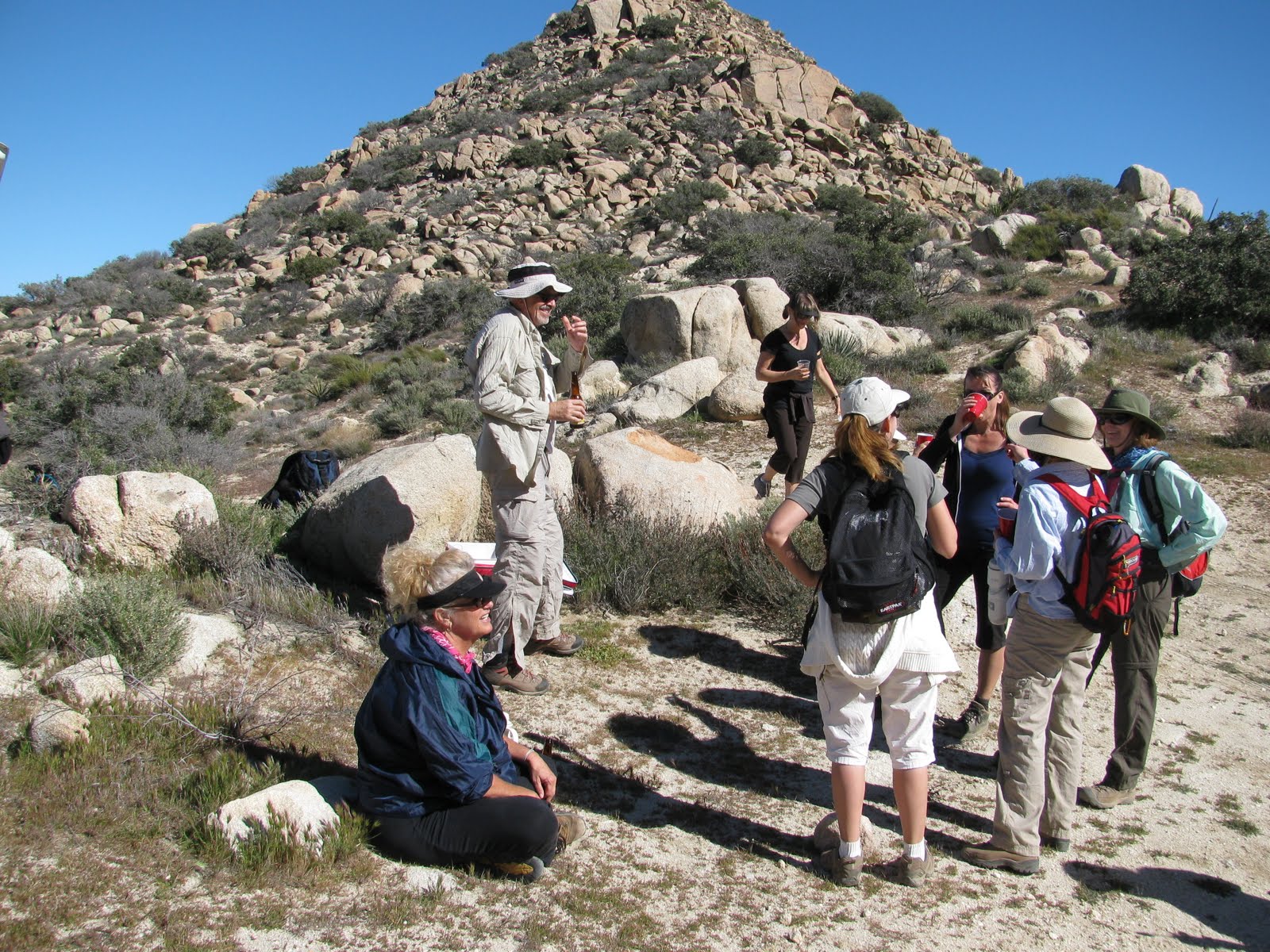
Patty is getting tired of looking at the 300th Post blog when she opens up Pat and Kathie, so here is my latest adventure to the Valley of the Moon this weekend. I try to go out with the Gourmet Hiking Club once a month because they go to such cool places and, not only that, when we get to our destination the group lays out a tablecloth and brings out delicious food prepared by every hiker. I can always count on Kathleen's gourmet peanut butter and jelly sandwiches on dark Cranberry bread.

The group was going to 4 wheel drive into the Valley, but Kathleen and I and Laurel, a novice to the group, decided to start out early and walk in to get the extra miles. The reader should understand the Valley is about 70 miles east of San Diego, right on the Mexico-US border, remote desert wilderness, and traveled by two legged "coyotes" and their Border Patrol pursuers. Kathleen and I had lined up a man to hike in with us, but at the last minute he couldn't make it so I packed my little Mace canister. A lot of good that would do.

We started out early at 7:30 AM, expecting to meet up with the Gourmet hikers when they arrived into the Valley, hike around a little bit, then have some yummy lunch. Simple. Just follow the vehicle route in to the point where vehicles could no longer handle the terrain, wait for the rest of the guys, and proceed on the Valley.

Needless to say, we took a wrong fork about 15 minutes into the hike. Seems this used to be an old mining area, lots of mines, and lots of forks off the main road. They all looked like main roads. What's worse, we didn't know we were "lost", so we just kept going - all up hill, ending up on a mountain ridge looking out over the desert and into Mexico. Stunning, but about 10:00 AM I was wondering when those 4 wheelers were going to catch up with us.

I was taking pictures of the beautiful scenery, Laurel and Kathleen are trying to figure out where we were, and - voila! - Laurel spots a group on the road below. Had to be our group. They were going to wrong direction for illegals.


By the time we had bushwacked, bouldered and high tailed it down to the road, the group was gone. We spent the next hour tracking - yep, just like Indians - the main group, wondering if we were getting more "lost" or would there be any food left when we found them. Or, in the back of my mind, could we find our way out of here if we didn't find them.


It wasn't lost on us that because we had counted on a straightforward hike in, meet up with experienced Valley of the Mooners and get guided in the rest of the way that we failed to bring a full size topographic map, left our emergency kit in the car, and had no cell phone service in this remote area.


Just before noon, we finally spotted our group across the Valley floor, a good three quarters mile away, perched high on a rock - eating our picnic without us! We did hook up for a splendid lunch on what was left and, bellies full, we could appreciate the beauty and uniqueness of this special place on the hike out.

Rock formations that one could only wonder "why doesn't that fall off?"


"How did that happen?"


"Looks like a shoe up there".


"I think he's missing a couple fingers on that hand".


Easter Island, fallen over.


"I'm just as tired as you, buddy".


Pac Man


Palisades that would make an Incan proud.


Finally, a cold beer at the end of the hike. Like I said, it's a cool group.


All's well that ends well. But next time no leaving the emergency kit back in the car.