Showing posts with label Helen Nute. Show all posts

Sunday, September 23, 2012

Lost Hikers: Sound familiar?

This article ran in the Fall River Herald in about 1915-6.  Helen is a great aunt to my generation, sister to Raymond Sr.   The article is undated but at the time of this experience she is teaching at a high school in Orleans, MA, a town just at the elbow of Cape Cod.    She graduated from Mt. Holyoke College and was a teacher until her marriage in 1917 at age 28.

YOUNG WOMEN LOST IN WOODS OF CAPE
Miss Helen E Nute of This City and Companion found in an exhausted state
Will suffer no serious effects from their way walking from Brewster to Orleans

Miss Helen E Nute of this city, daughter of J.E. Nute, manager of the Fall River Gas Works Co., and Miss Bertha Wilson of Thomasville, Me., assistant principals of the Orleans High School, had an extremely unpleasant experience Sunday night in the Brewster woods, in which they were wandering about from dark until after midnight.

Mr. and Mrs. J.E. Nute drove down from this city in their automobile Sunday morning to spend the day and started on their return about 3 PM.  Their daughter and Miss Wilson accompanied them as far as Brewster, intending to walk back to Orleans.

Not having arrived home after dark, Mr. and Mrs. Higgins, with whom the teachers board, became worried, and soon afterward made inquiries by telephone of Brewster residents, and ascertained that two young women had been seen entering the woods about 4 o’clock.  Fearing that the two teachers had become lost in the woods, Mr. Higgins notified the selectmen who also notified Deputy Sheriff Boland.

A general alarm was sent out about 9 o’clock by ringing the church bells, and searching parties were organized under the direction of Sheriff Boland, Dr. Lemuel Pope, Elnathan Eldredge, George Steel and others from different sections, who started out to search the various cross-roads and wooded paths.

Mr. Nute, who had arrived at home in this city, was notified by telephone about 9 o’clock, and he said the girls had spoken of taking a cross cut through the woods from Brewster to Orleans.  About midnight, one of the automobile searching parties penetrated the road leading through Roland Nickerson’s deer preserve near Cliff Pond in East Brewster woods, and learned that the young women had been there just before dark and inquired the way to the village.

The caretaker had directed them toward the Brewster road, but they had evidently become undecided again and had got lost before getting out of the woods.  This was the first clue to the young women since the search began.  The party took different paths, and Mrs. Higgins and his searchers soon found footprints.

On reaching a point about half way between Cliff pond and Baker’s pond they were overjoyed at meeting the two exhausted and frightened girls coming toward them, hardly able to speak from hoarseness, after shouting at their utmost for hours.  They reported having lost they way, owing to the density of the woods and the intense darkness which came on very early, owing to fog and cloudiness, when they left the Nickerson bungalow.

They were considerably worn out from their long tramp and the prospect of spending the entire night in the dark woods.  They had heard the bells and the tooting of automobile horns and whistles of every description, and could at times see the rays of the automobile headlights turned upward when climbing steep hills but, of course, were absolutely unable to make themselves heard by the searchers by screaming or shouting.

Every sound in the deep darkness, even after the rising moon had lightened it slightly, and every big tree seemed an object of terror, owing to their failing strength.  The searching parties had covered every road where automobiles could penetrate in that entire section between Brewster, East Harwich, and Orleans.

Meantime, Mr. Nute had become so alarmed that he and Mrs Nute started again from this city for the Cape about 11 PM, reaching Orleans about 3 o’clock Monday morning.  They were rejoiced to learn that their daughter and her companion had been found and that neither of the young ladies was in serious condition.  It is believed that they will suffer lasting effects from their experience.

Newspaper reporting is just not the same as a hundred years ago.

I think I may have inherited some of Helen’s genes.

Saturday, July 21, 2012

Joseph Nute and Harriet Gove Wilkins: Was it the Genes?

In April 1909, the Fall River Gas Works Company purchased a Model 20 Knox motor truck to supplement its traditional horse-and-wagon fleet. Just two days after his seventeenth birthday, my grandfather Raymond Nute rode in the new vehicle with his father and two brothers. The motor truck industry was in its infancy when Joseph Nute, general manager of the Fall River Gas Works Company, took his boys for an outing.

The outing was documented with a photograph, perhaps retained by the Nute family and later supplied to a Fall River newspaper. The paper republished it as a historical photograph on April 19, 1948, thirty-nine years to the day after the outing.


The accompanying caption reads,
COMFORT IS RELATIVE.  This was a gala holiday trip, April 19, 1909, on one of the first motor trucks purchased by the Fall River Gas Works Company. Judging from the happy smiles of the passengers, one gathers this vehicle had more to offer than a surrey. In the front seat, right, Joseph E. Nute, general manager of the Gas Company, with George Hadley, the driver. In the second seat are Mr. Nute's sons, Raymond, Alden, and Warren. Charles Leonard, superintendent of the Pond Street gas works, is facing in the rear seat. Behind him are Matthew Kelly, spare office, and Fred J. Hopkins, Paymaster. Many people may remember this truck.  It had coil springs in the rear - what we call today "knee action" - was chain driven, and had solid rubber tires. Background is probably the Narrows.
Joseph Edson Nute (1863-1949)

My great-grandfather, Joseph Nute, born in 1863 in Woodstock, Maine, was the seventh of Orsamus Nute’s children and second child born from the marriage of Orsamus and his second wife, Lovina Dunn Davis (1835-1880). 

Joseph was an infant when his oldest half-brother, Samuel Ambrose Nute, died. A twenty month-old half-sister, Emma, had died in 1857 and Orsamus’ first wife, also named Emma, died in 1860. Whether so many deaths in a short time influenced Orsamus' decision to leave rural Maine is speculative, but in 1864 he gathered the family and moved to Boston. Two more of Joseph’s siblings died there before the end of the decade.

Joseph graduated from Massachusetts Institute of Technology with a degree in mechanical engineering. Fresh out of school, he went to Philadelphia to work as an engineer for the United Gas Improvement Company. Two years later, he married Harriet Gove Wilkins (1864-1941), a young music teacher from Boston. Harriet descended from the Gove family in Lincoln, Massachusetts and the Wilkins family of New Hampshire and the Salem witch trials.

Joseph and his bride moved to Jersey City, New Jersey, where he spent the next three years as superintendent for United Gas. Their first child, Helen Elizabeth, was born there. In 1890, Joseph moved his young family to Fall River to become general manager of the Fall River Gas Works Company. He remained with the company until his retirement in 1924.

Joseph Edson Nute

Harriet Gove Wilkins

The family lived at several Fall River addresses, including 11 Maple Street in 1891; 47 Durfee Street in 1893; 94 Lincoln in 1896; 14 Bedford from 1897 to 1899; and 94 Wilkens Avenue in 1899. Their home at 914 Highland Avenue, a lovely Colonial Revival, was completed in 1900. It is now included in the Highlands Historic District on the National Register of Historic Places.

914 Highland Avenue

Life in Fall River

News articles in Fall River and Boston offer glimpses of Joseph and Harriet's life. In 1902, they vacationed in South Paris, Maine, likely with Orsamus. A fire broke out in a kitchen closet at the Highland Avenue home in May 1904. The news article indicates Joseph and his family occupied the second-floor apartment on the second floor and another occupant lived on the first floor. 

The motor truck outing in 1909 gave Joseph and his three sons the opportunity to experience the transition from buggy to motorized vehicles. In 1910, Joseph took the family camping at Camp Madockawando. The following year, a surprise birthday party was given for Warren, a junior at B.M.C. Durfee High School. In 1914, the newspaper reported Helen and a girlfriend had become lost in the woods on Cape Cod. In 1928, Joseph and Harriet took a winter vacation cruise to San Juan, Puerto Rico.

The newspaper articles document Joseph's extensive civic work, much of it in fundraising and the Boy Scouts.
  • Treasurer of a 1914 relief fund for victims of a devastating Salem fire;
  • Treasurer of a Belgian Relief fund drive during World War I;
  • Treasurer of the Fall River Chamber of Commerce in 1916; 
  • Chairman and treasure of a 1917 campaign to raise funds for Boy Scouts;
  • Chairman of Fall River's Red Cross War Fund during World War I;
  • Director of the Fall River Chamber of Commerce in 1918;
  • Committee chairman for a hospital building campaign in 1920; 
  • Leader of a European Children's Relief Fund drive in 1920; and 
  • Toastmaster for a YMCA fund raising effort in 1921. 
In 1932, Joseph received the first Silver Beaver award for distinguished service to the Boy Scouts. His certificate was signed by President Herbert Hoover, then honorary president of the Boy Scouts of America.

A biographical sketch in Alanson Borden’s Our County and Its People: A Descriptive and Biographical Record of Bristol County, Massachusetts, describes Joseph as a member of the American Gas Light Association and the New England Association of Gas Engineers and as a recognized authority on gas-plant construction. 

A Fall River newspaper also reported Joseph ran over a man who jumped from a trolley car into his path in 1917.

In 1929, Joseph entered a partnership with his son-in-law, Arthur Wadsworth, to operate a “baby” dirigible from South Dartmouth airport. The blimp was destroyed in El Paso on Mar 24, 1932, and Joseph filed a $60,000 equity action against the insurance company to recover his loss. 

Children of Joseph Edson Nute and Harriet Gove Wilkins

Joseph and Harriet had five children. Helen, the eldest, was born in Jersey City; the three boys - Raymond, Alden, and Warren -  and the youngest child, Katharine, were born in Fall River.

Helen Elizabeth Nute (1888-1985)

Helen taught on the faculty at Mount Holyoke College. In 1917, at age twenty-eight, she married nineteen-year old Arthur G. Wadsworth who had been her student.  The ceremony was officiated by Arthur’s father and grandfather, both clergymen. Helen and Arthur had one child, Ann, who died at home in Fall River at age three. The family moved to South Dartmouth in the 1930s. 

Arthur served in both world wars: with dirigibles in WW I and as a Major in the U.S. Army Air Force during World War II. As an oil financier, he lived in Tulsa, Oklahoma at intervals from 1940 until 1960 during which he drilled an estimated 300 wildcat oil wells in Oklahoma, Kansas, Texas, and Kentucky. When the venture in Kentucky failed in 1961, he took his own life at home in Dartmouth. His obituary reports he died from a heart attack.

My father, Raymond Nute, Jr., lived with Helen's family in the mid-1930s in order to attend a New England high school. His parents, Raymond Edson Nute, Sr. and Alice Packard Studley, lived in Kentucky at the time and felt the experience would better prepare him for college. 

During my childhood, our family often returned to Helen's home, a beautiful estate with three-car garage and guest house overlooking the water and abutting the Hawes-Wadsworth Reserve. Helen was actively involved in conservation, habitat preservation, and anything having to do with wildlife. 

Helen donated about six acres of her estate land in 1972 to help create the Preserve. In addition to creating the Hawes-Wadsworth Reserve, she also gifted a neighboring 2.5-acre parcel of her estate on Gaffney Road to the New Bedford Garden Club, now known as the New Bedford Garden Club Reserve. Inside the New Bedford Garden Club Reserve is a kettle pond, a fascinating geological feature created during the last Ice Age. Most kettle ponds have been covered over by residential development, but Helen's gift has preserved this pristine example. What makes this specific kettle pond famous locally is that it is completely encircled by massive rhododendrons and mountain laurel. I remember well how proud Helen was of this pond.

Helen lived in the South Dartmouth home until her death. She was cremated at Forest Hills.

Raymond Edson Nute (1892-1958)

Raymond began his studies at Massachusetts Institute of Technology but transferred after a year to study pomology - the science of cultivating fruit - at the University of Massachusetts School of Agriculture, still ranked as the #1 agriculture program in the United States. He married Alice Packard Studley in 1915 at the Studley family home. A newspaper account noted Harriet wore her own wedding dress to the ceremony.

Raymond managed a cranberry bog in Lakeville, Massachusetts until 1920. He and Alice moved the family to the Louisville area where he introduced “scientific farming” to Kentucky. 

Warren Wilkins Nute (1894-1960)

Warren enlisted in the U.S. Navy in July 1918 and served during World War I aboard USS SC-259, one of the wooden-hulled submarine chasers collectively known as the “Splinter Fleet.” Service aboard these small ships was considered hazardous duty.

After the war, Warren worked as a bank clerk. He married Maud Bamford Tattersall, settled in New Bedford, and later worked as a clerk at the New Bedford Gas and Edison Light Company. He carried on his father's interest in the family genealogy.

Two of their sons served in World War II. Warren Wilkins II was in the Navy. Gordon Bamford Nute, a first lieutenant and navigator in the Army Air Corps, flew thirty-five missions in the European theater. 

Warren was cremated at Forest Hills in Boston and buried in New Bedford.

Alden Davis Nute (1895-1971)

Alden graduated from the Massachusetts Institute of Technology in 1917 and served in the Army’s Chemical Warfare Service during World War I. He married a fellow MIT student, Loretta Mildred Dakin, who also graduated from MIT.  An article in a 1920 M.I.T. paper reported,
"Miss Loretta Mildred Dakin Sp  '18 has just been appointed bacteriologist for the United States Health Service at New Haven, Connecticut.  Ms Dakin goes to New Haven from the health department of Toledo, Ohio
After graduation from the Toledo Normal School, she came to the Institute and specialized under Professor William T. Sedgwick of the Biology Department in bacteriology and chemistry, leaving in 1918 to take further work at Harvard Medical and Columbia University.

The appointment of women in the health service has been found to be better than filling the positions with men.  The war gave the first impetus to this movement and the women have become more and more prominent in health work."
Alden spent his career as a chemist. He became the assistant superintendent of a Fall River cotton company and later worked for the Calco Chemical Company in Connecticut. In 1923, Joseph, MIT class of 1885, and Alden, MIT class of 1917, attended an MIT Alumni reunion together in 1923. Alden was cremated at Waring-Ashton in Fall River.

Katharine Nute (1899-1833)
The youngest child, Katharine, graduated from the Boston School of Occupational Therapy and worked as an occupational therapist at the Lakeville Sanitorium for tuberculosis patients. She lived at home and never married. She died from lymphoma at only thirty-four and was cremated at Forest Hills.


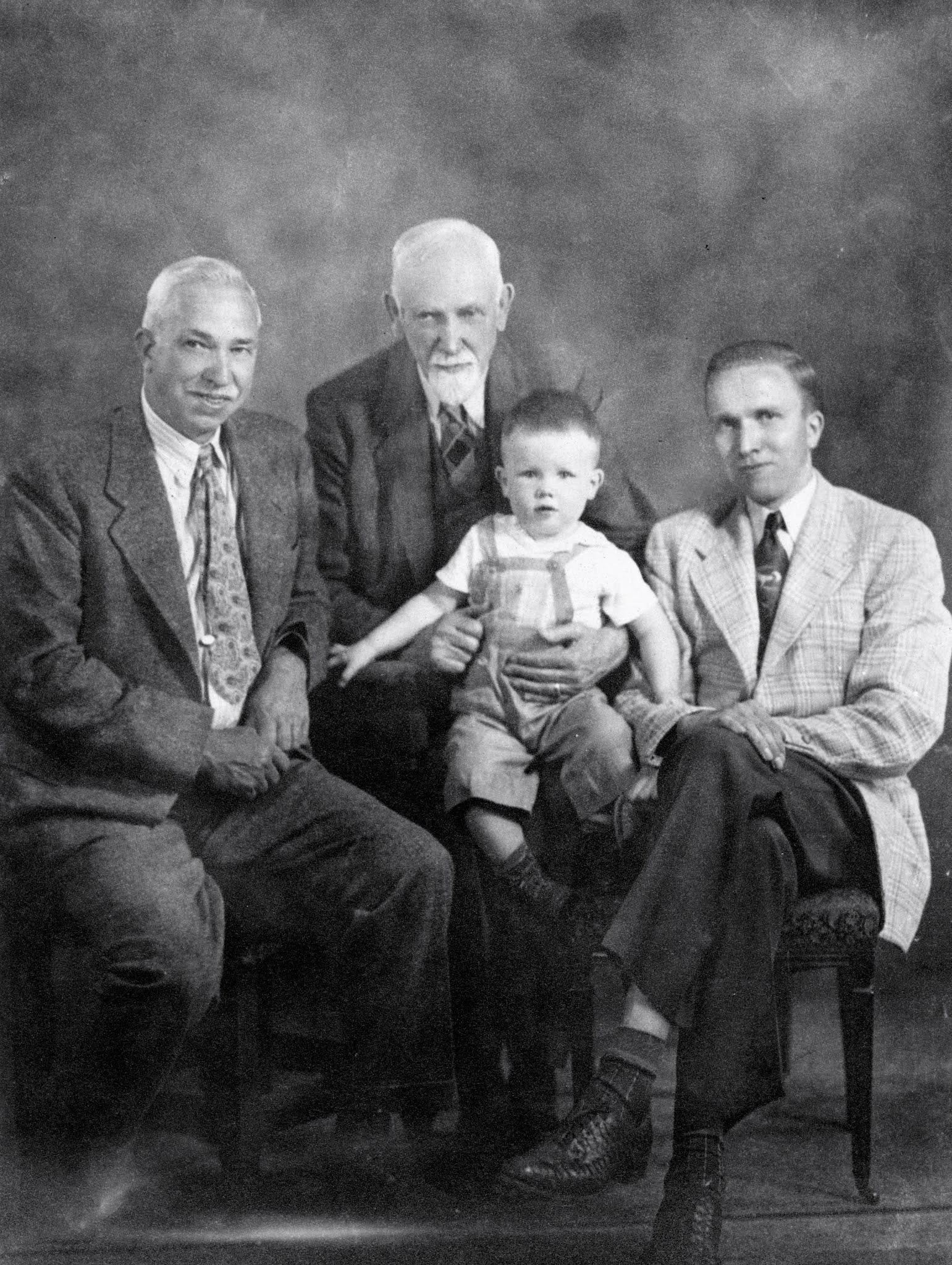
Raymond Edson Nute, Sr. Joseph Nute holding Raymond Nute III, Raymond Edson Nute Jr.
1944

Joseph’s Later Years

In 1920, Joseph and Harriet still had three of their adult children living at home: Warren who was working as a bank clerk, Alden a chemist in a cotton mill, and twenty year-old Katharine. The household included their longtime housekeeper, Susan Simmons, whom Joseph remembered in his will.

Joseph retired from the Gas Works in 1924 at age sixty-one, and became involved in business partnerships, including with Helen's husband, Arthur, for a dirigible to operate at the South Dartmouth airport. The blimp was destroyed in El Paso in 1932.

Joseph devoted years to researching the Nute genealogy with a distant cousin, Percy Elmer Nute (1884-1965) of Lynnfield, Massachusetts. Together, they traced descendants of the early Nute family of Dover, New Hampshire. Amy Emery compiled their Information into book form; a copy is held in the New Hampshire Historical Society. Joseph’s research papers were donated to the New England Genealogical and Historical Society in Boston and are available on request.

After Harriet died on May 21, 1941, Joseph, then seventy-seven, went to live with Helen and Arthur in South Dartmouth. He died September 15, 1949, and was cremated at Forest Hills in Boston.

So, was it in the genes? Joseph’s restless curiosity, devotion to public service, and willingness to try something new echo through the lives of his children: a teacher, an agricultural innovator, war veterans, a chemist, an occupational therapist, all college or vocational graduates. Not by genes alone - Joseph and Harriet created a home that valued education, service, scientific inquiry, and hard work.