Sunday, October 21, 2012

Young Alice Packard Studley: 1891-1921

When our Grandma Nute died in 1976, her obituary gave the standard information for a woman at the time - age, where she went to church,  how many children, grandchildren, and great-grandchildren, and where she was buried.  At the time she died, she was 84 years old, attended Perry Christian Church, had four children, 10 grand children and seven great-grand children, and was survived by her sister, Nettie.  She had been living with daughter, Jeannette, in Painesville, Ohio, and she was buried alongside Raymond, Sr., in Perry Cemetery.

Her unwritten history, though, is not revealed in an obituary, birth, marriage, death or census records.  With family photos, Alice’s scrapbook, and information about the times and people around her, perhaps we can stitch together her early life.

When Alice was born in 1891, Fall River was a thriving, prosperous city  with three daily newspapers, a host of textile mills, and daily steamboat trips to New York City.   The high school was a four story, towered, granite building that had its own astronomy observatory and telescope. BMC Durfee High School was built in 1886 in the upscale Highlands neighborhood, and is now designated as a historic building housing a probate and family courthouse.

BMC Durfee High School
Alice was descended from two Mayflower passengers, Richard Warren and William Bradford, from Revolutionaries, and two grandfathers who were Civil War Veterans.

Alice's father, Sidney Elmer Studley, was born in Maine months after his father went to the war, and lived in a blue collar, working class neighborhood in Boston most of his young life until marrying Martha Hathaway Borden in Fall River in 1887.  He had been a clerk in Boston, but the hard working young man worked his way up to owning his own grocery in Fall River.  The family lived in rentals but by 1910, Sidney had bought a home in a nicer neighborhood.

Sidney Elmer Studley (1863-1941)
Alice's mother, Martha, came from the Borden family who had been in the vicinity since the 1600's.   Her father, Stephen Bailey Borden, had also been away to the war when Martha was born.

Martha Hathaway Borden
Both photos appear to be around the time the young couple married.

Nettie was the firstborn child for the young couple in April 1889, and Alice followed in August 1891.  This is the earliest photo we have of the two girls, likely in 1892, the same year as the Lizzie Borden axe murders of her father and stepfather in Fall River.

Alice and Nettie,1892
Alice about a year later, very likely on her second birthday,

Alice, probably 1893
and both girls in matching dresses in the following year.

Alice and Nettie, 1894


The girls and Martha seem to be warmly and fashionably dressed while traveling about the city in the mid-1890's.

Alice, Mother Martha, and Nettie

We have little photographic record of the girls until the following family photo which appears to be turn of the century.

 Aunt Nettie Borden Howland, Martha H Studley, Uncle Harry Howland, Cousin Ida Borden
Nettie Borden Studley, Alice Packard Studley
Nettie Borden Howland is Sidney's sister, young Alice's paternal aunt. She was married to Harry Howland.  Ida Borden is a second cousin, niece to Stephen Bailey Borden.

We have a photo of Alice dated December 1905, and labeled age "14 years, 4 months",

Alice, December 2005
and another dated 1907, age 16, likely 10th grade at BMC Durfee, that wonderful high school with the observatory pictured above.
Alice in 1907
This full length photo appears to be around the same time as the portrait above, but may have been a year earlier.  She is wearing, as always, those beautiful embroidered dresses and the same gold locket.  I know it is gold as she and Raymond gave this writer a similar engraved gold locket.  I have wondered what happened to Alice's locket.

Alice in high school
A photo with Nettie on the left and three girlfriends is undated, and leaves to imagination what was the occasion.  A wedding, a graduation, or just going to church.  How ever did they keep these white dresses clean, what with all the horse poop there must have been in the streets, and that is the subject of a future post.

Nettie on far left, Alice on far right
The following two photos are a mystery, as they are labeled by someone else.  The labels refer to visiting someone in Tilton, New Hampshire.  She would have been old enough to travel on her own to New Hampshire after high school, but who did she know there?  Tilton is home to a private preparatory school which also gave degrees to women for a period.  She may have been visiting a girlfriend who went away to school.

"Alice P Studley, after Nute, as she visited me in Tilton, NH. Cross Road"
"Alice Studley as she looked when visiting Tilton"
Would she have had two portraits done in New Hampshire?  Or, made in Fall River and sent later to her girlfriend.  She is clearly maturing and beginning to wear hats.

She graduated in 1911, at age 20 from BMC Durfee and worked in the office at Fall River Gas Company where Raymond's father, Joseph, was manager.   

A 1914 photo shows a lovely young woman, perhaps her engagement portrait,

Alice in 1914
and the same year a photo with both Nute and Studley families, indicating Alice and Raymond had likely started their relationship by this time.  Very possibly, they knew each other at BMC Durfee High School as they were about the same age, or from Alice working for Raymond's father, Joseph, at the Gas Works.

From right: Aunt Jennie Borden, in back Susan Simmons (Harriett's servant), Mother Nute (Harriett), Aunt Annie Wilkins, Alice's mother Martha Borden Studley, and Alice in 1914
Raymond went off to school at Massachusetts Institute of Technology, a year latter changed to Massachusetts Agricultural College, now University of Massachusetts, and graduated in 1914.  We first have a photo of Raymond and Alice together dated November 3, 1915.  

Alice and Raymond, Nov 3, 1915
Alice and Raymond were married on November 8, 1915 in Fall River and the occasion was reported in two newspapers.  A Fall River newspaper described a wedding held at the home of the bride in the presence of immediate family, followed by a reception for friends and relatives.

Home Wedding of Well Known Young People Last Evening

... The house was most artistically decorated for the occasion.  Southern smilax screened the walls and was entwined about the stair case and chandeliers.  The fireplace of the room where the ceremony was performed was banked with autumn leaves through which shone red electric lights.  Pink and white chrysanthemums were also used in clusters to good advantage in the decorative scheme.

As the bridal party left the upper rooms and proceeded down the stairs, Lohengrin’s Wedding March was played by Edmund Bottomly, piano, and Miss Helen Borden, violinist.  The bride was accompanied by her sister, Nettie Borden Studley, and by the sister of the groom, Helen Nute.  They were met under the nuptial arch by the groom and his attendant, Murray Lincoln of North Easton, a classmate at Amherst.  The ushers were Alden and Warren Nute, brothers of the groom.  The double ring service was used and during the ceremony, the musicians rendered “Perfect Love”, “O Promise Me’, and for the recessional, Mendelssohn’s Bridal Chorus.

There were about 150 present at the reception at 7 o’clock.

The bride wore a beautiful gown of white gros de londris, made en train and trimmed with pearls and Duchess lace.  Her tulle veil was caught in cap effect with lilies of the valley and she carried a bouquet of the same flower.  The bridesmaids wore watermelon pink crepe de chine trimmed with silver embroidered silk net and rosebuds.  They carried arm bouquets of Killarney roses.  Mrs. Studley wore a handsome dress of grey crepe de meteor with old rose vestee and silver trimmings.  Mrs. Nute wore the gown which she wore at her own wedding.  It was white faille silk trimmed with duchess lace.  The gift of the bride to her maids were gold brooches of filigree work set with pearls.  The gift of the groom to his attendant was a tie pin.

There was a handsome display of wedding gifts, including mahogany, silver, linen, china, heirlooms of both families and money in checks and gold.  The bride is a graduate of the Durfee high school and has been employed for some time in the office of the Fall River Gas Company.  Mr. Nute was a student at Durfee High School and M.I.T., and graduated from Amherst agricultural college in 1914.  He is at present manager of a farm in Lakeville, Mass.

Alice and Raymond made their home at the Lakeville farm, outside of Fall River, for the next 5 years and started their family with the birth of their first two children, Ray Jr. in 1916 and Jeannette in 1920.  Alice matured into a young farm wife and mother, but still elegant as shown at the 1917 wedding of Raymond's sister, Helen, held at the home of Joseph and Harriett Nute, yes in the fashionable Highland neighborhood of Fall River.

Raymond Jr. Alice, Raymond Sr, Joseph Nute and Harriet Gove Wilkins Nute, July 2, 1917

In 1920 Alice was 29 years old. The young woman used to her finery, the lace, the silver and chandeliers, along with Raymond, young Ray Jr. and infant Jeannette, took the bold step to migrate west to Kentucky, the first in their lines to move out of New England in 300 years.  The rest we know in Mr. Nute's Peach Fed Free Range Turkeys.


Sunday, September 23, 2012

Lost Hikers: Sound familiar?

This article ran in the Fall River Herald in about 1915-6.  Helen is a great aunt to my generation, sister to Raymond Sr.   The article is undated but at the time of this experience she is teaching at a high school in Orleans, MA, a town just at the elbow of Cape Cod.    She graduated from Mt. Holyoke College and was a teacher until her marriage in 1917 at age 28.

YOUNG WOMEN LOST IN WOODS OF CAPE
Miss Helen E Nute of This City and Companion found in an exhausted state
Will suffer no serious effects from their way walking from Brewster to Orleans

Miss Helen E Nute of this city, daughter of J.E. Nute, manager of the Fall River Gas Works Co., and Miss Bertha Wilson of Thomasville, Me., assistant principals of the Orleans High School, had an extremely unpleasant experience Sunday night in the Brewster woods, in which they were wandering about from dark until after midnight.

Mr. and Mrs. J.E. Nute drove down from this city in their automobile Sunday morning to spend the day and started on their return about 3 PM.  Their daughter and Miss Wilson accompanied them as far as Brewster, intending to walk back to Orleans.

Not having arrived home after dark, Mr. and Mrs. Higgins, with whom the teachers board, became worried, and soon afterward made inquiries by telephone of Brewster residents, and ascertained that two young women had been seen entering the woods about 4 o’clock.  Fearing that the two teachers had become lost in the woods, Mr. Higgins notified the selectmen who also notified Deputy Sheriff Boland.

A general alarm was sent out about 9 o’clock by ringing the church bells, and searching parties were organized under the direction of Sheriff Boland, Dr. Lemuel Pope, Elnathan Eldredge, George Steel and others from different sections, who started out to search the various cross-roads and wooded paths.

Mr. Nute, who had arrived at home in this city, was notified by telephone about 9 o’clock, and he said the girls had spoken of taking a cross cut through the woods from Brewster to Orleans.  About midnight, one of the automobile searching parties penetrated the road leading through Roland Nickerson’s deer preserve near Cliff Pond in East Brewster woods, and learned that the young women had been there just before dark and inquired the way to the village.

The caretaker had directed them toward the Brewster road, but they had evidently become undecided again and had got lost before getting out of the woods.  This was the first clue to the young women since the search began.  The party took different paths, and Mrs. Higgins and his searchers soon found footprints.

On reaching a point about half way between Cliff pond and Baker’s pond they were overjoyed at meeting the two exhausted and frightened girls coming toward them, hardly able to speak from hoarseness, after shouting at their utmost for hours.  They reported having lost they way, owing to the density of the woods and the intense darkness which came on very early, owing to fog and cloudiness, when they left the Nickerson bungalow.

They were considerably worn out from their long tramp and the prospect of spending the entire night in the dark woods.  They had heard the bells and the tooting of automobile horns and whistles of every description, and could at times see the rays of the automobile headlights turned upward when climbing steep hills but, of course, were absolutely unable to make themselves heard by the searchers by screaming or shouting.

Every sound in the deep darkness, even after the rising moon had lightened it slightly, and every big tree seemed an object of terror, owing to their failing strength.  The searching parties had covered every road where automobiles could penetrate in that entire section between Brewster, East Harwich, and Orleans.

Meantime, Mr. Nute had become so alarmed that he and Mrs Nute started again from this city for the Cape about 11 PM, reaching Orleans about 3 o’clock Monday morning.  They were rejoiced to learn that their daughter and her companion had been found and that neither of the young ladies was in serious condition.  It is believed that they will suffer lasting effects from their experience.

Newspaper reporting is just not the same as a hundred years ago.

I think I may have inherited some of Helen’s genes.

Sunday, September 16, 2012

Nettie: The Other Studley

Every child needs a doting aunt, and ours was Nettie Borden Studley (1889-1990), older sister to our grandmother, Alice Packard Studley (1891-1976).  They came from working class backgrounds whose New England customs meant you had a family name passed down at birth.  

Our Nettie was named for a maternal aunt, Nettie H. Borden (1869-1923),


and Alice received her middle name from a maternal grandmother, Harriet A. Packard (1827-1893).


Nettie's and Alice's father, Sidney Elmer Studley (1863-1941), grew up in the ethnic, working class neighborhoods of Chelsea and Hyde Park, Boston, and likely did not finish high school as he was already working as an express clerk at the age of 17.  

Their mother, Martha Hathaway Borden (1863-1936), also grew up in a working class family in Fall River, Massachusetts.  Martha's father, a Civil War veteran, was a laborer, machinist, and meat salesman at various times in his life.

The couple married in Fall River in June 1887 - both were 24 years old - and  settled into a neighborhood on the hill overlooking Taunton River as it empties into Mount Hope Bay.  Sidney got into the grocery business, perhaps with help from Martha’s father, Stephen Bailey Borden, and worked his way up over the years until he was manager, then owner, of a grocery on Linden Street in Fall River.  Martha must have been a good mother as pictures of the girls indicate they were well cared for, perhaps even indulged.


The little girls' photo was likely taken in 1893, the same year Lizzie Borden was accused of the axe murders of her father and stepmother in Fall River.  Both Grandma Alice and Aunt Nettie vehemently denied any blood relation to Lizzie.   Uh, seems unlikely as Bordens in that area descend from two Borden brothers.  


A mid-to late 1890's photo shows a well-dressed family on a sleigh ride outing.


Alice, Martha, and Nettie

In 1900, the family was living in a rented duplex at 594 Bradford Avenue, a nicer neighborhood, and Sidney was working as a grocery clerk.


This photo of Nettie may well be around the 8th grade, but perhaps taken when she graduated from BMC Durfee High School in 1908.


By 1910, the family owned a house at 972 Maple Street, indeed a nice neighborhood.  Sidney is a grocery store manager, Alice is 18, still attending BMC Durfee, and Nettie is 21 years old, working as a bookkeeper at Small Brothers, one of the textile mills for which Fall River was known.  Nettie remained with this company for her entire career, finally retiring at age 72.  Sidney became the owner of the grocery store on Linden Street.

In 1915, Nettie's sister married a young man from Massachusetts Agricultural College, now University of Massachusetts, and left the family home to be a farmer's wife - and we have seen what an amazing farmer he was.  When I was growing up I had heard Nettie had a fiance or young man she liked very much who was killed in World War I.  For this or whatever reason, she never married and lived with her parents for the rest of their lives.


In 1921, Sidney, Martha, and Nettie moved down the street to 724 Maple Street where they remained until just before Martha died in 1936.  In 1935, the parents and Nettie moved into a house at 172 Hanover, just behind the 724 Maple Street address, and Sidney lived with Nettie until he died in 1941.


Nettie's house at 172 Hanover Street
I believe 724 Maple is the house in far left of photo
Nettie had a way of making everyone her family, and likely her co-workers at the thread factory filled in for the absence of her parents and sister.  Alice's family, children and grandchildren became the focus of her travels, and often she of theirs.  As a youngster growing up on the farm in Lewis County, we looked forward to the Christmas gift we always knew we would get from Aunt Nettie.  I can still remember the visit when she bought me a pair of red boots.  She visited there by train,


Vanceburg Station in 1940's
Alice, Nettie, and perhaps Helen Plummer
and followed us to northern Ohio.


Jeannette, Aunt Nettie, George
Ray & Kathie
Joellen, Janie, young George
No trip to New England was complete without stopping off "to see Aunt Nettie".


Aunt Nettie, Jeannette
Donald, Joellen, George "Clif"
Fall River Herald News ran an article in 1960 on her retirement at age 72,


Bookkeeper Feted by Firm after Fifty Years' Service


Small Brothers Mfg. Co. last night honored a woman who has been with the organization for 50 years.  She is Miss Nettie B. Studley, the thread-manufacturingfirm's head bookkeeper.
When Miss Studley joined Small Brothers in 1910 to begin her first job, the firm was only 25 years old and still operated by its founders, Elisha H. and Reuben C. Small. The bookkeeping department was small; in fact, she was it. 


As a retirement gift, they gave her a TransCanadian Rail trip which she took by herself - age 72 no less.

In 1968, Nettie  gave up her residence and moved into senior living at the Fall River Home for the Aged at 1172 Highland Avenue.  She loved to show off her room and the elegant setting, pointing out they took every meal with linen tablecloths, silver, and crystal glassware.  She continued to be a prolific letter writer.  She was mentally sharp and  at age 87 amazed my Ohio Republican Chairman then-husband with her command of politics over lunch.


Throughout her life, she had a hobby of needlepoint and some of the family are lucky to have beautiful pieces she gifted.    She continued to crochet and knit afghans through her later years.


Nettie at the Fall River Home for the Aged
Fall River News in November 1980 covered a ceremony with Nettie as the guest of honor in which a tree planted by Sidney in 1940 needed to be moved and replanted.

"I remember when poppa planted the tree", she said, reflecting a remarkable memory that can summon people and dates that have long since passed.  "He wanted to brighten the area around the Haffenreffer House on Hanover Street (then owned by the hospital).  So he donated a garden that he planted himself."


The article went on to say,


The nonagenarian observes the local scene with a keen eye from her present domicile.  She marveled at the prospect of a new five story patient care facility that will consolidate Union and Truesdale services at the Union site.  


"Change is welcome", she noted, "when the old is accommodated to make way for the new".


The Fall River Herald News covered her 100th birthday party, noting she supervised all the arrangements herself.  


100th Birthday Party
Nettie died in 1990 at age 101.   Her obituary noted she was acknowledged as one of the first women in the area to hold a major corporate position in the city.

Alice died in 1976 at age 84, seventeen years younger than Nettie.  Alice had a more active lifestyle on the farm, and I have long thought the longevity difference was related in part to Nettie's positive outlook, evident even in that 1893 photo.


Monday, September 03, 2012

Wednesday, 8/17/11: Glenbeigh to Cahersiveen – The Trail Starts

After a lovely breakfast (how does Anne make such fluffy eggs?), we took off for Cahersiveen, pronounced like cursive with an ine at the end, only car for the first syllable.  Here’s Kathie at the head of the trail.


We could not have asked for more beautiful weather or scenery. 


Of course, there were sheep and cattle to ogle along the way.  They ogled us; we ogled them.  No herding was necessary this time, however. 
 

Walking along, noticing the flora, I couldn’t help but think of leprechauns and trolls.


Pretty but treacherous – see the rocks in the trail? 
 
 
In some places, we couldn’t sidestep the rocks but rather had to plow right through them.  In others, the rocks were mixed with boot-sucking mud.  I mean, literally, in a couple of places, one or the other of my boots was sucked clean off my foot.  I took to making up haikus in my head:

Rocky flat good for legs.
Rocky up good for heart.
Rocky down good for naught.

or

The walkers are walking
The buzzards are circling
They say, “Look!  Tasty treats!”

 
As usual, I was dillydallying way behind Kathie and Kathleen.  Can you see the tiny figures way up ahead?  If you’re anything like me, you’re more focused on the spectacular view in the background…and also on the horsie moseying up to see if I have a treat to offer. 
 
 
What was supposed to be a twelve mile hike turned out to be an eighteen mile walk, due to a lack of clear directions where we left the trail.  Between the three of us, along with Mary (a Catholic University nursing major), and Bree (a Harvard pre-law student), we simply could not figure out which way we were to go to get to the Southern Sun, our B&B for the night.  After several false starts and asking directions of a couple of people, we did however arrive safely.  (That last stretch along the busy 2-laner was a little scary, eh girls?) 

Our hostess referred us to Frank’s Pub for dinner, where I had homemade vegetable soup, soda bread, and salad.  Yum!  The young waiter/bartender was very sweet.  I loved his accent!  He recommended the apple pie, so we took a slice to go and stopped by the Daniel O’Connell Catholic Church on our way out.  Supposedly, this is the only Catholic church in the world named after a person who is not a saint.  Huh.

Back in the room, I noticed blisters starting on my right heel and both big toes.  Not good.

(If you want to see a description of the hike we took, go to the Macs Adventure site here)

Saturday, September 01, 2012

Tuesday Traveling – Taxi, Train, Bus, and Feet

Our taxi pulled up at 6:45 on Tuesday morning to take us to Heuston Station for the 7 a.m. train to Limerick Junction.  There, we quickly switched over to another train to take us to Limerick, where we caught a bus to Glenbeigh.   

 
In Glenbeigh, we found our lodgings for the night – the Emir View House, where we were greeted by proprietress Anne and her daughter, Louise, a high school rising sophomore at the time, and Louise’s little sister.  Lovely people!  They advised us to take the 2-mile walk to Rossbeigh Beach, which we did, (getting a little lost along the way, as usual).  According to its website, “An extensive sandy beach in a rural environment, Rossbeigh is a designated natural heritage area and a Special Area of Conservation with an important habitat and flora and fauna present.” 
 

After hiking the 2 miles back, we stopped by Rumours Bistro for dinner.  The black, grey, and red modern interior was quite pleasing, and the food was great. 

Then back to the Emir View to ready ourselves for our next big adventure…
 

Monday, Our Last Day in Dublin

We took off along the canal to get to Dublin Castle, where I was fascinated by an exhibit of sand sculptures in the courtyard.


Close by the castle, we visited St. Werburgh’s Church of 1178 origin.  I thought this was a handsome little church, strangely military-ish, especially given the fact St. Werburgh was actually a woman.  The organ pipes were especially pretty.


Back on the castle grounds...


Behind the photographer who took the shot above (that would be me) sits the Chester Beatty Library.  Chester was an American mining engineer/magnate back in the first half of the last century who enjoyed traveling and collecting books, art, manuscripts, New Testament texts, etc.  He retired to Ireland and bequeathed his collection to a public trust that is supported by the Irish government.  So admission is free!  While we were there, a special exhibit of Mattise’s works was going on.  Nice.  Truly a lovely place to visit and then have lunch, which we did. 


A hop, skip, and jump from the castle is Christ Church Cathedral, an Anglican cathedral built in the 1800s on a 1171 foundation, which in turn was built on the site of a church built by a Danish king of Dublin in 1038.  Whew!  Did you get all that?  The current structure is huge, and the 12th century crypt is very cool.  Supposedly, the heart of St. Laurence O’Toole is encased in a heart-shaped box somewhere in the cathedral; I didn’t see it, did you guys?  Well, no matter – it was stolen in March of this year.  Now why would anyone want a moldy old heart from the 12th century, even if it was a saint’s?  Shocking.


From there we walked along the Liffey River to get to the train station for schedule information, then on we went – by bus – to the National Botanic Gardens in Glasvenin.  Even on a gray day, it was so beautiful.


After a quick walkthrough (it was getting late by now), we bussed back to town and had fish and chips for dinner before heading home to prepare for the next day - traveling to Glenbeigh.

Sunday, August 12, 2012

Sunday in Dublin

Sunday, August 14, 2011

You just can’t go to Dublin without visiting the Trinity College Library to see the Book of Kells.  So what did we do bright and early on Sunday?  We hit the Trinity College Library, along with a slew of other people who thought Sunday morning would be a good time to see it.

From the library’s pamphlet: 

Over 1000 years ago, when the Book of Kells was written, Ireland had a population of less than half a million people living in fortified homesteads along its coasts and inland waterways. 

The Irish church was largely monastic in organization.  Monks lived in communities devoted to the study of God’s word, fasts, and manual work.  The message of the life of Christ was spread primarily through gospel books, and the scribes and artists who produced them held an honored place in Irish society. 

The Book of Kells contains lavishly decorated copy in Latin of the four gospels.  It has long been associated with St. Colum Cille who founded his principal monastery on the island of Iona, off the west coast of Scotland, in about 561.  The Book of Kells was probably produced early in the 9th century by the monks of Iona, working wholly or partially at Iona itself or at Kells, county Meath, where they moved after 806 AD, when Iona was attacked by Vikings in a raid which left 68 monks dead.  The Book of Kells was sent to Dublin around 1653 for reasons of security during the Cromwellian period.  It came to Trinity College in 1661.

Have you ever read How the Irish Saved Civilization by Thomas Cahill?  It’s enlightening.


While Kathleen and Kathie lingered over the Book of Kells, I moseyed on over to the Long Room, which houses 200,000 of the library’s oldest books and, in cases down the center of the room, a bunch of medical exhibits.  In the cases I saw a book by Robert Graves (of Graves’ disease fame) and an 1811 diary of a lady who had a mastectomy without anesthesia.  Ouchie!  One book opened to a Jonathan Swift play, in which he wrote that “The best doctors are Doctor Dyet, Doctor Quiet, and Doctor Merryman.”  Of course, I was fascinated by the skeleton of a 7’ tall guy who had a pituitary adenoma.

From there we headed over to Dublin Castle to hit the Chester Beatty Library.  Since it was closed on Sunday, we went to St. Patrick’s, the national cathedral (Anglican).  St. Patrick supposedly baptized converts at a well that once existed in what is now the churchyard, and that is why there has been a church in this location since the fifth century.  Most of the current building is 13th century vintage.  Jonathan Swift, dean of the cathedral from 1713 until 1745, and his Stella (Esther Johnson, whom some say he married in 1716) are buried in the southwest end of the nave.  Of course, we know Jonathan Swift best as the author of Gulliver’s Travels.


On a column was a plaque with the following poem by Jonathan Swift.

Stella's Birth-Day

Stella this day is thirty-four,
(We shan't dispute a year or more;)
However, Stella, be not troubled,
Although thy size and years are doubled
Since first I saw thee at sixteen,
The brightest virgin on the green;
So little is thy form declined;
Made up so largely in thy mind.

O, would it please the gods to split
Thy beauty, size, and years, and wit!
No age could furnish out a pair
Of nymphs so graceful, wise, and fair;
With half the lustre of your eyes,
With half your wit, your years, and size.
And then, before it grew too late,
How should I beg of gentle fate,
(That either nymph might have her swain,)
To split my worship too in twain.

Do you suppose he was trying to tell her she needed to join Weight Watchers?

After we left the cathedral, we walked along and found the place – now an alley - where Handel’s Messiah was first sung in 1742 by the combined choirs of St. Patrick’s and Christ Church cathedrals.  If you listen closely, you can hear the ghosts still singing the Hallelujah Chorus…or was that Kathie? 

From there we went to Subway for lunch - because we obviously can’t get enough of it in the States, and then to the National Museum to see the 8th century Celtic Brooch of Tara and the bog mummies.  Eww.  I erased that from my mind’s eye by doing a rubbing of a Celtic design in the kids area.  Never let it be said that I don’t know how to have a good time.

The weather that day was great.  Walking along the main drag, Kathie spotted the front door of a Georgian rowhouse that she just had to have a photo of.  The only thing is that the door was at the top of a set of stone steps.  Of course, she mounts the steps and is getting the shot when the owner walks up.  He patiently waits for her to take her picture then says, “Would you like to see the inside?”  And do you suppose that Kathie could turn down an offer like that?  Not on your life.  I must admit, it was a perfectly lovely house, but what if he’d been a serial killer, Kath?  I can just imagine the headlines – “American ladies just had to see the inside of the killer’s house…”

We had dinner at Taste again, and then headed over to the Gaiety Theater, built in 1871, for Riverdance – which was so, so good.  We had perfect seats and of course the music and dancers were just fabulous.  What a treat!


All in all, it was a very good day.

Saturday, July 21, 2012

Joseph and Harriet Nute: Was it the Genes?

Just two days after his 17th birthday, young Raymond Nute took a ride with the men of the family on a motor truck vehicle in Fall River, Massachusetts.  It was documented with a photo and perhaps published at the time in the Fall River newspaper.  In any event, the photo was published some unknown years later, likely as a historical photo, and the news clipping recently found in family papers.


The narrative reads,

COMFORT IS RELATIVE.  This was a gala holiday trip, April 19, 1909, on one of the first motor trucks purchased by the Fall River Gas Works Company.  Judging from the happy smiles of the passengers, one gathers this vehicle had more to offer than a surrey.  In the front seat, right, Joseph E. Nute, general manager of the Gas Company, with George Hadley, the driver.  In the second seat are Mr. Nute's sons, Raymond, Alden, and Warren.  Charles Leonard, superintendent of the Pond Street gas works, is facing in the rear seat.  Behind him are Matthew Kelly, spare office, and Fred J. Hopkins, Paymaster.  Many people may remember this truck.  It had coil springs in the rear - what we call today "knee action" - was chain driven, and had solid rubber tires.  Background is probably the Narrows.
GGF Joseph Nute was the seventh of Orsamus' children, and second born from the marriage of 2nd GGPs Orsamus and Lovina Dunn Davis. Born in Woodstock in 1863, he was an infant when his oldest half-brother, Samuel Ambrose Nute, died and Orsamus gathered up the family and moved everyone to Boston. Two of Joseph's half sibs died before he was born and another three sibs and his mother would die by 1880.

Joseph graduated from Boston's Massachusetts Institute of Technology in mechanical engineering in 1885.  Fresh out of school, he took his first job in Philadelphia as an engineer for the United Gas Improvement Company of Philadelphia.  Two years later, he married a young music teacher from Boston, GGM Harriet Gove Wilkins, and transferred with his new bride to Jersey City, New Jersey, where he worked for the next three years as superintendent for United Gas and their first born, Helen Elizabeth, was born.   Joseph moved his young family to Fall River in 1890 where he took charge of the Fall River Gas Works Company, and remained in this position until his retirement.

His biography published in Our Country and Its People, Part 2, by Alanson Borden, Boston History Company, relates that Joseph was a member of the American Gas Light Association, the New England Association of Gas Engineers and a recognized authority on all matters pertaining to gas construction. 

Harriet was descended from the Gove (of Edward, John and Nathaniel family in Lincoln, MA) and Wilkins families in Boston. 

Joseph Edson Nute

Harriet Gove Wilkins

Joseph and Harriet lived in various addresses in Fall River, including 11 Maple Street in 1891, 47 Durfee Street in 1893, 94 Lincoln in 1896, 14 Bedford 1897-1899, and 94 Wilkens Avenue in 1899. Their home at 914 Highland Avenue was completed in 1900, a lovely Colonial Revival. The home is on the National Register of Historic Places as part of the Highlands Historic District.

914 Highland Avenue

News articles in Fall River and Boston shed light on Joseph and Harriet's activities while living in Fall River. In 1902, the family took a vacation to South Paris, ME, likely with Orsamus. A fire occurred in a kitchen closet at the Highland Avenue home in May 1904. The news article indicates Joseph and family lived in an apartment on the second floor and another occupant lived in the first floor apartment. A news article in 1909 showed Joseph taking sons Raymond, Alden, and Warren, as well as some officials for a ride in one of the first motor trucks purchased by the Fall River Gas Works. In 1910, Joseph took the family camping at Camp Madockawando. In 1911, a surprise birthday party was given for Warren, a junior at BMC Durfee High School. In 1914, the paper reported Helen and a girlfriend were lost in the woods on Cape Cod.

Numerous news articles relate Joseph's involvement in scouting and civic activities. He was treasurer of a relief fund for a devastating Salem, MA, fire in 1914, as well as treasurer of a WWI Belgian Relief fund drive ini 1914, treasurer for the Chamber of Commerce in 1916, chairman and treasure of a campaign to raise funds for Boy Scouts in 1917, chairman of Fall River's Red Cross War Fund in WWI, a director of the Fall River Chamber of Commerce in 1918, committee chairman for a hospital building campaign in 1920, in charge of a European Children's Relief Fund drive in 1920, and a toastmaster in charge of fund raising for the YMCA in 1921.

The paper also reported Joseph ran over a man who jumped from a trolley car into his path in 1917.

All three boys - Raymond, Alden, and Warren -  and the youngest child, Katharine, were born in Fall River. Their oldest son, Raymond, married Alice Packard Studley in the bride's home in 1915, and the paper notes Harriet wore her own wedding dress to the ceremony. Sons Alden enlisted in the chemical division of the US Army and Warren enlisted in the US Nave with a submarine chaser in July 1918.

Helen (1888-1985) taught on the faculty at Mount Holyoke College and married a student, Arthur G. Wadsworth, in 1917; he was 19 and she 28.  They lived in New Bedford and had one child, Ann, who died at an early age. The newspaper indicated Arthur was a lieutenant in the aviation corps when the couple visited Joseph and Harriet in 1919.

Warren (1894-1960) served World War I in the Splinter fleet, SC 259, a submarine chaser, and worked as a bank clerk after the war.  Working on a World War I submarine chaser was considered to be a pretty hazardous way to spend your time. Warren married Maud Bamford Tattersall and lived in New Bedford, employed as a clerk at the New Bedford Gas and Edison Light Company. Two of their sons fought in World War II, Warren Wilkins II in the Navy, and Gordon Bamford Nute a first lieutenant in the Army Air Corps flew 35 missions over the European theater as a navigator. Warren was cremated at Forest Hills in Boston and is buried in New Bedford.

Alden (1895-1971) graduated from the Massachusetts Institute of Technology in 1917, and married a fellow student, Loretta Dakin, who also graduated from MIT and went on to further graduate work.  An article in a 1920 M.I.T. paper reported,
Miss Loretta Mildred Dakin Sp  '18 has just been appointed bacteriologist for the United States Health Service at New Haven, Connecticut.  Ms Dakin goes to New Haven from the health department of Toledo, Ohio
After graduation from the Toledo Normal School, she came to the Institute and specialized under Professor William T. Sedgwick of the Biology Department in bacteriology and chemistry, leaving in 1918 to take further work at Harvard Medical and Columbia University.

The appointment of women in the health service has been found to be better than filling the positions with men.  The war gave the first impetus to this movement and the women have become more and more prominent in health work.

Alden had a career as a chemist after serving in the army in WWI. He became the assistant superintendent of the cotton company in Fall River, later working for the Calco Chemical Company in Connecticut. Joseph, class of 1885, and Alden, class of 1917, attended an MIT Alumni meeting together in 1923. Alden was cremated at Waring-Ashton in Fall River.

The youngest, Katharine (1899-1933), graduated from the Boston School of Occupational Therapy and was an occupational therapist at the Lakeville Sanitorium for tuberculosis. She lived at home, never married, until her death from lymphoma at the young age of 34. She was cremated at Forest Hills.

Living in the Highland Avenue home in 1920 were Joseph and Harriet, Warren who was working as a bank clerk, Alden working as a chemist in a cotton mill, Katharine, age 20, and a household employee, Susan Simmons.

And, of course, we know about the career of young Raymond who left MIT for Mass Ag to study pomology and created the wonderful orchard in Kentucky.  Such an illustrious group of kids they all were.

Joseph, age 61, retired from the Gas Works in 1924, and became involved in business partnerships, including a partnership with Helen's husband, Arthur, for a dirigible to operate at the South Dartmouth airport. The blimp was destroyed in El Paso in 1932. Joseph was unable to meet his obligations as a private investor in a gas company that went into receivership in 1929.

At age 68, Joseph received Fall River's first silver beaver for his contributions to the Boy Scouts.
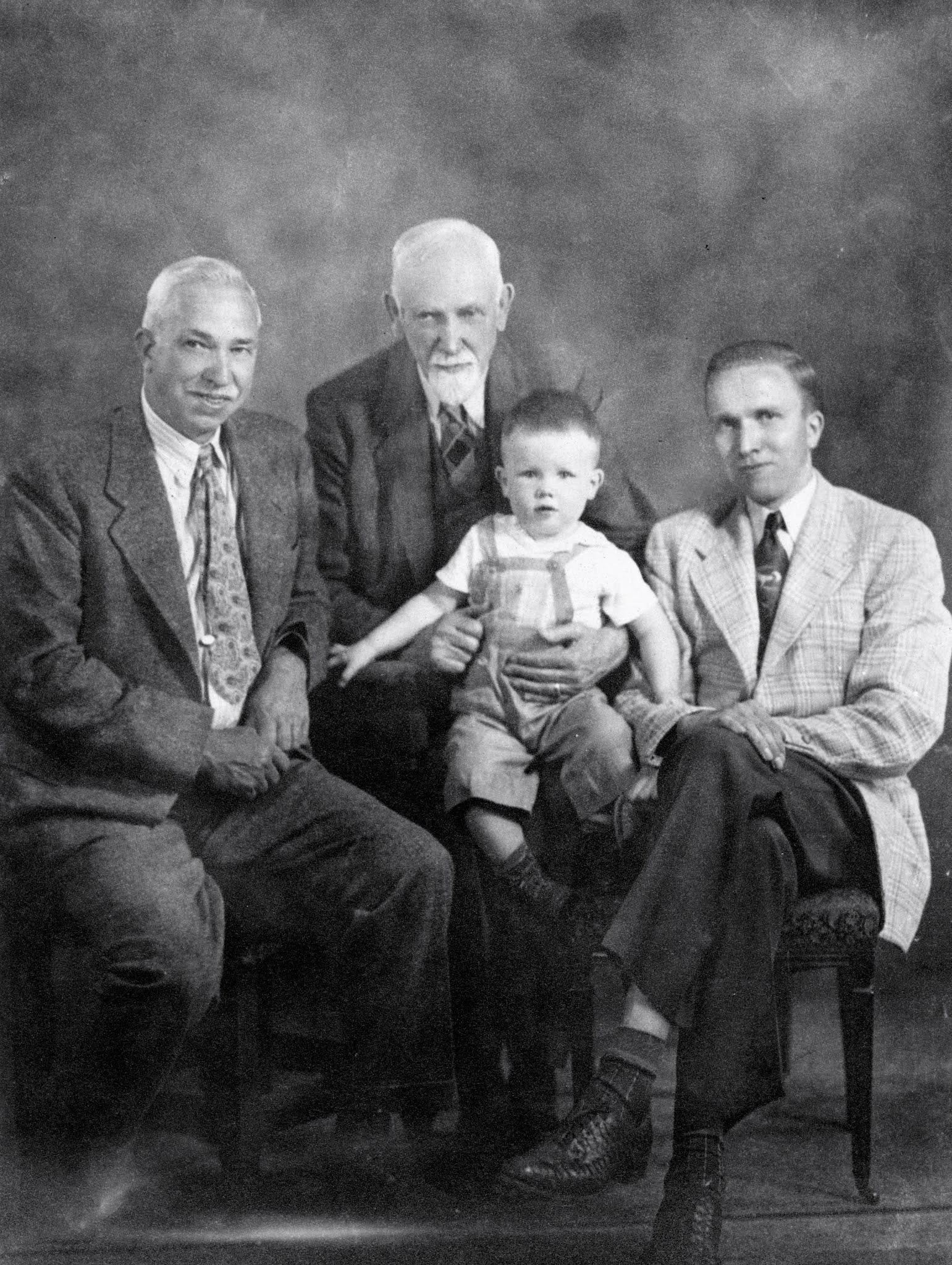
Raymond Edson Nute, Sr. Joseph Nute holding Raymond Nute III, Raymond Edson Nute Jr.
1944
Joseph exhaustively researched the Nute genealogy with a distant cousin, Percy Elmer Nute (1884-1965) of Lynnfield, MA. Together, they traced descendants from the original 1632 Nute settler in Dover, New Hampshire. Information was compiled by Amy Emery and put into book form. A copy is in the New Hampshire Historical Society library. His research was donated to the New England Genealogical and Historical Society in Boston and are available on request.

Following Harriet's death May 21, 1941, Joseph, age 77, went to live with Helen and Arthur in South Dartmouth. He died September 15, 1949, and was cremated at Forest Hills in Boston.