Friday, March 21, 2008
Dr. Taylor's Stroke of Insight
Kathie sent me this to post "with proper recognition". I'm not quite sure what kind of recognition she has in mind - perhaps that our mother (some of us think) recently had a minor stroke? Anyway, the video is almost nineteen minutes of neuroanatomist Jill Bolte Taylor talking to an audience in Monterey about her own stroke back in 1996. Fascinating! You won't believe what she "got" from the experience.


Sunday, March 16, 2008
And Now I Have Three!
Not to be outdone by family additions, the West Coast household welcomes two new kitties debuting today on the Internet, Black Zulette and IvoryLena. They were "rescue" kitties totally pampered by their original rescue owner, right down to the acrylic nails.

PorkChop has been lonely since Don Diego de San Diego died just before Christmas. A cat can watch just so much bird TV by himself.
Introducing IvoryLena...

"I'll take milk and sugar with my tea, thank you..."
And Black Zulette...
 "I'll have that bird for dinner, s'il vous plait..."
In case the reader is wondering about the names, the young ladies arrived with the names Ivory and Ebony. Hayley, grandaughter #1 and the rower, wanted to name them after the women who started ZLAC, America's oldest rowing club for women right here in San Diego, and I wanted to keep some part of their original name. Our choices were Zulette, Lena, Agnes, and Caroline. Not a hard choice to make.
PorkChop? Well, he's still hissing around and rethinking the "answered prayer" thing.

PorkChop has been lonely since Don Diego de San Diego died just before Christmas. A cat can watch just so much bird TV by himself.
Introducing IvoryLena...

"I'll take milk and sugar with my tea, thank you..."
And Black Zulette...
 "I'll have that bird for dinner, s'il vous plait..."
In case the reader is wondering about the names, the young ladies arrived with the names Ivory and Ebony. Hayley, grandaughter #1 and the rower, wanted to name them after the women who started ZLAC, America's oldest rowing club for women right here in San Diego, and I wanted to keep some part of their original name. Our choices were Zulette, Lena, Agnes, and Caroline. Not a hard choice to make.
PorkChop? Well, he's still hissing around and rethinking the "answered prayer" thing.
Tuesday, March 04, 2008
And Baby Makes Five!
And now we present, born just yesterday afternoon, LaLa and Patrick's younger brother - Matthew Boyd!

OK, so he's sleeping. How about his proud older sister holding Matthew...

And his older brother, totally in love with him, trying to teach him "Itsy Bitsy Spider"...
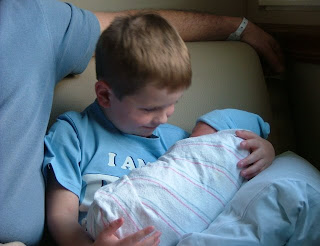
And a happy family of five!

Matthew Boyd's stats: 7 lbs 8 oz, 20 inches long, born at 1:23 p.m. on 3/3/08. (The happy father predicted the closest delivery time, then did a fabulous job as Mom's coach - "C'mon Honey...push, push, PUSH!")

OK, so he's sleeping. How about his proud older sister holding Matthew...

And his older brother, totally in love with him, trying to teach him "Itsy Bitsy Spider"...

And a happy family of five!

Matthew Boyd's stats: 7 lbs 8 oz, 20 inches long, born at 1:23 p.m. on 3/3/08. (The happy father predicted the closest delivery time, then did a fabulous job as Mom's coach - "C'mon Honey...push, push, PUSH!")
Saturday, February 23, 2008
Children of Bhutan
Once we left the trailhead at Paro on our high altitude Himalaya "walk" we encountered few villages, really more like settlements, in this remote, rural part of the world. As usual for my trips to the Himalayas, I carry about 200 toothbrushes in lieu of candy and look for the children and schools.
Six days into walking and climbing we came to the settlement of Lingzhi and a boarding school of 80 children in primary grades.

A beautiful view from a realtor's point, but at 13,150' winter stays around for nine months of the year. The Lingzhi area has about 300-400 people, most living a great distance from the school.
 By law, men and boys are required to wear a "gho" in schools, government offices, and on formal occasions. It is like a roomy bathrobe, tied with a belt and a little tricky to getting it on right and proper. Once fixed, it is warm, comfy, and lots of things can be stuck inside, both front and back. The girls at Lingzhi wore a long version of the gho. I wondered what this young one was carrying inside her gho.

Like the Children of Cuba, the children of these mountains are as photogenic as the scenery.

Most of the children living at these high altitudes had the reddened cheeks from exposure to the sun and cold.

Does the young boy below seem to be listening attentively to a school lesson? Or could he be trying to figure out a group of white people singing "Old MacDonald Had A Farm", chicken, pig sounds and all? On the spur of the moment it was the only children's song we all knew.

Four more days of walking and several passes, we came to the settlement of Laya, a settlement on the smuggling route from Tibet, and another school.

The Layap culture is based on yak herding, their beast of burden. We had not seen a vehicle road since leaving Paro ten walking days back, and the value of the yak was clear, even if they didn't eat the beast unless it was accidentally killed. One afternoon we came across some men butchering a yak below the trail. The unfortunate beast had been on the short end of a yak fight, and our cook took the opportunity to buy some fresh meat. I always said I wouldn't eat yak, but if you get hungry enough... tastes pretty much like hamburger.
Laya is unique in the world for these conical hats, beaded sometimes elaborately in the back, worn by the women of the area. Women are the primary yak herders and the hat is believed to keep the herd fertile.

By now we had learned to leave the singing to the children, and they did next to a bonfire several hours into the cold night.
A couple more days of walking we came to the village of Gasa, famous for its hot springs. Only catch is, no way to get there except by walking - no tourist crowds here! - and were we ready for a little hot tub soaking!
While checking out the dzong/monastery at Gasa, I heard a familiar sound... I felt homesick. I slipped away from the group and asked one of the young monk students, "Is that a cat?"
He went inside and brought out, you guessed it, a very well fed cat.

Previous chapters:
These Boots Were Made for Walking
Doors of Bhutan
Tiger's Nest and Not Your Ordinary Cupcakes
Goodness, Gracious! Great Balls of Fire
One final chapter to come... stay tuned! And then Patty has to finish her Russia stories!
Six days into walking and climbing we came to the settlement of Lingzhi and a boarding school of 80 children in primary grades.

A beautiful view from a realtor's point, but at 13,150' winter stays around for nine months of the year. The Lingzhi area has about 300-400 people, most living a great distance from the school.
 By law, men and boys are required to wear a "gho" in schools, government offices, and on formal occasions. It is like a roomy bathrobe, tied with a belt and a little tricky to getting it on right and proper. Once fixed, it is warm, comfy, and lots of things can be stuck inside, both front and back. The girls at Lingzhi wore a long version of the gho. I wondered what this young one was carrying inside her gho.
Like the Children of Cuba, the children of these mountains are as photogenic as the scenery.

Most of the children living at these high altitudes had the reddened cheeks from exposure to the sun and cold.

Does the young boy below seem to be listening attentively to a school lesson? Or could he be trying to figure out a group of white people singing "Old MacDonald Had A Farm", chicken, pig sounds and all? On the spur of the moment it was the only children's song we all knew.

Four more days of walking and several passes, we came to the settlement of Laya, a settlement on the smuggling route from Tibet, and another school.

The Layap culture is based on yak herding, their beast of burden. We had not seen a vehicle road since leaving Paro ten walking days back, and the value of the yak was clear, even if they didn't eat the beast unless it was accidentally killed. One afternoon we came across some men butchering a yak below the trail. The unfortunate beast had been on the short end of a yak fight, and our cook took the opportunity to buy some fresh meat. I always said I wouldn't eat yak, but if you get hungry enough... tastes pretty much like hamburger.
Laya is unique in the world for these conical hats, beaded sometimes elaborately in the back, worn by the women of the area. Women are the primary yak herders and the hat is believed to keep the herd fertile.

By now we had learned to leave the singing to the children, and they did next to a bonfire several hours into the cold night.
A couple more days of walking we came to the village of Gasa, famous for its hot springs. Only catch is, no way to get there except by walking - no tourist crowds here! - and were we ready for a little hot tub soaking!
While checking out the dzong/monastery at Gasa, I heard a familiar sound... I felt homesick. I slipped away from the group and asked one of the young monk students, "Is that a cat?"
He went inside and brought out, you guessed it, a very well fed cat.

Previous chapters:
These Boots Were Made for Walking
Doors of Bhutan
Tiger's Nest and Not Your Ordinary Cupcakes
Goodness, Gracious! Great Balls of Fire
One final chapter to come... stay tuned! And then Patty has to finish her Russia stories!
Tuesday, February 19, 2008
Goodness, Gracious! Great Balls of Fire!
A couple weeks back I wrote about the Doors of Bhutan and one practice in this Buddhist country was particularly puzzling.

Why the ubiquitous public display of the male member in this Himalaya kingdom, soon to be a constitutional monarchy/parliamentary democracy?
No sooner wondered than the March issue of National Geographic arrived in the mail. Inside is an article "Bhutan's Enlightened Experiment" with a terrific description about Bhutan's history and emergence from its cocoon into modernity. And, of course, those amazing National Geographic photographs. If you want to understand Bhutan, run to your local newsstand for a copy or check out the website.
But, back to my story. When I asked a Bhutanese about the phalluses, I was told "it's good luck".
According to National Geographic, though, the significance lies in Bhutanese Buddhism itself. It seems there was a 16th century lama, Drukpa Kunley, also called the "Divine Madman", who "caroused across the countryside...slew dragons and granted enlightenment to young maidens with the magical powers of his 'flaming thunderbolt'".
Have we progressed in the last 500 years?
Sunday, February 17, 2008
Courage Under Fire
"Our coach said we wouldn't win today", Hayley said from the back seat of the car.
It was 4:30 AM and dark. I was driving her to the team bus for her first crew racing, a southern California regatta being held in Long Beach this weekend. She and her other Novice buddies had been learning to row for the last six weeks with ZLAC, a San Diego women's rowing club started by four ladies in 1892, Zulette, Lena, Agnes, and Caroline.
"Why would he say something like that", I asked. I wondered about this coach, but I didn't say anything.
"I don't know". Neither of us was awake enough at that hour to think this through.
There was room on the bus but, no thanks, I'll pass on a bus load of teenagers.
Her mother called from out of town at 9:00 AM after we arrived in our separate vehicles and before her first race to ask how Hayley was holding up. "I think she was a little nervous in the car, but she seems fine now", I reported. Indeed, jitters weren't apparent watching these youngsters hanging out together, getting their boats ready and in the water. They were all business in the water and typical 13 year olds on shore.
The other racing clubs were clearly bigger in numbers -- ZLAC pretty much had to race everyone to fill a boat -- but if ZLAC racers felt intimidated it didn't show.
Hayley had two races, an eight man shell to row and a four to "cox", then a third race to cox was added. Most boats had a coxswain (pronounced cox-en) to motivate and keep the team together.
The eight "man" shell for the first race looked long enough to launch a jet.

As they rowed up"river" to get into position, I got my own position on the opposite bank to take pictures for her Mom, that was my assignment for the day. I could see rowers coming down river and focused my camera on the lane that best fit Hayley's description of where they would be rowing. Snap, snap, snap... some good shots and I turned to leave.

Wait, there's another team coming from farther back. Are they in the same race? Could it be?
I waited. Yes, it was Hayley rowing in her boat of eight. Not quite as crisp and speedy as the others, but they were making their way to the finish line.

By the third race, I knew where to look for these plucky girls. Hayley was the "cox" on this boat, filling in at the last minute. I was positioned again, waiting to take that perfect photo, following the progress of the last boat toward my direction. Just a minute... they seemed to get off course, they were almost stopped, were they dropping out? I learned from Hayley later, you can't just "drop out" unless your equipment totally fails. I watched as they got themselves together and started up again, of course by this time very far back in the race. When they passed by, though, they looked beautiful and, in my book, pretty courageous.

I asked Hayley later what happened. "Tanicia caught a crab, we were heading for the rocks", she responded.
Not knowing the lingo at this point, I thought this was a strange thing to be doing in a competitive race. She explained catching a crab is putting the oar into the water other than vertical and it throws the whole boat off, sometimes violently.
I asked how she handled this, being the cox and all. She answered with some technical lingo, then said, "I just kept calm. If I hadn't, they would have all lost it". I think to myself, another generation with a "shield on her arm"!
The day was almost over, but not until unloading their boats back in San Diego, one hundred jump squats for leaving trash on the bus, and a Hannah Montana movie ("Ouma, you need some teen pop culture").
The next morning was more of the same, only in San Diego on Mission Bay. The girls had a "duel" with Xavier Rowing Club from Arizona. I was beginning to learn this sport starts pretty early in the morning, like before dawn, getting their boats ready.

Hayley had two races, a four man cox and an eight man row. (I'm starting to learn the talk.) I watched a quiet moment before the four man event...

and the launch for the eight man race.

Hayley was becoming a seasoned racer. She and her team would row almost a mile out into the bay to their starting positions, then bring the boat back across the bay, all by themselves from so far away you couldn't see them in the distance. No mind they would be in last place. It takes a lot of guts for a thirteen year old who knows all the words to Hannah Montana's "Nobody's Perfect" song.
It was 4:30 AM and dark. I was driving her to the team bus for her first crew racing, a southern California regatta being held in Long Beach this weekend. She and her other Novice buddies had been learning to row for the last six weeks with ZLAC, a San Diego women's rowing club started by four ladies in 1892, Zulette, Lena, Agnes, and Caroline.
"Why would he say something like that", I asked. I wondered about this coach, but I didn't say anything.
"I don't know". Neither of us was awake enough at that hour to think this through.
There was room on the bus but, no thanks, I'll pass on a bus load of teenagers.
Her mother called from out of town at 9:00 AM after we arrived in our separate vehicles and before her first race to ask how Hayley was holding up. "I think she was a little nervous in the car, but she seems fine now", I reported. Indeed, jitters weren't apparent watching these youngsters hanging out together, getting their boats ready and in the water. They were all business in the water and typical 13 year olds on shore.
The other racing clubs were clearly bigger in numbers -- ZLAC pretty much had to race everyone to fill a boat -- but if ZLAC racers felt intimidated it didn't show.
Hayley had two races, an eight man shell to row and a four to "cox", then a third race to cox was added. Most boats had a coxswain (pronounced cox-en) to motivate and keep the team together.
The eight "man" shell for the first race looked long enough to launch a jet.

As they rowed up"river" to get into position, I got my own position on the opposite bank to take pictures for her Mom, that was my assignment for the day. I could see rowers coming down river and focused my camera on the lane that best fit Hayley's description of where they would be rowing. Snap, snap, snap... some good shots and I turned to leave.

Wait, there's another team coming from farther back. Are they in the same race? Could it be?
I waited. Yes, it was Hayley rowing in her boat of eight. Not quite as crisp and speedy as the others, but they were making their way to the finish line.

By the third race, I knew where to look for these plucky girls. Hayley was the "cox" on this boat, filling in at the last minute. I was positioned again, waiting to take that perfect photo, following the progress of the last boat toward my direction. Just a minute... they seemed to get off course, they were almost stopped, were they dropping out? I learned from Hayley later, you can't just "drop out" unless your equipment totally fails. I watched as they got themselves together and started up again, of course by this time very far back in the race. When they passed by, though, they looked beautiful and, in my book, pretty courageous.

I asked Hayley later what happened. "Tanicia caught a crab, we were heading for the rocks", she responded.
Not knowing the lingo at this point, I thought this was a strange thing to be doing in a competitive race. She explained catching a crab is putting the oar into the water other than vertical and it throws the whole boat off, sometimes violently.
I asked how she handled this, being the cox and all. She answered with some technical lingo, then said, "I just kept calm. If I hadn't, they would have all lost it". I think to myself, another generation with a "shield on her arm"!
The day was almost over, but not until unloading their boats back in San Diego, one hundred jump squats for leaving trash on the bus, and a Hannah Montana movie ("Ouma, you need some teen pop culture").
The next morning was more of the same, only in San Diego on Mission Bay. The girls had a "duel" with Xavier Rowing Club from Arizona. I was beginning to learn this sport starts pretty early in the morning, like before dawn, getting their boats ready.

Hayley had two races, a four man cox and an eight man row. (I'm starting to learn the talk.) I watched a quiet moment before the four man event...

and the launch for the eight man race.

Hayley was becoming a seasoned racer. She and her team would row almost a mile out into the bay to their starting positions, then bring the boat back across the bay, all by themselves from so far away you couldn't see them in the distance. No mind they would be in last place. It takes a lot of guts for a thirteen year old who knows all the words to Hannah Montana's "Nobody's Perfect" song.
Thursday, February 14, 2008
Where are my beads?
So can you tell which of our presidential candidates might have said the following?
“I do not want -- as I believe most Americans do not want -- to sell out American interests, to simply withdraw, to raise the white flag of surrender. That would be unacceptable to us as a country and as a people. But I am concerned -- as I believe most Americans are concerned -- that the course we are following at the present time is deeply wrong. I am concerned -- as I believe most Americans are concerned -- that we are acting as if no other nations existed, against the judgment and desires of neutrals and our historic allies alike. I am concerned -- as I believe most Americans are concerned -- that our present course will not bring victory; will not bring peace; will not stop the bloodshed; and will not advance the interests of the United States or the cause of peace in the world.”
“I am concerned that, at the end of it all, there will only be more Americans killed; more of our treasure spilled out; and because of the bitterness and hatred on every side of this war, more hundreds of thousands of … slaughtered; so that they may say, as Tacitus said of Rome: "’They made a desert, and called it peace.’"
“We are entitled to ask -- we are required to ask -- how many more men, how many more lives, how much more destruction will be asked, to provide the military victory that is always just around the corner, to pour into this bottomless pit of our dreams?
“But this question the Administration does not and cannot answer. It has no answer -- none but the ever-expanding use of military force and the lives of our brave soldiers, in a conflict where military force has failed to solve anything in the past…Instead, the war will go on, year after terrible year -- until those who sit in the seats of high policy are men who seek another path. And that must be done this year.”
“For it is long past time to ask: what is this war doing to us? Of course it is costing us money … but that is the smallest price we pay. The cost is in our young men, the … thousands of their lives cut off forever. The cost is in our world position -- in neutrals and allies alike, every day more baffled by and estranged from a policy they cannot understand.”
Fooled ya. The above excerpts are from a speech made by Bobby Kennedy almost 40 years ago at Kansas State University. The war he was talking about was Viet Nam. We just don't seem to learn, do we?
(At the end of the movie Bobby, I cried my eyes out listening to his City Club of Cleveland speech on violence, given the day after Martin Luther King, Jr.'s assassination, while reconstructed scenes of the aftermath of RFK's own assassination flashed on the screen.)
“I do not want -- as I believe most Americans do not want -- to sell out American interests, to simply withdraw, to raise the white flag of surrender. That would be unacceptable to us as a country and as a people. But I am concerned -- as I believe most Americans are concerned -- that the course we are following at the present time is deeply wrong. I am concerned -- as I believe most Americans are concerned -- that we are acting as if no other nations existed, against the judgment and desires of neutrals and our historic allies alike. I am concerned -- as I believe most Americans are concerned -- that our present course will not bring victory; will not bring peace; will not stop the bloodshed; and will not advance the interests of the United States or the cause of peace in the world.”
“I am concerned that, at the end of it all, there will only be more Americans killed; more of our treasure spilled out; and because of the bitterness and hatred on every side of this war, more hundreds of thousands of … slaughtered; so that they may say, as Tacitus said of Rome: "’They made a desert, and called it peace.’"
“We are entitled to ask -- we are required to ask -- how many more men, how many more lives, how much more destruction will be asked, to provide the military victory that is always just around the corner, to pour into this bottomless pit of our dreams?
“But this question the Administration does not and cannot answer. It has no answer -- none but the ever-expanding use of military force and the lives of our brave soldiers, in a conflict where military force has failed to solve anything in the past…Instead, the war will go on, year after terrible year -- until those who sit in the seats of high policy are men who seek another path. And that must be done this year.”
“For it is long past time to ask: what is this war doing to us? Of course it is costing us money … but that is the smallest price we pay. The cost is in our young men, the … thousands of their lives cut off forever. The cost is in our world position -- in neutrals and allies alike, every day more baffled by and estranged from a policy they cannot understand.”
Fooled ya. The above excerpts are from a speech made by Bobby Kennedy almost 40 years ago at Kansas State University. The war he was talking about was Viet Nam. We just don't seem to learn, do we?
(At the end of the movie Bobby, I cried my eyes out listening to his City Club of Cleveland speech on violence, given the day after Martin Luther King, Jr.'s assassination, while reconstructed scenes of the aftermath of RFK's own assassination flashed on the screen.)
Sunday, February 10, 2008
Tiger's Nest and Not Your Ordinary Cupcakes
I was starting to get sick getting onto the plane in LAX, that telltale scratchy throat, the body aches, but 23 hours of flying time later, a day in bed in Bangkok, and I was ready for the first adventure -- climbing up to Tiger's Nest.
Really, the first adventure was flying into the valley of Paro, descending over a high Himalaya ridge into the town that used to be the capital of Bhutan. Our guide, Phil Ershler, had clued us that the approach to Paro was going to be interesting. I might have some other words for what seemed to be nearly vertical banking, more than once, in a commercial airliner to enter the narrow valley. I could look down the plane's wing to the river below. Not much choice, this was the only airstrip in the whole country. I looked over at Phil. He was smiling.
Fifteen of us were here to follow Phil and our Bhutanese guide, Tschering (prounounced chair-ing), through 150 Himalaya miles... on foot... the only trek for which I've had to submit a climbing resume' to be accepted.
The first test... a steep hike from Paro at 7,500' to Taktsang Monastery, or Tiger's Nest, at 10,500'. Actually, thank God, we drove to the trailhead at 8,500'. I know Phil is watching us and deciding whether he's going to need to bring along a "sagwagon" once we get started on the real thing. In the US, it's a van that follows cyclers or runners who can't go on in a race. In the mountains, it's a horse. Not quite as humiliating as being "bagged" on Rainier, but close. I'm tired from my cold, weak from the altitude but I'm drinking, drinking, drinking, trying to pee clear, and hoping I don't look to Phil like I'm going to need a sagwagon on the expedition.

A couple hours up a well worn dirt path through pine, oak and rhododendren forest we get a look at Tiger's Nest through the clouds. Mystical, magical, perched on a granite ledge that drops 3000' to the valley floor, it definitely has that Wow factor.

More walking and some time later -- time has mysteriously become irrelevant - the clouds have cleared.
A closer look at what has become the image of Bhutan, and I am compelled to wonder, as everyone must -- how did they do this? Not only is the monastery built on a narrow ledge, but the approach is even narrower. The monastery burned completely down in 1998 and was reconstructed using an electric tram car from the valley floor. But in 1692 when it was built? It's not like there were electric trams or thousands of Egyptian slaves.
Look closely at the bottom of the above picture and you can see a string of prayer flags from the monastery across that 3000' gorge to the other side. How did they do that? My thought is -- it was shot with an arrow. Archery is the national Bhutanese sport and I have seen a Bhutan archer hit a bull's eye from a football field length distance.

The next question -- why here? It's not from lack of flat places on the valley floor.
Well, it seems in 747 A.D. the founder of Bhutan Buddhism, Guru Rinpoche, or Padmasambavha, flew across the Himalayas from Tibet on the back of a tiger to Taktsang and meditated in a cave for three months. He came out of the cave and converted the people in the valley below to Buddhism. There are several sacred caves at Taktsang, one inside the monastery. A small temple was built above the site in the early 1500's and they thought about building Tiger's Nest for a couple centuries, but they were always busy building some other dzong or monastery until finally a high up monk assigned the task of Tiger's Nest to a teenager! Never underestimate kids.
Non-Buddhists can enter the monastery only with a special permit from the government, and we had one. Most view the monastery across the "ravine", but we were fortunate to go inside. A monk blessed our trip and gave us a Buddhist symbol to wear around our necks. Climbers going into the Himalayas seek out blessings before heading to the hills, and I suspect Phil had something to do with our permit.
Bhutan Majestic tells us:
"It is believed that more merit is gained if we meditate one minute in Taktsang than to meditate months together in other sacred places. Its sacred essence is that of Drubkhang/Pelphug, the holy cave in which Guru Rinpoche and many other renowned saints meditated, and also the body of Langchen Pelgyi Singye had been placed deep in the rocks under the site of Kudung Chorten."
No question, this is a very special place.
Heading down, I paused at a curious place just below the monastery.

It was another cave with what appeared to be hundreds of cupcakes.
I looked closer, still looked like cupcakes, little decorated tasties.

Not so, Tschering said.
Turns out each cupcake was a person, cremated, mixed with a little water to make these shapes, and brought by a relative to this holy place. The soul has left the physical body to await the next reincarnation.

Bhutan Majestic has an excellent historical background on Taktsang as well as daily Bhutan news, well worth reading.
Really, the first adventure was flying into the valley of Paro, descending over a high Himalaya ridge into the town that used to be the capital of Bhutan. Our guide, Phil Ershler, had clued us that the approach to Paro was going to be interesting. I might have some other words for what seemed to be nearly vertical banking, more than once, in a commercial airliner to enter the narrow valley. I could look down the plane's wing to the river below. Not much choice, this was the only airstrip in the whole country. I looked over at Phil. He was smiling.
Fifteen of us were here to follow Phil and our Bhutanese guide, Tschering (prounounced chair-ing), through 150 Himalaya miles... on foot... the only trek for which I've had to submit a climbing resume' to be accepted.
The first test... a steep hike from Paro at 7,500' to Taktsang Monastery, or Tiger's Nest, at 10,500'. Actually, thank God, we drove to the trailhead at 8,500'. I know Phil is watching us and deciding whether he's going to need to bring along a "sagwagon" once we get started on the real thing. In the US, it's a van that follows cyclers or runners who can't go on in a race. In the mountains, it's a horse. Not quite as humiliating as being "bagged" on Rainier, but close. I'm tired from my cold, weak from the altitude but I'm drinking, drinking, drinking, trying to pee clear, and hoping I don't look to Phil like I'm going to need a sagwagon on the expedition.

A couple hours up a well worn dirt path through pine, oak and rhododendren forest we get a look at Tiger's Nest through the clouds. Mystical, magical, perched on a granite ledge that drops 3000' to the valley floor, it definitely has that Wow factor.

More walking and some time later -- time has mysteriously become irrelevant - the clouds have cleared.
A closer look at what has become the image of Bhutan, and I am compelled to wonder, as everyone must -- how did they do this? Not only is the monastery built on a narrow ledge, but the approach is even narrower. The monastery burned completely down in 1998 and was reconstructed using an electric tram car from the valley floor. But in 1692 when it was built? It's not like there were electric trams or thousands of Egyptian slaves.
Look closely at the bottom of the above picture and you can see a string of prayer flags from the monastery across that 3000' gorge to the other side. How did they do that? My thought is -- it was shot with an arrow. Archery is the national Bhutanese sport and I have seen a Bhutan archer hit a bull's eye from a football field length distance.

The next question -- why here? It's not from lack of flat places on the valley floor.
Well, it seems in 747 A.D. the founder of Bhutan Buddhism, Guru Rinpoche, or Padmasambavha, flew across the Himalayas from Tibet on the back of a tiger to Taktsang and meditated in a cave for three months. He came out of the cave and converted the people in the valley below to Buddhism. There are several sacred caves at Taktsang, one inside the monastery. A small temple was built above the site in the early 1500's and they thought about building Tiger's Nest for a couple centuries, but they were always busy building some other dzong or monastery until finally a high up monk assigned the task of Tiger's Nest to a teenager! Never underestimate kids.
Non-Buddhists can enter the monastery only with a special permit from the government, and we had one. Most view the monastery across the "ravine", but we were fortunate to go inside. A monk blessed our trip and gave us a Buddhist symbol to wear around our necks. Climbers going into the Himalayas seek out blessings before heading to the hills, and I suspect Phil had something to do with our permit.
Bhutan Majestic tells us:
"It is believed that more merit is gained if we meditate one minute in Taktsang than to meditate months together in other sacred places. Its sacred essence is that of Drubkhang/Pelphug, the holy cave in which Guru Rinpoche and many other renowned saints meditated, and also the body of Langchen Pelgyi Singye had been placed deep in the rocks under the site of Kudung Chorten."
No question, this is a very special place.
Heading down, I paused at a curious place just below the monastery.

It was another cave with what appeared to be hundreds of cupcakes.
I looked closer, still looked like cupcakes, little decorated tasties.

Not so, Tschering said.
Turns out each cupcake was a person, cremated, mixed with a little water to make these shapes, and brought by a relative to this holy place. The soul has left the physical body to await the next reincarnation.

Bhutan Majestic has an excellent historical background on Taktsang as well as daily Bhutan news, well worth reading.
Saturday, February 09, 2008
A Mother's Love
I should be paying my bills. Instead, I'm blogging. I don't write for weeks and then I go hog wild. Go figure.
I don't know how to embed this video from the New York Times, so just click on the link and watch, ok?
I don't know how to embed this video from the New York Times, so just click on the link and watch, ok?
Imagine That
Kathie e-mailed me this link the other day. To protect the innocent, the significance of the article’s content to us will remain undisclosed here. :)
Anyway, it seems that Karma Wangchuk, a member of the Bhutanese royal family (we think) who is also an urban planning student at MIT, has spent some time shadowing Missoula (MT) city planning officials. Why Missoula? There are similarities between Missoula and Thimphu, the capital of Bhutan and the city of which Mr. Wangchuk is currently the deputy chief town planner.
”There are, of course, a few differences. Instead of black bears and whitetail deer getting into backyards, it's wild boars and elephants. And developers defer to government planners, although they may appeal to the king if they dispute a decision.”
Imagine that.
“'Every citizen has access to the king,' Wangchuk said Wednesday as he prepared to return to Boston. 'That keeps everybody in check. At the end of the day, you don't want to fail the king, country or people. It's shameful to ask that I only benefit and others suffer.'”
That last sentence was bolded by me. Can you imagine our government people (or any of the rest of us Americans, for that matter) thinking like that?
Bhutan has a four-pillared test for making major decisions. According to the article's author, “An action must create sustainable benefits for the economy, the culture, the environment and the government.”
Perhaps we could have gross national happiness if our government used a similar test.
The writer goes on to say that “a recent proposal to aggressively log the nation's extensive forests was defeated because its economic benefits couldn't match its environmental impact.”
Wow. Are you listening, Dubya? How about you presidential candidates?
When Mr. Wangchuck finishes up at MIT, he will return home and run for mayor. Hope he wins.
Anyway, it seems that Karma Wangchuk, a member of the Bhutanese royal family (we think) who is also an urban planning student at MIT, has spent some time shadowing Missoula (MT) city planning officials. Why Missoula? There are similarities between Missoula and Thimphu, the capital of Bhutan and the city of which Mr. Wangchuk is currently the deputy chief town planner.
”There are, of course, a few differences. Instead of black bears and whitetail deer getting into backyards, it's wild boars and elephants. And developers defer to government planners, although they may appeal to the king if they dispute a decision.”
Imagine that.
“'Every citizen has access to the king,' Wangchuk said Wednesday as he prepared to return to Boston. 'That keeps everybody in check. At the end of the day, you don't want to fail the king, country or people. It's shameful to ask that I only benefit and others suffer.'”
That last sentence was bolded by me. Can you imagine our government people (or any of the rest of us Americans, for that matter) thinking like that?
Bhutan has a four-pillared test for making major decisions. According to the article's author, “An action must create sustainable benefits for the economy, the culture, the environment and the government.”
Perhaps we could have gross national happiness if our government used a similar test.
The writer goes on to say that “a recent proposal to aggressively log the nation's extensive forests was defeated because its economic benefits couldn't match its environmental impact.”
Wow. Are you listening, Dubya? How about you presidential candidates?
When Mr. Wangchuck finishes up at MIT, he will return home and run for mayor. Hope he wins.
Tuesday, February 05, 2008
Doors of Bhutan
I walked 150 high altitude miles of Bhutan's Himalayas in October, through snow, rain, mud, glacial moraine, yak stampedes, over high passes, and saw some of the most beautiful remote landscape in the world. What did I come home with? Pictures of doors and windows and dzongs and children. In this isolated part of the world where buildings are white washed mud and stone, the doors and windows are splashed with color.

Know what the most common response was when I said I was going to walk Bhutan?
You guessed it -- "Where is Bhutan?"
Well, it's a small Buddhist Himalaya kingdom bounded by Tibet on the north and India on the other three sides. The geography is so difficult Bhutan was never conquered or colonized. Mountain climbing was not allowed. Tourists visas were difficult to obtain. Smoking is not allowed. By law, 60% of the country must be covered by forest. Until not long ago, Bhutan was essentially a medieval agrarian society. Most of the people probably didn't know about "us" until television and Internet was allowed in 1999. And so the culture remained fairly pure.

In the 1980's His Majesty King Jigme Singye Wangchuk introduced his goal and philosophy for the country: Gross National Happiness (GNH). Success measured by the people's happiness, not the gross national product, or shopping, or material acquisition.
He envisioned bringing the country into modernity based on Four Pillars - economic growth and development, preservation of their cultural heritage, preservation of the environment, and good governance based on integrity, efficiency, accountability and transparency.

In December 2006, the king abdicated to his son, Jigme Khesar Namgeyl Wangchuk, 26 years old, Oxford educated, and single - the world's youngest head of state who is supervising the transition to a democracy with a constitutional monarchy. A few weeks ago, elections were held for the upper parliament. The oldest elected parliamentarian is 45 years old, and most are in their 20's and 30's.

The next elections in March will form the lower parliament, and Bhutan will be on its way to a westernized democracy with a goal of happiness for its people.

Sound like Shangri-La?

At the end of January, about two weeks ago and a few days after the March elections were announced, the country experienced a series of bomb blasts believed set off by Nepali militants. It seems that in the early '90's, the Bhutan authorities, in a type of ethnic cleansing, stripped citizenship from Hindu Bhutanese who were Nepalese in origin. About 100,000 fled or were forced to leave the country. Most crossed the border to Nepal and still live in refugee camps. An agreement between Nepal and the US last year to resettle 60,000 Bhutan refugees in the United States created more conflict with those who believed they should be allowed to return to Bhutan. The conditions have been fertile ground for Maoists and communist groups to foment militantism in the camps and the bombings appear related to disrupting the elections.

Are you asking yourself, is that what I think it is?
Yes, two large, hairy penises. In Bhutan the penis is a symbol of good luck, and they are everywhere. It is not unusual to come across a guest house or restaurant, like this one in an idyllic 13,000' village, and be welcomed by twin dicks. Or to go to the village spring and have to collect water out of a penis shaped pipe.
The doors of Bhutan are opening. Wishes for Good Luck and Happiness to them as they let us into their world.

Know what the most common response was when I said I was going to walk Bhutan?
You guessed it -- "Where is Bhutan?"
Well, it's a small Buddhist Himalaya kingdom bounded by Tibet on the north and India on the other three sides. The geography is so difficult Bhutan was never conquered or colonized. Mountain climbing was not allowed. Tourists visas were difficult to obtain. Smoking is not allowed. By law, 60% of the country must be covered by forest. Until not long ago, Bhutan was essentially a medieval agrarian society. Most of the people probably didn't know about "us" until television and Internet was allowed in 1999. And so the culture remained fairly pure.

In the 1980's His Majesty King Jigme Singye Wangchuk introduced his goal and philosophy for the country: Gross National Happiness (GNH). Success measured by the people's happiness, not the gross national product, or shopping, or material acquisition.
He envisioned bringing the country into modernity based on Four Pillars - economic growth and development, preservation of their cultural heritage, preservation of the environment, and good governance based on integrity, efficiency, accountability and transparency.

In December 2006, the king abdicated to his son, Jigme Khesar Namgeyl Wangchuk, 26 years old, Oxford educated, and single - the world's youngest head of state who is supervising the transition to a democracy with a constitutional monarchy. A few weeks ago, elections were held for the upper parliament. The oldest elected parliamentarian is 45 years old, and most are in their 20's and 30's.

The next elections in March will form the lower parliament, and Bhutan will be on its way to a westernized democracy with a goal of happiness for its people.

Sound like Shangri-La?

At the end of January, about two weeks ago and a few days after the March elections were announced, the country experienced a series of bomb blasts believed set off by Nepali militants. It seems that in the early '90's, the Bhutan authorities, in a type of ethnic cleansing, stripped citizenship from Hindu Bhutanese who were Nepalese in origin. About 100,000 fled or were forced to leave the country. Most crossed the border to Nepal and still live in refugee camps. An agreement between Nepal and the US last year to resettle 60,000 Bhutan refugees in the United States created more conflict with those who believed they should be allowed to return to Bhutan. The conditions have been fertile ground for Maoists and communist groups to foment militantism in the camps and the bombings appear related to disrupting the elections.

Are you asking yourself, is that what I think it is?
Yes, two large, hairy penises. In Bhutan the penis is a symbol of good luck, and they are everywhere. It is not unusual to come across a guest house or restaurant, like this one in an idyllic 13,000' village, and be welcomed by twin dicks. Or to go to the village spring and have to collect water out of a penis shaped pipe.
The doors of Bhutan are opening. Wishes for Good Luck and Happiness to them as they let us into their world.
Saturday, February 02, 2008
Out of the mouths of ...
Where better to ski than the wide open spaces of Vail?

And in what better company than grandbabies? A teen and nearly teen, they object to being called grandbabies.

When one insists on skiing with an open jacket, even with a temperature below zero,

and the other gets distracted by knocking snow out of trees,
and still wears alien holographic ski googles,

I say they are still grandbabies.
This year, though, they thought they were too old to go to ski school. They came up with a deal. If their Ouma would be their teacher, and they could behave like good students, they wouldn't have to go to regular ski school. Fair enough, I thought.

They lined up to listen, followed through with directions. One problem, though. While I'm OK with teaching more advanced techniques, I didn't know how to get the younger one out of her "pizza-french fries" into parallel skiing. I talked about edges, and knees into the hill, and upweighting, and using your breathing to set a rhythm. But, how to get Jennifer to progress beyond the wedge?
I said to the older one, "Hayley, I don't think I can get Jennifer out of the wedge. You're going to have to help teach her since you're closer to learning how to do that."
Hayley turned to her sister and said firmly, "Jennifer, keep your skis together".
I watched in amazement as Jennifer headed down the mountain, skis perfectly together.
Is there a lesson here?

And in what better company than grandbabies? A teen and nearly teen, they object to being called grandbabies.

When one insists on skiing with an open jacket, even with a temperature below zero,

and the other gets distracted by knocking snow out of trees,
and still wears alien holographic ski googles,

I say they are still grandbabies.
This year, though, they thought they were too old to go to ski school. They came up with a deal. If their Ouma would be their teacher, and they could behave like good students, they wouldn't have to go to regular ski school. Fair enough, I thought.

They lined up to listen, followed through with directions. One problem, though. While I'm OK with teaching more advanced techniques, I didn't know how to get the younger one out of her "pizza-french fries" into parallel skiing. I talked about edges, and knees into the hill, and upweighting, and using your breathing to set a rhythm. But, how to get Jennifer to progress beyond the wedge?
I said to the older one, "Hayley, I don't think I can get Jennifer out of the wedge. You're going to have to help teach her since you're closer to learning how to do that."
Hayley turned to her sister and said firmly, "Jennifer, keep your skis together".
I watched in amazement as Jennifer headed down the mountain, skis perfectly together.
Is there a lesson here?
Sunday, January 27, 2008
Advice from George
Words of advice from George Washington on the occasion of his farewell address in 1796:
"I have already intimated to you the danger of parties in the state, with particular reference to the founding of them on geographical discriminations. Let me now take a more comprehensive view, and warn you in the most solemn manner against the baneful effects of the spirit of party, generally.
"This spirit, unfortunately, is inseparable from our nature, having its root in the strongest passions of the human mind. It exists under different shapes in all governments, more or less stifled, controlled, or repressed; but, in those of the popular form, it is seen in its greatest rankness, and is truly their worst enemy.
"The alternate domination of one faction over another, sharpened by the spirit of revenge, natural to party dissension, which in different ages and countries has perpetrated the most horrid enormities, is itself a frightful despotism. But this leads at length to a more formal and permanent despotism. The disorders and miseries, which result, gradually incline the minds of men to seek security and repose in the absolute power of an individual; and sooner or later the chief of some prevailing faction, more able or more fortunate than his competitors, turns this disposition to the purposes of his own elevation, on the ruins of Public Liberty.
"Without looking forward to an extremity of this kind, (which nevertheless ought not to be entirely out of sight,) the common and continual mischiefs of the spirit of party are sufficient to make it the interest and duty of a wise people to discourage and restrain it.
"It serves always to distract the Public Councils, and enfeeble the Public Administration. It agitates the Community with ill-founded jealousies and false alarms; kindles the animosity of one part against another, foments occasionally riot and insurrection. It opens the door to foreign influence and corruption, which find a facilitated access to the government itself through the channels of party passions. Thus the policy and the will of one country are subjected to the policy and will of another."
Oh, that we would have listened to George...
"I have already intimated to you the danger of parties in the state, with particular reference to the founding of them on geographical discriminations. Let me now take a more comprehensive view, and warn you in the most solemn manner against the baneful effects of the spirit of party, generally.
"This spirit, unfortunately, is inseparable from our nature, having its root in the strongest passions of the human mind. It exists under different shapes in all governments, more or less stifled, controlled, or repressed; but, in those of the popular form, it is seen in its greatest rankness, and is truly their worst enemy.
"The alternate domination of one faction over another, sharpened by the spirit of revenge, natural to party dissension, which in different ages and countries has perpetrated the most horrid enormities, is itself a frightful despotism. But this leads at length to a more formal and permanent despotism. The disorders and miseries, which result, gradually incline the minds of men to seek security and repose in the absolute power of an individual; and sooner or later the chief of some prevailing faction, more able or more fortunate than his competitors, turns this disposition to the purposes of his own elevation, on the ruins of Public Liberty.
"Without looking forward to an extremity of this kind, (which nevertheless ought not to be entirely out of sight,) the common and continual mischiefs of the spirit of party are sufficient to make it the interest and duty of a wise people to discourage and restrain it.
"It serves always to distract the Public Councils, and enfeeble the Public Administration. It agitates the Community with ill-founded jealousies and false alarms; kindles the animosity of one part against another, foments occasionally riot and insurrection. It opens the door to foreign influence and corruption, which find a facilitated access to the government itself through the channels of party passions. Thus the policy and the will of one country are subjected to the policy and will of another."
Oh, that we would have listened to George...
Tuesday, January 15, 2008
It Just Blows My Mind
Here I sit, eating my breakfast and surfing through my favorite blogs. I really should run upstairs and get my shower, given that I need to be at work in an hour, but I've just read a blog post that I must respond to right now or it will torment me all day.
I'm proud to say that Janet Lee is an RN in the Nursery of the hospital where I work. She's a very articulate writer whose blog I enjoy so much. Her cat photos provide a lighter side to her more serious posts, many of which poke at politicians and our crazy society. Don't think I've read one that I've disagreed with. This morning's was no different.
In "Counting Coupe" (and BTW, Janet, that's "coup"!), Janet expresses her concern about her one and only child, a son who is on a Navy ship in the Persian Gulf, in a post about our fearless leader's preference for military measures over diplomacy. I love her phrase, "if Bush hadn't squandered all our good will in the world" - it's so accurate.
So what's upsetting me is the reply of her first commenter, a blogger with whom I'm not familiar. Having no children herself, Marcheline has written on her own blog a post to Janet about how her husband, a former Army Ranger, is a wonderful and fun-loving man as a result of his military experience: "I don't know another man on earth who is as tender and compassionate as he is, and yet I pity the person who would raise a hand to harm me or anyone he cares about."
Again - I know next to nothing about Marcheline so I hope she won't mind my picking on her. Since she's a blogger, she must be wonderful :) and a thinker, and yet I'm wondering how she's missed the fact that many of our Vietnam vets and many of the kids coming home nowadays from Iraq are absolutely haunted by PTSD.
I had several Ranger and Special Forces friends when I was in the military and yes, they were a wild and fun bunch of kids. The emotional damage they suffer now, though, breaks my heart. Remember John? He's a loving, compassionate family man and a brilliant writer - a friend whom I would also trust with my life. Some evenings now, though, he "patrols the perimeter" of his home, continually on the lookout for invading VC.
How can we continue to send our kids into these senseless wars, knowing how scarred they can be when they return? And why do we women still allow it? (I'm obviously including myself here.)
It just blows my mind.
I'm proud to say that Janet Lee is an RN in the Nursery of the hospital where I work. She's a very articulate writer whose blog I enjoy so much. Her cat photos provide a lighter side to her more serious posts, many of which poke at politicians and our crazy society. Don't think I've read one that I've disagreed with. This morning's was no different.
In "Counting Coupe" (and BTW, Janet, that's "coup"!), Janet expresses her concern about her one and only child, a son who is on a Navy ship in the Persian Gulf, in a post about our fearless leader's preference for military measures over diplomacy. I love her phrase, "if Bush hadn't squandered all our good will in the world" - it's so accurate.
So what's upsetting me is the reply of her first commenter, a blogger with whom I'm not familiar. Having no children herself, Marcheline has written on her own blog a post to Janet about how her husband, a former Army Ranger, is a wonderful and fun-loving man as a result of his military experience: "I don't know another man on earth who is as tender and compassionate as he is, and yet I pity the person who would raise a hand to harm me or anyone he cares about."
Again - I know next to nothing about Marcheline so I hope she won't mind my picking on her. Since she's a blogger, she must be wonderful :) and a thinker, and yet I'm wondering how she's missed the fact that many of our Vietnam vets and many of the kids coming home nowadays from Iraq are absolutely haunted by PTSD.
I had several Ranger and Special Forces friends when I was in the military and yes, they were a wild and fun bunch of kids. The emotional damage they suffer now, though, breaks my heart. Remember John? He's a loving, compassionate family man and a brilliant writer - a friend whom I would also trust with my life. Some evenings now, though, he "patrols the perimeter" of his home, continually on the lookout for invading VC.
How can we continue to send our kids into these senseless wars, knowing how scarred they can be when they return? And why do we women still allow it? (I'm obviously including myself here.)
It just blows my mind.
Saturday, January 12, 2008
Making Schools, Not War
Kathie and her family visited us here in Charleston over Christmas. As always, we had such a good time! It was so nice to finally meet Isabella, a proud and strong little woman of 5.
Isabella and her mom stayed at Jessie's house and Kathie stayed with Kelly and me. Of course, Kathie cooked for us - some yummy shrimp scampi that she just "threw" together one evening and a wonderful moussaka for Christmas Day. (We like to have international menus for Christmas.)
While she was here, Kathie and I went to see the movie "Charlie Wilson's War", starring Tom Hanks, Julia Roberts, and Philip Seymour Hoffman. This is how Fandango describes the movie, which is based on a true story: "Charlie Wilson, an alcoholic womanizer and Texas congressman, persuaded the CIA to train and arm resistance fighters in Afghanistan to fend off the Soviet Union. With the help of rogue CIA agent, Gust Avrakotos, the two men supplied money, training and a team of military experts that turned the ill-equipped Afghan freedom-fighters into a force that brought the Red Army to a stalemate. However, the result also empowered the Taliban and terrorists including Osama bin Laden."
The part this description leaves out is the ending (and if you haven't seen the movie but plan to, skip the rest of this paragraph). With the help of American dollars appropriated by our Congress at the request of Charlie Wilson, the Afghanis have driven the Soviets from their country. Charlie is shown meeting with a US congressional committee to request more money, only this time the money is for educating the Afghanis. His request is turned down.
Hmmm.
Kathie gave me two terrific gifts for Christmas - a Crate and Barrel gift card (ooh, they have cool stuff!) and a Netflix subscription. The first movie I selected for my queue was "Syriana". Yes, the movie's a few years old but I had never seen it, even though George Clooney and Matt Damon star in it (two of my "boyfriends", as Kathie calls her favorite hunky-boy actors, singers, whatever).
FYI - "Syriana" is loosely based on Robert Baer's memoir See No Evil, an account of his time in the CIA.
When the DVD showed up in my mailbox a couple of days later, I ripped it open and watched it. Chaos and confusion! There are at least four story lines going on in Syriana, a bit like "Crash". I finished watching the movie, thought about it overnight, then decided to look it up on Wikipedia. Armed with a better understanding of the individual plots, I watched the movie again. My confusion was much reduced this time - but not completely!
The subplot that I did understand from the very beginning was the one about the two young Pakistani men who are laid off from their jobs in an oil field (Iranian?) that has just been bought by a Chinese company. This is how Wikipedia describes it: "Since the company has provided food and lodging, the workers face the threat of poverty and deportation due to their unemployed status. Wasim desperately searches for work. Wasim and his friend join an Islamic school to learn Arabic in an effort to improve their employment prospects. While playing soccer, they meet a charismatic blue-eyed Muslim fundamentalist cleric, who eventually leads them to execute a suicide attack on a Connex-Killen LNG tanker using a shaped-charge explosive from the missing Tehran missile." OK, so that last bit about the missile is from one of the other plots. Keep up.
So, all the young Pakistani guys really wanted was a job.
Hmmm.
 When I talked with Kathie the weekend after Christmas, she mentioned a book that all of San Diego is reading this year, entitled Three Cups of Tea: One Man's Mission to Promote Peace...One School at a Time. I just finished reading it last night. If you read only one book this year, make sure this is the one. And be sure to buy it from Amazon through this link. Essentially, this New York Times bestseller is about a mountain climber/RN who has dedicated his life to building schools in Pakistan and Afghanistan. Well into the book, he talks about how some kids in these countries have been drawn in to extremist Islamic schools - simply because there are no other schools available.
Double hmmmm.
Back in September of 2001, I talked with a nun friend about the horrific World Trade Center catastrophe. I expressed to her my concern that, in our pain and shock, we would skip a collective soul search for underlying causes and pass right on to a kneejerk military reaction. After all, "What would Jesus do?" I asked her.
Sister Renee, who lives in Philadelphia and works with people who lost relatives and friends in the Trade Centers, responded that the Catholic Church recognizes "justifiable war". As much as I respected her, and maybe because of my respect, I was sorely disappointed by her answer.
I guess I'll read another of Kathie's recommendations next: The End of Faith: Religion, Terror, and the Future of Reason.
Isabella and her mom stayed at Jessie's house and Kathie stayed with Kelly and me. Of course, Kathie cooked for us - some yummy shrimp scampi that she just "threw" together one evening and a wonderful moussaka for Christmas Day. (We like to have international menus for Christmas.)
While she was here, Kathie and I went to see the movie "Charlie Wilson's War", starring Tom Hanks, Julia Roberts, and Philip Seymour Hoffman. This is how Fandango describes the movie, which is based on a true story: "Charlie Wilson, an alcoholic womanizer and Texas congressman, persuaded the CIA to train and arm resistance fighters in Afghanistan to fend off the Soviet Union. With the help of rogue CIA agent, Gust Avrakotos, the two men supplied money, training and a team of military experts that turned the ill-equipped Afghan freedom-fighters into a force that brought the Red Army to a stalemate. However, the result also empowered the Taliban and terrorists including Osama bin Laden."
The part this description leaves out is the ending (and if you haven't seen the movie but plan to, skip the rest of this paragraph). With the help of American dollars appropriated by our Congress at the request of Charlie Wilson, the Afghanis have driven the Soviets from their country. Charlie is shown meeting with a US congressional committee to request more money, only this time the money is for educating the Afghanis. His request is turned down.
Hmmm.
Kathie gave me two terrific gifts for Christmas - a Crate and Barrel gift card (ooh, they have cool stuff!) and a Netflix subscription. The first movie I selected for my queue was "Syriana". Yes, the movie's a few years old but I had never seen it, even though George Clooney and Matt Damon star in it (two of my "boyfriends", as Kathie calls her favorite hunky-boy actors, singers, whatever).
FYI - "Syriana" is loosely based on Robert Baer's memoir See No Evil, an account of his time in the CIA.
When the DVD showed up in my mailbox a couple of days later, I ripped it open and watched it. Chaos and confusion! There are at least four story lines going on in Syriana, a bit like "Crash". I finished watching the movie, thought about it overnight, then decided to look it up on Wikipedia. Armed with a better understanding of the individual plots, I watched the movie again. My confusion was much reduced this time - but not completely!
The subplot that I did understand from the very beginning was the one about the two young Pakistani men who are laid off from their jobs in an oil field (Iranian?) that has just been bought by a Chinese company. This is how Wikipedia describes it: "Since the company has provided food and lodging, the workers face the threat of poverty and deportation due to their unemployed status. Wasim desperately searches for work. Wasim and his friend join an Islamic school to learn Arabic in an effort to improve their employment prospects. While playing soccer, they meet a charismatic blue-eyed Muslim fundamentalist cleric, who eventually leads them to execute a suicide attack on a Connex-Killen LNG tanker using a shaped-charge explosive from the missing Tehran missile." OK, so that last bit about the missile is from one of the other plots. Keep up.
So, all the young Pakistani guys really wanted was a job.
Hmmm.
 When I talked with Kathie the weekend after Christmas, she mentioned a book that all of San Diego is reading this year, entitled Three Cups of Tea: One Man's Mission to Promote Peace...One School at a Time. I just finished reading it last night. If you read only one book this year, make sure this is the one. And be sure to buy it from Amazon through this link. Essentially, this New York Times bestseller is about a mountain climber/RN who has dedicated his life to building schools in Pakistan and Afghanistan. Well into the book, he talks about how some kids in these countries have been drawn in to extremist Islamic schools - simply because there are no other schools available.
Double hmmmm.
Back in September of 2001, I talked with a nun friend about the horrific World Trade Center catastrophe. I expressed to her my concern that, in our pain and shock, we would skip a collective soul search for underlying causes and pass right on to a kneejerk military reaction. After all, "What would Jesus do?" I asked her.
Sister Renee, who lives in Philadelphia and works with people who lost relatives and friends in the Trade Centers, responded that the Catholic Church recognizes "justifiable war". As much as I respected her, and maybe because of my respect, I was sorely disappointed by her answer.
I guess I'll read another of Kathie's recommendations next: The End of Faith: Religion, Terror, and the Future of Reason.
Tuesday, December 18, 2007
IN MEMORIAM
Don Diego de San Diego
1992-2007

Diego was a brave, loyal and loving kittie.
His gentle spirit is free to travel the world.
1992-2007

Diego was a brave, loyal and loving kittie.
His gentle spirit is free to travel the world.
Saturday, September 29, 2007
Jonesing for Nick Cave
A week or so ago, Joan posted a YouTube of Nick Cave...she's apparently into deep-voiced men. Her post reminded me of probably the first YouTube I ever saw, which was on the blog of my first blogging buddy, Martin (aka Augustus). Alas, I think Martin is no longer blogging, but I still love the YouTube he posted. Here it is...
These Boots Were Made for Walking

I started to write my mountain stories several months back and got as far as Whitney and Shasta. The next chapter on Mt. Rainier was partly completed when interrupted by our trip to Russia. Patty picked up on the Russia chapter of our life, and I left the writing to her. To date she has us only out of Moscow sailing up the Moscow Canal... who knows when that story will get finished! I thought I would get my mountain stories finished, interspersed with the Russia stories, but it didn't happen. I thought I could add this current story on as a final surprise. Time is running out so this story is written out of order. The intervening stories will get written, I promise.
Darjeeling, India, 1998. I was a late comer to mountaineering, beginning as a complete novice on Mt. Whitney when I was turning 50 and now - six years later, six years older, and many mountains in between - I was sitting with world renowned climber Nawang Gombu, seven years older than I and still climbing and guiding. Gombu, nephew of Tenzing Norgay and national hero in India, was the first man to climb Mt. Everest twice (with an American expedition in 1963 and an Indian expedition in 1965. He was a young sherpa with Hillary's and Tenzing Norgay's first summit of Everest in 1953. Our small climbing group had just finished a foray into the Indian Himalayas, guided by Gombu's brother-in-law, Phursumba, and we had come to Gombu's house in Darjeeling for a celebratory dinner.
Gombu is a gracious and gentle man, not more than five feet tall.

The rest of the group had dispersed around the house, and I was alone with Gombu in a room filled with pictures of Gombu with President Kennedy, Queen Elizabeth, and other heads of state.
The following year Phursumba was leading an all woman expedition to Imje Tse ("Island Peak"), a 20,000' summit in the Everest Region. I wanted to go. I would be 57 years old. Underline OLD. Young elderly, as Kelly would say. But Gombu was even older and still climbing.
The question was burning to be asked. He listened to my quandary about whether to try for Imje Tse. What did Gombu think?
Quietly and simply, in his Tibetan Buddhist way he said, "Another year doesn't make a difference."
That was all the license I needed, and I kept going... Imje Tse, Kalapathar, Everest Base Camp, Annapurna Sanctuary, Machu Picchu, Salkantay ... if it went uphill I was ready to go. I was inspired by the story of the man from Perry's Expedition who, at age 89, returned to the Antarctic to climb a mountain named after him. I dragged along my girl friends, and even Patty. We went places no one sees except on foot, or maybe yak or llama or water buffalo. Some are still climbing - Ellen is off to Kilimanjaro this weekend, Hisako is off to New Zealand in February.
San Diego, September 2007. Very soon I will be leaving for a Bhutan expedition - 150 Himalayan miles on foot in 14 days including two rest days, elevations 8,000 to 16,000 - led by Phil Ershler from International Mountain Guides. Phil was guiding in my group when I climbed Rainier some years ago. He has climbed the Seven Summits twice, once as a bachelor and once with his wife. His first American summit of the north face of Everest is legendary. He is on my hero list.
Almost as soon as I made the commitment by paying my money I began to have doubts. I woke up at night doing the math. 150 miles divided by 12 days ... hm-m-m that's like six consecutive Whitney's, twelve half marathons. I was plagued in training by the muscles in my left leg that had fused together from years of being on foot.
My left leg fixed by Keith Alban's neuromuscular therapy, my muscles and ego beefed up by Deon Lourens, my cardio pumped up by Cowles and Iron Mountains, I am ready to go... again.
I'm still following that philosophy - another year doesn't make a difference, and Phursumba's mantra - you don't conquer the mountain, you only conquer yourself.
Patty's note: If you can't make the link for Deon Lourens work, don't feel pregnant - we can't either. Just type "deonsworld.com" in your browser's address bar and you'll get to his site. The boy is a hoot.
Saturday, September 08, 2007
Last day in Moscow. Wah.
Sunday face update – the skin on either side of my jaw felt crinkly. That couldn’t be good.
Kathie and I had a free day, meaning that we hadn’t signed up for any tours. So we set off for the Pushkin Museum to see the Trojan stuff stolen from the Nazis at the end of World War II. Kathie likes antiquities. Me, I figure the Russians should have taken a whole lot more stuff to make up for the 20 million people they lost.
First, we stopped back by the Christ our Savior Cathedral and got this shot of the front.
 When we finally found the Pushkin and walked in, it took us a bit to find the exhibit we were looking for. The docents either didn’t speak English or they didn’t understand why we would be looking for the Trojan exhibit. We finally found it and it was pretty nice. Just about everything was gold and intricate. I think Kathie was satisfied; she’d gotten her antiquities fix for the day.
I think this is the museum that we’d heard housed a lot of reproductions created by university students, so we blew briefly through the sculpture room on our way out. Looking through Kathie’s guidebook now, however, I see that this museum has a pretty impressive collection of fine art, including pieces by Monet, Degas, Kandinsky, and Chagall. Who knew? I’m glad we didn’t stay though; I like art as well as the next guy but after a room or two full of it, I start getting glassy-eyed.
Outside, we had a little trouble orienting ourselves and even more trouble finding a way to cross Manezhnaya Ulitsa (ulitsa = street) to get over to Red Square. Finally, we jaywalked across a not so busy street to a tunnel that crossed under the very busy Manezh Street, and we came out in Alexander Garden. Here we got this shot of what looks like an excavation of the Kremlin wall foundation.
 Walking through the crowd at the north end of Red Square, we passed several street vendors. One guy had a monkey and a falcon chained to a wooden crate. Very sad and truly weird. Can’t imagine seeing something like that in NYC. Now, a naked cowboy playing a guitar maybe…
Here's a shot of Kazan Cathedral on the northeastern corner of Red Square. It's a reconstruction of the original that was demolished in 1936. That devil Stalin.
 The square itself was barricaded off and deserted - except for a pathetic little parade of six or eight peeps waving Communist Party placards. When they passed, the uniformed guys removed the barricades and the square filled with people again, but not before Kathie could snap this shot.
 We returned to the blini place in GUM where we saw a couple of our fellow cruisers, Diane and Ruth, who asked us for directions back to the ship. We told them we’d take them back by way of the Metro, if they liked, right after we visited Varvarka Street. They were game, so after we finished our lunches, we set out for Varvarka.
I just love that name. It just sounds so Russian to me. You’d never know that it was named after a St. Barbara, would you?
We strolled along and stopped here and there to get some photos. As usual, Kathie went to extremes to get good shots.


 At one point, a man who looked to be in his forties and wearing worn fatigues approached us with an offer to sell us some Moscow postcards. We smiled and said, “Nyet, spacibo,” to him and turned back to our discussion regarding how to get to the Church of the Trinity in Nikitniki (I think that’s what we were looking for - wasn’t it, Kath?) He proceeded to give us directions in unaccented American English, shocking us all. I don’t remember his story now, why he had spent time in the U.S., but he was a nice guy and we thanked him for his directions and crossed the street in our quest.
 The ship left for St. Petersburg at 5:30. Kathie and I were sad to leave Moscow. Inga had told us that we would like St. Petersburg better, but we doubted that would be possible.
After dinner, all of us went out on deck to watch as we went through our first set of locks. I hadn’t even seen a lock before, so this was a huge thrill for me. The engineering behind raising or lowering the water in a canal by thirty six feet is just way beyond my comprehension.


Kathie and I had a free day, meaning that we hadn’t signed up for any tours. So we set off for the Pushkin Museum to see the Trojan stuff stolen from the Nazis at the end of World War II. Kathie likes antiquities. Me, I figure the Russians should have taken a whole lot more stuff to make up for the 20 million people they lost.
First, we stopped back by the Christ our Savior Cathedral and got this shot of the front.
 When we finally found the Pushkin and walked in, it took us a bit to find the exhibit we were looking for. The docents either didn’t speak English or they didn’t understand why we would be looking for the Trojan exhibit. We finally found it and it was pretty nice. Just about everything was gold and intricate. I think Kathie was satisfied; she’d gotten her antiquities fix for the day.
I think this is the museum that we’d heard housed a lot of reproductions created by university students, so we blew briefly through the sculpture room on our way out. Looking through Kathie’s guidebook now, however, I see that this museum has a pretty impressive collection of fine art, including pieces by Monet, Degas, Kandinsky, and Chagall. Who knew? I’m glad we didn’t stay though; I like art as well as the next guy but after a room or two full of it, I start getting glassy-eyed.
Outside, we had a little trouble orienting ourselves and even more trouble finding a way to cross Manezhnaya Ulitsa (ulitsa = street) to get over to Red Square. Finally, we jaywalked across a not so busy street to a tunnel that crossed under the very busy Manezh Street, and we came out in Alexander Garden. Here we got this shot of what looks like an excavation of the Kremlin wall foundation.
 Walking through the crowd at the north end of Red Square, we passed several street vendors. One guy had a monkey and a falcon chained to a wooden crate. Very sad and truly weird. Can’t imagine seeing something like that in NYC. Now, a naked cowboy playing a guitar maybe…
Here's a shot of Kazan Cathedral on the northeastern corner of Red Square. It's a reconstruction of the original that was demolished in 1936. That devil Stalin.
 The square itself was barricaded off and deserted - except for a pathetic little parade of six or eight peeps waving Communist Party placards. When they passed, the uniformed guys removed the barricades and the square filled with people again, but not before Kathie could snap this shot.
 We returned to the blini place in GUM where we saw a couple of our fellow cruisers, Diane and Ruth, who asked us for directions back to the ship. We told them we’d take them back by way of the Metro, if they liked, right after we visited Varvarka Street. They were game, so after we finished our lunches, we set out for Varvarka.
I just love that name. It just sounds so Russian to me. You’d never know that it was named after a St. Barbara, would you?
We strolled along and stopped here and there to get some photos. As usual, Kathie went to extremes to get good shots.


 At one point, a man who looked to be in his forties and wearing worn fatigues approached us with an offer to sell us some Moscow postcards. We smiled and said, “Nyet, spacibo,” to him and turned back to our discussion regarding how to get to the Church of the Trinity in Nikitniki (I think that’s what we were looking for - wasn’t it, Kath?) He proceeded to give us directions in unaccented American English, shocking us all. I don’t remember his story now, why he had spent time in the U.S., but he was a nice guy and we thanked him for his directions and crossed the street in our quest.
 The ship left for St. Petersburg at 5:30. Kathie and I were sad to leave Moscow. Inga had told us that we would like St. Petersburg better, but we doubted that would be possible.
After dinner, all of us went out on deck to watch as we went through our first set of locks. I hadn’t even seen a lock before, so this was a huge thrill for me. The engineering behind raising or lowering the water in a canal by thirty six feet is just way beyond my comprehension.


Subscribe to:
Posts (Atom)