Sunday, August 12, 2012

Sunday in Dublin

Sunday, August 14, 2011

You just can’t go to Dublin without visiting the Trinity College Library to see the Book of Kells.  So what did we do bright and early on Sunday?  We hit the Trinity College Library, along with a slew of other people who thought Sunday morning would be a good time to see it.

From the library’s pamphlet: 

Over 1000 years ago, when the Book of Kells was written, Ireland had a population of less than half a million people living in fortified homesteads along its coasts and inland waterways. 

The Irish church was largely monastic in organization.  Monks lived in communities devoted to the study of God’s word, fasts, and manual work.  The message of the life of Christ was spread primarily through gospel books, and the scribes and artists who produced them held an honored place in Irish society. 

The Book of Kells contains lavishly decorated copy in Latin of the four gospels.  It has long been associated with St. Colum Cille who founded his principal monastery on the island of Iona, off the west coast of Scotland, in about 561.  The Book of Kells was probably produced early in the 9th century by the monks of Iona, working wholly or partially at Iona itself or at Kells, county Meath, where they moved after 806 AD, when Iona was attacked by Vikings in a raid which left 68 monks dead.  The Book of Kells was sent to Dublin around 1653 for reasons of security during the Cromwellian period.  It came to Trinity College in 1661.

Have you ever read How the Irish Saved Civilization by Thomas Cahill?  It’s enlightening.


While Kathleen and Kathie lingered over the Book of Kells, I moseyed on over to the Long Room, which houses 200,000 of the library’s oldest books and, in cases down the center of the room, a bunch of medical exhibits.  In the cases I saw a book by Robert Graves (of Graves’ disease fame) and an 1811 diary of a lady who had a mastectomy without anesthesia.  Ouchie!  One book opened to a Jonathan Swift play, in which he wrote that “The best doctors are Doctor Dyet, Doctor Quiet, and Doctor Merryman.”  Of course, I was fascinated by the skeleton of a 7’ tall guy who had a pituitary adenoma.

From there we headed over to Dublin Castle to hit the Chester Beatty Library.  Since it was closed on Sunday, we went to St. Patrick’s, the national cathedral (Anglican).  St. Patrick supposedly baptized converts at a well that once existed in what is now the churchyard, and that is why there has been a church in this location since the fifth century.  Most of the current building is 13th century vintage.  Jonathan Swift, dean of the cathedral from 1713 until 1745, and his Stella (Esther Johnson, whom some say he married in 1716) are buried in the southwest end of the nave.  Of course, we know Jonathan Swift best as the author of Gulliver’s Travels.


On a column was a plaque with the following poem by Jonathan Swift.

Stella's Birth-Day

Stella this day is thirty-four,
(We shan't dispute a year or more;)
However, Stella, be not troubled,
Although thy size and years are doubled
Since first I saw thee at sixteen,
The brightest virgin on the green;
So little is thy form declined;
Made up so largely in thy mind.

O, would it please the gods to split
Thy beauty, size, and years, and wit!
No age could furnish out a pair
Of nymphs so graceful, wise, and fair;
With half the lustre of your eyes,
With half your wit, your years, and size.
And then, before it grew too late,
How should I beg of gentle fate,
(That either nymph might have her swain,)
To split my worship too in twain.

Do you suppose he was trying to tell her she needed to join Weight Watchers?

After we left the cathedral, we walked along and found the place – now an alley - where Handel’s Messiah was first sung in 1742 by the combined choirs of St. Patrick’s and Christ Church cathedrals.  If you listen closely, you can hear the ghosts still singing the Hallelujah Chorus…or was that Kathie? 

From there we went to Subway for lunch - because we obviously can’t get enough of it in the States, and then to the National Museum to see the 8th century Celtic Brooch of Tara and the bog mummies.  Eww.  I erased that from my mind’s eye by doing a rubbing of a Celtic design in the kids area.  Never let it be said that I don’t know how to have a good time.

The weather that day was great.  Walking along the main drag, Kathie spotted the front door of a Georgian rowhouse that she just had to have a photo of.  The only thing is that the door was at the top of a set of stone steps.  Of course, she mounts the steps and is getting the shot when the owner walks up.  He patiently waits for her to take her picture then says, “Would you like to see the inside?”  And do you suppose that Kathie could turn down an offer like that?  Not on your life.  I must admit, it was a perfectly lovely house, but what if he’d been a serial killer, Kath?  I can just imagine the headlines – “American ladies just had to see the inside of the killer’s house…”

We had dinner at Taste again, and then headed over to the Gaiety Theater, built in 1871, for Riverdance – which was so, so good.  We had perfect seats and of course the music and dancers were just fabulous.  What a treat!


All in all, it was a very good day.

Saturday, July 21, 2012

Joseph Nute and Harriet Gove Wilkins: Was it the Genes?

In April 1909, the Fall River Gas Works Company purchased a Model 20 Knox motor truck to supplement its traditional horse-and-wagon fleet. Just two days after his seventeenth birthday, my grandfather Raymond Nute rode in the new vehicle with his father and two brothers. The motor truck industry was in its infancy when Joseph Nute, general manager of the Fall River Gas Works Company, took his boys for an outing.

The outing was documented with a photograph, perhaps retained by the Nute family and later supplied to a Fall River newspaper. The paper republished it as a historical photograph on April 19, 1948, thirty-nine years to the day after the outing.


The accompanying caption reads,
COMFORT IS RELATIVE.  This was a gala holiday trip, April 19, 1909, on one of the first motor trucks purchased by the Fall River Gas Works Company. Judging from the happy smiles of the passengers, one gathers this vehicle had more to offer than a surrey. In the front seat, right, Joseph E. Nute, general manager of the Gas Company, with George Hadley, the driver. In the second seat are Mr. Nute's sons, Raymond, Alden, and Warren. Charles Leonard, superintendent of the Pond Street gas works, is facing in the rear seat. Behind him are Matthew Kelly, spare office, and Fred J. Hopkins, Paymaster. Many people may remember this truck.  It had coil springs in the rear - what we call today "knee action" - was chain driven, and had solid rubber tires. Background is probably the Narrows.
Joseph Edson Nute (1863-1949)

My great-grandfather, Joseph Nute, born in 1863 in Woodstock, Maine, was the seventh of Orsamus Nute’s children and second child born from the marriage of Orsamus and his second wife, Lovina Dunn Davis (1835-1880). 

Joseph was an infant when his oldest half-brother, Samuel Ambrose Nute, died. A twenty month-old half-sister, Emma, had died in 1857 and Orsamus’ first wife, also named Emma, died in 1860. Whether so many deaths in a short time influenced Orsamus' decision to leave rural Maine is speculative, but in 1864 he gathered the family and moved to Boston. Two more of Joseph’s siblings died there before the end of the decade.

Joseph graduated from Massachusetts Institute of Technology with a degree in mechanical engineering. Fresh out of school, he went to Philadelphia to work as an engineer for the United Gas Improvement Company. Two years later, he married Harriet Gove Wilkins (1864-1941), a young music teacher from Boston. Harriet descended from the Gove family in Lincoln, Massachusetts and the Wilkins family of New Hampshire and the Salem witch trials.

Joseph and his bride moved to Jersey City, New Jersey, where he spent the next three years as superintendent for United Gas. Their first child, Helen Elizabeth, was born there. In 1890, Joseph moved his young family to Fall River to become general manager of the Fall River Gas Works Company. He remained with the company until his retirement in 1924.

Joseph Edson Nute

Harriet Gove Wilkins

The family lived at several Fall River addresses, including 11 Maple Street in 1891; 47 Durfee Street in 1893; 94 Lincoln in 1896; 14 Bedford from 1897 to 1899; and 94 Wilkens Avenue in 1899. Their home at 914 Highland Avenue, a lovely Colonial Revival, was completed in 1900. It is now included in the Highlands Historic District on the National Register of Historic Places.

914 Highland Avenue

Life in Fall River

News articles in Fall River and Boston offer glimpses of Joseph and Harriet's life. In 1902, they vacationed in South Paris, Maine, likely with Orsamus. A fire broke out in a kitchen closet at the Highland Avenue home in May 1904. The news article indicates Joseph and his family occupied the second-floor apartment on the second floor and another occupant lived on the first floor. 

The motor truck outing in 1909 gave Joseph and his three sons the opportunity to experience the transition from buggy to motorized vehicles. In 1910, Joseph took the family camping at Camp Madockawando. The following year, a surprise birthday party was given for Warren, a junior at B.M.C. Durfee High School. In 1914, the newspaper reported Helen and a girlfriend had become lost in the woods on Cape Cod. In 1928, Joseph and Harriet took a winter vacation cruise to San Juan, Puerto Rico.

The newspaper articles document Joseph's extensive civic work, much of it in fundraising and the Boy Scouts.
  • Treasurer of a 1914 relief fund for victims of a devastating Salem fire;
  • Treasurer of a Belgian Relief fund drive during World War I;
  • Treasurer of the Fall River Chamber of Commerce in 1916; 
  • Chairman and treasure of a 1917 campaign to raise funds for Boy Scouts;
  • Chairman of Fall River's Red Cross War Fund during World War I;
  • Director of the Fall River Chamber of Commerce in 1918;
  • Committee chairman for a hospital building campaign in 1920; 
  • Leader of a European Children's Relief Fund drive in 1920; and 
  • Toastmaster for a YMCA fund raising effort in 1921. 
In 1932, Joseph received the first Silver Beaver award for distinguished service to the Boy Scouts. His certificate was signed by President Herbert Hoover, then honorary president of the Boy Scouts of America.

A biographical sketch in Alanson Borden’s Our County and Its People: A Descriptive and Biographical Record of Bristol County, Massachusetts, describes Joseph as a member of the American Gas Light Association and the New England Association of Gas Engineers and as a recognized authority on gas-plant construction. 

A Fall River newspaper also reported Joseph ran over a man who jumped from a trolley car into his path in 1917.

In 1929, Joseph entered a partnership with his son-in-law, Arthur Wadsworth, to operate a “baby” dirigible from South Dartmouth airport. The blimp was destroyed in El Paso on Mar 24, 1932, and Joseph filed a $60,000 equity action against the insurance company to recover his loss. 

Children of Joseph Edson Nute and Harriet Gove Wilkins

Joseph and Harriet had five children. Helen, the eldest, was born in Jersey City; the three boys - Raymond, Alden, and Warren -  and the youngest child, Katharine, were born in Fall River.

Helen Elizabeth Nute (1888-1985)

Helen taught on the faculty at Mount Holyoke College. In 1917, at age twenty-eight, she married nineteen-year old Arthur G. Wadsworth who had been her student.  The ceremony was officiated by Arthur’s father and grandfather, both clergymen. Helen and Arthur had one child, Ann, who died at home in Fall River at age three. The family moved to South Dartmouth in the 1930s. 

Arthur served in both world wars: with dirigibles in WW I and as a Major in the U.S. Army Air Force during World War II. As an oil financier, he lived in Tulsa, Oklahoma at intervals from 1940 until 1960 during which he drilled an estimated 300 wildcat oil wells in Oklahoma, Kansas, Texas, and Kentucky. When the venture in Kentucky failed in 1961, he took his own life at home in Dartmouth. His obituary reports he died from a heart attack.

My father, Raymond Nute, Jr., lived with Helen's family in the mid-1930s in order to attend a New England high school. His parents, Raymond Edson Nute, Sr. and Alice Packard Studley, lived in Kentucky at the time and felt the experience would better prepare him for college. 

During my childhood, our family often returned to Helen's home, a beautiful estate with three-car garage and guest house overlooking the water and abutting the Hawes-Wadsworth Reserve. Helen was actively involved in conservation, habitat preservation, and anything having to do with wildlife. 

Helen donated about six acres of her estate land in 1972 to help create the Preserve. In addition to creating the Hawes-Wadsworth Reserve, she also gifted a neighboring 2.5-acre parcel of her estate on Gaffney Road to the New Bedford Garden Club, now known as the New Bedford Garden Club Reserve. Inside the New Bedford Garden Club Reserve is a kettle pond, a fascinating geological feature created during the last Ice Age. Most kettle ponds have been covered over by residential development, but Helen's gift has preserved this pristine example. What makes this specific kettle pond famous locally is that it is completely encircled by massive rhododendrons and mountain laurel. I remember well how proud Helen was of this pond.

Helen lived in the South Dartmouth home until her death. She was cremated at Forest Hills.

Raymond Edson Nute (1892-1958)

Raymond began his studies at Massachusetts Institute of Technology but transferred after a year to study pomology - the science of cultivating fruit - at the University of Massachusetts School of Agriculture, still ranked as the #1 agriculture program in the United States. He married Alice Packard Studley in 1915 at the Studley family home. A newspaper account noted Harriet wore her own wedding dress to the ceremony.

Raymond managed a cranberry bog in Lakeville, Massachusetts until 1920. He and Alice moved the family to the Louisville area where he introduced “scientific farming” to Kentucky. 

Warren Wilkins Nute (1894-1960)

Warren enlisted in the U.S. Navy in July 1918 and served during World War I aboard USS SC-259, one of the wooden-hulled submarine chasers collectively known as the “Splinter Fleet.” Service aboard these small ships was considered hazardous duty.

After the war, Warren worked as a bank clerk. He married Maud Bamford Tattersall, settled in New Bedford, and later worked as a clerk at the New Bedford Gas and Edison Light Company. He carried on his father's interest in the family genealogy.

Two of their sons served in World War II. Warren Wilkins II was in the Navy. Gordon Bamford Nute, a first lieutenant and navigator in the Army Air Corps, flew thirty-five missions in the European theater. 

Warren was cremated at Forest Hills in Boston and buried in New Bedford.

Alden Davis Nute (1895-1971)

Alden graduated from the Massachusetts Institute of Technology in 1917 and served in the Army’s Chemical Warfare Service during World War I. He married a fellow MIT student, Loretta Mildred Dakin, who also graduated from MIT.  An article in a 1920 M.I.T. paper reported,
"Miss Loretta Mildred Dakin Sp  '18 has just been appointed bacteriologist for the United States Health Service at New Haven, Connecticut.  Ms Dakin goes to New Haven from the health department of Toledo, Ohio
After graduation from the Toledo Normal School, she came to the Institute and specialized under Professor William T. Sedgwick of the Biology Department in bacteriology and chemistry, leaving in 1918 to take further work at Harvard Medical and Columbia University.

The appointment of women in the health service has been found to be better than filling the positions with men.  The war gave the first impetus to this movement and the women have become more and more prominent in health work."
Alden spent his career as a chemist. He became the assistant superintendent of a Fall River cotton company and later worked for the Calco Chemical Company in Connecticut. In 1923, Joseph, MIT class of 1885, and Alden, MIT class of 1917, attended an MIT Alumni reunion together in 1923. Alden was cremated at Waring-Ashton in Fall River.

Katharine Nute (1899-1833)
The youngest child, Katharine, graduated from the Boston School of Occupational Therapy and worked as an occupational therapist at the Lakeville Sanitorium for tuberculosis patients. She lived at home and never married. She died from lymphoma at only thirty-four and was cremated at Forest Hills.


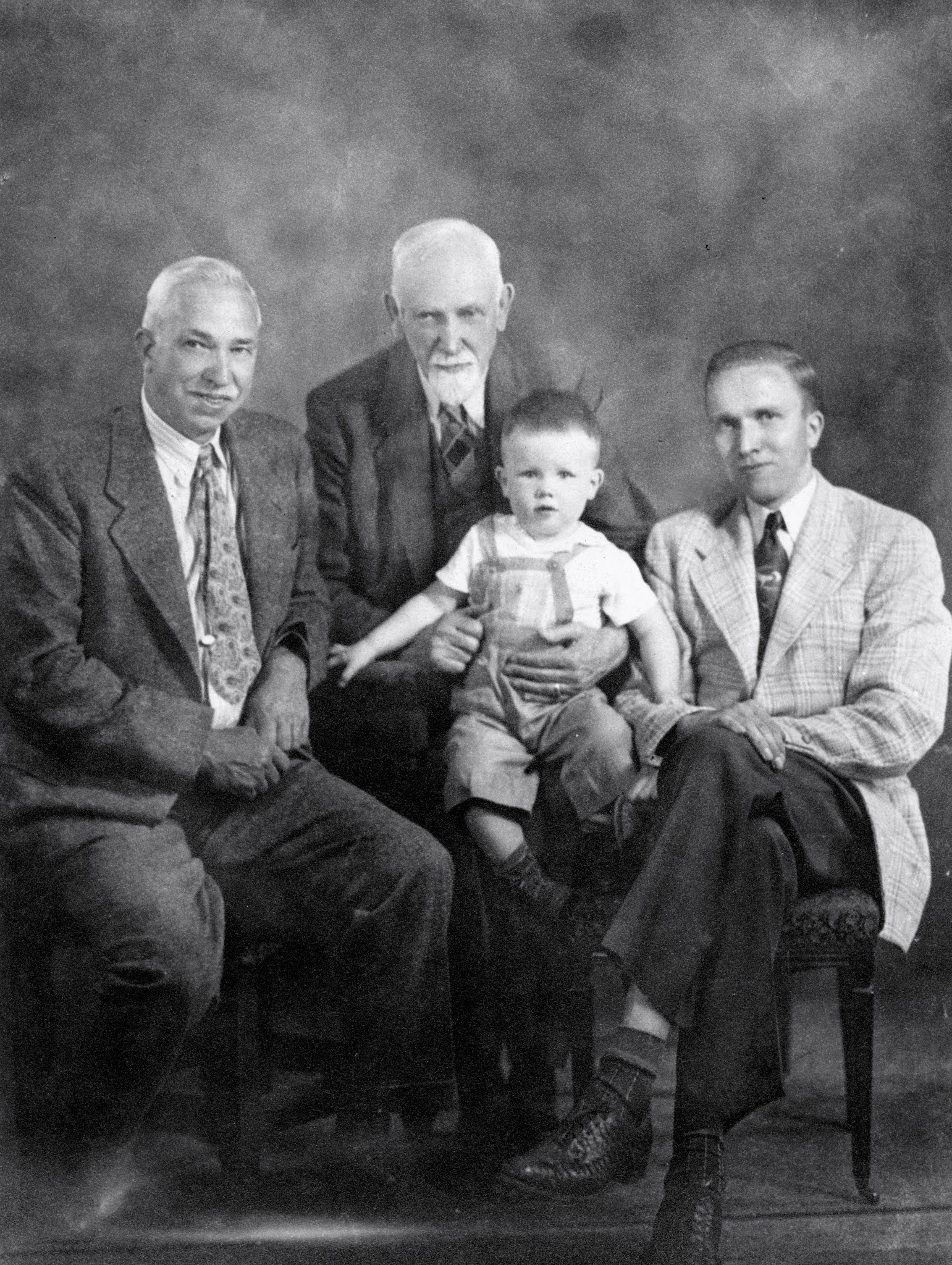
Raymond Edson Nute, Sr. Joseph Nute holding Raymond Nute III, Raymond Edson Nute Jr.
1944

Joseph’s Later Years

In 1920, Joseph and Harriet still had three of their adult children living at home: Warren who was working as a bank clerk, Alden a chemist in a cotton mill, and twenty year-old Katharine. The household included their longtime housekeeper, Susan Simmons, whom Joseph remembered in his will.

Joseph retired from the Gas Works in 1924 at age sixty-one, and became involved in business partnerships, including with Helen's husband, Arthur, for a dirigible to operate at the South Dartmouth airport. The blimp was destroyed in El Paso in 1932.

Joseph devoted years to researching the Nute genealogy with a distant cousin, Percy Elmer Nute (1884-1965) of Lynnfield, Massachusetts. Together, they traced descendants of the early Nute family of Dover, New Hampshire. Amy Emery compiled their Information into book form; a copy is held in the New Hampshire Historical Society. Joseph’s research papers were donated to the New England Genealogical and Historical Society in Boston and are available on request.

After Harriet died on May 21, 1941, Joseph, then seventy-seven, went to live with Helen and Arthur in South Dartmouth. He died September 15, 1949, and was cremated at Forest Hills in Boston.

So, was it in the genes? Joseph’s restless curiosity, devotion to public service, and willingness to try something new echo through the lives of his children: a teacher, an agricultural innovator, war veterans, a chemist, an occupational therapist, all college or vocational graduates. Not by genes alone - Joseph and Harriet created a home that valued education, service, scientific inquiry, and hard work. 


Monday, May 28, 2012

Don't Hold Your Breath

What kind of ingrate goes on an all-expense paid trip to Ireland and Iceland, then waits nine months to blog about it? You’re lookin’ at her. OK, so you’re not – you’re just reading the first of her very belated blogposts about the trip.

After our very inspiring and character-building 200-mile hike on the Camino de Santiago in the fall of 2010 – about which it also took me months to get around to writing, I figured 80 miles on the Kerry Way in Ireland would be a relative piece of cake. So when Kathie told me that Kathleen was planning the trip and asked if I would like to go…well, really, what would you say? 

We took off on Friday, August 12th, for Dublin. The overnight flight was the crampedest – yes, that is now a word in my dictionary - I have ever experienced. I mean, really, Delta? We’re not 3 feet tall.  A few more inches between rows would not kill you, would it? Or maybe those seats should have been reserved for leprechauns. 

Upon arriving in Dublin on Saturday morning, we caught a bus that stopped right in front of the Portabello Bed and Breakfast, a lovely Victorian row house on South Circular Road, owned by Paul and Eileen Coughlin. We dragged our stuff in, chatted with Paul a bit, got situated in the front basement apartment (1 room with 3 beds and an itty bitty bathroom in a closet-sized space – which is not really so unusual in Europe), grabbed some euros at the ATM across the street, and hopped on the bus to downtown. Later we found out that we could easily walk there, but taking the bus this time was a good thing because we met a young lady who recommended Taste Food Co. for lunch.   


I had the roasted Mediterranean vegetable something or other (the menu description: “toasted focaccia buttered with our own hummus, topped with rocket tossed in balsamic dressing, mozzarella, basil pesto & roasted med veg”), which was quite tasty.

Then we wandered around a bit on our way to the tourist office. Along the way, we passed this sign for McDonald’s.


(Whaddya think – is that a hoot or what?) Then picked up some tickets for River Dance on Sunday evening.  We finally made it to the tourist office where we bought tickets for the hop on-hop off bus and got the scoop on Molly Malone from the tourist office lady.


According to Wikipedia, “Molly is commemorated in a statue designed by Jeanne Rynhart, erected to celebrate the city's first millennium in 1988. Placed at the bottom of Grafton Street in Dublin, this statue is known colloquially as 'The Tart With The Cart', 'The Dish With The Fish', 'The Trollop With The Scallop(s)', 'The Dolly With the Trolley', and 'The Flirt in the Skirt'. The statue portrays Molly as a busty young woman in seventeenth-century dress. Her low-cut dress and large breasts were justified on the grounds that as ‘women breastfed publicly in Molly's time, breasts were popped out all over the place.’"

In Dublin's fair city,
Where the girls are so pretty,
I first set my eyes on sweet Molly Malone,
As she wheeled her wheel-barrow,
Through streets broad and narrow,
Crying, "Cockles and mussels, alive, alive, oh!"
"Alive, alive, oh,
Alive, alive, oh",
Crying "Cockles and mussels, alive, alive, oh".

She was a fishmonger,
But sure 'twas no wonder,
For so were her father and mother before,
And they each wheeled their barrow,
Through streets broad and narrow,
Crying, "Cockles and mussels, alive, alive, oh!"
(chorus)

She died of a fever,
And no one could save her,
And that was the end of sweet Molly Malone.
Now her ghost wheels her barrow,
Through streets broad and narrow,
Crying, "Cockles and mussels, alive, alive, oh!"
(chorus)

Apparently U2 did a version of that.  Huh.

So we hopped on and off the hop on-hop off bus – which is obviously what you’re supposed to do - to get the lay of the land.  Somewhere about halfway through the route, the three of us started nodding off.  Having slept all of 3 minutes on the flight, we were pretty tired puppies.  When the route ended, we were not sorry to hop off for good and get some dinner at O'Neill's, where Paul had recommended we get the fish and chips.  The fish and chips were so-so, but what do Yankees know about such things?


When will I write about the rest of the trip?  Who knows?  It might be tomorrow…or it might be in another nine months.  Don’t hold your breath.  It's been so long since I've blogged that I have to catch up on all the new Blogger tricks.  Oy.


Sunday, May 20, 2012

Sunset Trail, Laguna Meadow, and More

A couple weeks ago, two friends and I set out on a Jim Duggan adventure to the Laguna Mountains east of San Diego - and an amazing adventure it was. Jim is a horticulturalist for the Getty Museum Central Garden, a wonder of the art and plant world, and an expert on San Diego hiking. I can remember the first time I looked over the edge to the Getty Central Garden, a Wow! experience, unforgettable like where were you when you heard Kennedy died.

Everyone goes to the Anza Borrego desert for early spring flowers. How many know about the spectacular mountain meadows and hillsides of the Lagunas in springtime? Our mission was Noble Canyon in late April to hike and see the flowers.  The original trail was put in by the Civilian Conservation Corps in the 1930's.  Why aren't we putting people to work these days with lasting projects like this?


We set off through  pine and oak forests, Kathleen (pink shirt) covered head to toe due to severe allergy to poison oak, Jim in his trademark shorts regardless of rattlesnake risk.  While our trail head was Penny Pines leading onto the Noble Canyon trail, Jim cut off at one point to our destination, the Sunset Trail skirting Laguna Meadow.


We climbed to a ridge with view to a beautiful valley below which may be Filaree Flats. 


Still everywhere is evidence of the wildfires that raged through this area almost a decade ago.  I worried about all the critters that must have been crisped, but Kathleen reassured me that many smaller animals went underground, the larger ones were able to flee, and not many carcasses were found after the fire.


Life renews itself in the spring., like these sprouting black oak leaves.  The very baby ones are still red.


Farther on, the long Laguna Meadow opened up and I got a Wyeth Christina photo of Debra.


After heading into the forest ridge down to Big Laguna Lake in the distance, we headed back along the edge of the meadow, Jim and Kathleen stopping to examine, photo and note the botany of the area.  Deb said later she was grateful for their stops.  He's a hard guy to keep up with.


 I took a few flower photos of my own,


we headed back to the trail head, and climbed into the car to head north on Sunrise Highway.  Hillsides on both sides of the road were filled with Ceanothus, the California version of lilacs, and magenta western redbud. How many times can you say Wow!

We got out again at the Pedro Fages Historical Marker,


which reads,

On October 29, 1772, Colonel Pedro Fages headed east from San Diego searching for army deserters.  It was the first entry by Europeans into Oriflamme Canyon.  From there, Fages and his men travelled on through Cajon Pass, around the Mojave and the Central Valley, and eventually reached Mission San Luis Obispo.  As a result, he discovered the Colorado Desert and the San Joaquin Valley.

Whoever placed this marker was clearly having a Columbus discovered America moment.

Colonel Pedro Fages commanded the original Spanish army sent to stake a claim in California.   Along with Father Junipero Serra, they all climbed the Presidio hill in 1769 and planted the cross for Spain.  

You gotta wonder about a guy willing to head this far out into uncharted- for them - territory looking for a few deserters.  I wondered how they made their way, fed themselves,  and kept on track until I read this letter written by Don Pedro to Don Jose de Galvez.  If you're from San Diego, take the time to read this part of our history.   You've also gotta wonder about anyone who would desert in an unknown land into the back wilderness of San Diego County.

An old road could be seen going east, crossing into Oriflamme Canyon, used by travelers and stage coaches in the 1800's, but we turned west along an unnamed trail with wonderful tree skeletons,


and a view toward Cuyamaca Reservoir.


We were all walked out for the day, ready to turn back, when Jim pointed out a stripe through the valley below.

"Part of the old road where it turned to go into San Diego", he said.  


History, it's everywhere.

Thursday, April 19, 2012

The Shot Heard Round the World

On the night of April 18, 1775, 800 British regulars were moving out of Boston, west toward Lexington and Concord, with objectives to capture two troublemakers, Samuel Adams and John Hancock in Lexington, as well as stores of patriot munitions at a farm in Concord. Paul Revere set off on his famous midnight ride,

So through the night rode Paul Revere;
And so through the night went his cry of alarm
To every Middlesex village and farm,---
from Henry Wadsworth Longfellow

Along the way he warned the patriot locals and other riders were dispersed to spread the word to the “Minutemen” who were prepared to muster at a minute’s notice. Revere and two buddies warned Lexington and were detained at Lincoln, a small town adjacent to Concord and Lexington. By that time the wheel was in motion and in the early morning hours of April 19 about 70 patriot militia confronted the British at Lexington Green. After a fierce defense by vastly outnumbered Lexington Minutemen, the British advanced on toward Concord, six miles away, looking to capture a large patriot munitions store on a farm two miles west of the North Bridge over the Concord River.

Meanwhile, Minutemen from Concord and surrounding farm towns of Middlesex County had mustered and marched toward the North Bridge to confront the British and prevent their movement across the small river toward the munitions store. Believed to be first at the bridge were minutemen from Lincoln. In face of the large British force, 250 minutemen retreated across the bridge. As reinforcements arrived and smoke was seen coming from the meetinghouse, spreading through town, the growing force of Minute men advanced with orders to fire only if fired upon.

The British retreated back across the bridge, but a shot rang out and the fight was on.


By the rude bridge that arched the flood,

Their flag to April's breeze unfurled,

Here once the embattled farmers stood

And fired the shot heard round the world.
From Concord Hymn, Ralph Waldo Emerson

The British fled and retreated toward Boston, harassed all the way back by patriot militia. The British lost 200 men by the end of the day, a victory setting the Revolution in motion.

A young Lincoln farmer, Nathaniel Gove, 26 years, would have been wakened by the alarm in the early morning hours, likely by 1:00 AM on April 19, and hurriedly put on his clothes, gathered his rifle or musket, perhaps grabbed a biscuit, and mounted his horse to join the other Lincoln minutemen in Colonel Abijah Pierce’s Regiment. The weather was probably a chilly 40 degrees. He left behind a young 22 year old wife, Elizabeth, and two children, Tabitha, age 2 and Nathaniel, almost a year old. He was off to join with his buddies of Lincoln who had been expecting this situation to arise sooner or later.

They marched from Lincoln at about 2:00 AM and arrived at Concord, four miles away about 4:00 AM, the first Minutemen to reach the North Bridge “in a body, under their two captains, Abijah Pierce and William Smith, bringing the rumor that men had been killed at Lexington. The Lincoln men, then, with the two Concord minute companies (some members being probably absent saving the stores) marched down the Lexington Road."
Allen French, The Day of Lexington and Concord (1925)

"One compney I beleave of minnit men was raisd in a most every town to stand at a minnits warning. Before sunrise thair was I beleave 150 of us and more of all that was thair. -- We thought we wood go and meet the Britsch. We marched Down to wards L[exington] about a mild or a mild half and we see them acomming, we halted and stayd till they got within about 100 Rods then we was orded to the about face and marchd before them with our Droms and fifes agoing and also the B[ritish]. We had grand musick.”
Amos Barrett, letter of April 19, 1825 in We Were There! The American Rebels

And meet the British they did. By noon, the British were retreating back to Boston, the Minutemen having won the first battle of the American Revolution.

Nathaniel, our 5th great grandfather, returned home to the farm and had eight more children. His great grandfather was John Gove, immigrant from England in 1635 and brother to the “treasonous” Edward Gove who led Gove’s Rebellion against the British in 1683.

Sunday, March 04, 2012

Edward Gove, Touched with Fire

There is more to our story of Edward Gove.

In The Treason and Trial of Edward Gove, I spoke of his personal characteristics - "strenuous", quick to avenge, taken to court for assaults - and his accomplishments as a leader in the militia, member of the New Hampshire assembly, and then "Gove's Rebellion" that brought on a death sentence and confinement to the Tower of London.

As I was reading about Edward in The Gove Book, I couldn't help but be struck by this man's endless energy. He migrated from Charlestown forty miles north to Salisbury at age 27 and bought a right of commonage, i.e., to pasture animals on common land. A dizzying rate of buying and selling land over the next 20 years followed this humble beginning, in the process moving to Hampton, New Hampshire, where he acquired a large home, stables, a tavern and was a large landholder.

As an aside, in 1787 a Georgian colonial home, Elmfield, was built on Edward's original 1670 land grant in Hampton, New Hampshire. The Quaker poet, John Greenleaf Whitter was a frequent guest and died here in 1892. The home was passed through generations of Goves until moved to a new site in Greenwich, CT in 1996.


But, back to my story.

Edward's indictment on this first armed resistance in the British Colonies accused him of "raising insurrection with treasonable words... inciting the people to sedition and rebellion, declaring for liberty and the like, to the great disturbance of his Majesties peace". Indeed, he rode into the colonial village of Seacoast at the head of only a dozen men from Hampton on the day before his final arrest, "waving his sword and the trumpeter sounding a military medley", but was surrounded by militia and all put on house arrest. The group escaped and when the constable showed up at Edward's house, Edward pointed his sword at his chest, "I will not be taken in my house".

The following day Edward again arrives in Hampton with his rebels, complete with the trumpeter and Edward riding at their head with carbine and sword drawn, this time taken into custody and immediately placed on trial.

Needless to say, Edward was a colorful person.

What interests this writer is the trial deposition of a 70 year old neighbor, John Stephens,

That Edward Gove now of Hampton in the Province of New Hampshire was some years since in a Strange Distemper, Seemingly Lunatick, and did attempt to kill the wife of George Martin, Saying that shee bewitched him and did to that end charged his pistolls and endeavored it of which condition of his the Court at Hampton being enformed did sent for him and understanding his condition, ordered that he should be committed into safe custody to prevent his doeing hurt to himselfe or others. Ipswich prison was the place intended, but the said Steephens, out of respects to Gove, undertook to look to him, with this condition that, if he could not rule him, he should be assisted to carry him to the aforesaid Prison.

The said Steephens saith that he did abide with him about three weekes, in which time he did humor him as a child, to keep him quiet and from doeing hurt to himselfe or others; sometimes he was seemingly Rationall, and at other times seemingly distracted, that the said Steephens was forced to lock up the dores and lock him in, sometimes he would take a booke and read an houre or two, sometimes he would be more like a mad man, and would not medle with it, Mr. Dolton the minister of Hampton being there one time, advised that we should keep bookes from him, that he might not read too long to trouble his head, which wee carefully observed.

After a while he grew pritty well and went from the said Steephens house, But the said Steephens do further declare that he did look upon him as a man that was always subject to that distemper. He thinks it was naturall to him for his mother lived and died in that kind of Distemper...


And, forty three year old John Steephens, a son of the above Stephens, gave deposition,

"He doth well Remember that when Edward Gove was at his fathers house, he was in generall as his father hath above affermed... doth affirme and declare that the said Gove was distracted and unsafe in his actions and motions and that his father attended him and followed him alway day and night during the time of his aboad at his house, for none of the house besides him could prevail with him, he lay with him at night and he hath heard his father often say that he was often fourst to hold him in his arms to keep him from rising and going about in the night...

There be also many more that can testifie to the like; if need be, & some that can sweare they were in company and did many times help to bind the said Edward Gove hand & foote (when he was out in his head) for feare he should doe hurt to himselfe or others."


When Edward was in the Tower of London, his wife, Hannah, petitioned the king and begged for the life of her husband "who by means of a distemper of Lunacy or some such like, which he have benn Subject unto (by times) from his youth, and yet is untill now (as his mother was before him) (though at some times seemingly very Rationall) which have occasioned him Irationally and evily to demeane himself (by means of some unhappy provocation) to such actions whereby he may have incured until himselfe the Sentence of Death..."

A petition from another colonial to King Charles II documented that after Governor Cranfield imposed custom on merchant ships,

"hereupon the said Edw. Gove was much troubled in mind and these and the other violent proceedings of Mr. Cranfield had such an influence upon him that it hindered by his ordinary Rest, neither had he above 2 hours Sleep in 18 days, whereby he became almost distracted... scarce knowing at that time what he either did or said".

As a psychiatrist who has cared for countless patients in the throes of mania, I believe these testimonies give good evidence Edward Gove suffered from bipolar disorder with episodes of mania. In the interim between bouts of mania, he was energetic, intense, driven, gregarious, volatile, reckless, and a man of high achievement, a temperament often associated with bipolar disorder. The genetic nature of bipolar disorder has been established and the depositions of the Stephens' indicate Edward's mother was likely also bipolar.

Kay Jamison in her book Touched with Fire has written about madness and suicide in countless artistic and creative individuals - Shumann, Shelley, Keats, Van Gogh, and Lord Tennyson among many others. Who hasn't wondered about Robert Downey, Jr. and Mel Gibson?

I think it's a good bet our Edward joins this illustrious list,

Who wore at their hearts the fire's centre.
Born of the sun, they travelled a short while toward the sun
And left the vivid air signed with their honour.

Stephen Spender, 1933

Edward is our 8th great grand uncle, and his mother our 9th great grandmother.

Resource: The Gove Book, History and Genealogy of The American Family of Gove and Notes of European Goves, by William Henry Gove, 1922.

Sunday, February 12, 2012

Salton Sea: Once in a Lifetime, No Need to Repeat

The bucket list got shorter this weekend with an excursion east to the Salton Sea. I've seen it in a distance from mountain tops and flyovers but never set foot on its dead fish bone beaches.

My buddy in adventure, Kathleen, and I picked up her friend, Laura, on a ridge top in Julian in the early morning. Laura's home had been totally crisped in a San Diego wildfire. Rebuilt on the same location, the home has a stunning view across the mountains and high desert to the Salton Sea 50 miles away.

We drove through the Anza Borrego Desert, down Banner grade - I blinked, and missed Banner - through all terrain vehicle Ocotillo Wells where those young men and boys get maimed and killed while tearing up the desert, past the Los Puertecito marker where DeAnza camped on his way from Mexico to San Francisco in 1775, and dropped down 200 feet below sea level into the Salton Sea Basin.

The accidental lake of the Salton Sea lies on the site of Lake Cuahilla, an ancient sea that dried up in the 1500's when the Colorado River feeder on its way to the Gulf of California silted up. A engineering incident in 1905 breached the wall of the river, again filling up the basin until the breach was repaired in 1907. Since then, the sea has been kept alive with feeder run-off from farm irrigation in Imperial Valley filled with pesticides and fertilizer. The salinity has risen to exceed the Pacific Ocean and Great Salt Lake. Periodic die offs of unbelievable millions of fish and the 2003 water deal to divert Colorado River water from the Imperial Valley farms to San Diego has sealed the fate of the Sea in spite of token bureaucratic gestures to restore the area. The playground of celebrities and resort mecca of retirees in the 1950's has been replaced with rusted out trailers, naked telephone poles, and crumbling concrete piers.

Kathleen and I had romanticized preconceived images of the Salton from an Scott London's online photography site and You Tube video, The Accidental Sea.

Getting out of the car at the Salton City pier we were met first with a wind that nearly took off the car door, then a less than romantic stench of dead and decaying fish lining the shore.


The blue lake color is a reflection of the sky as the water itself is a dark tannish brown. The "sandy beaches" are actually pulverized skeletons of the millions and millions of fish that have died off.


Kathleen and I walked to the end of the pier where Kathleen checked out a circular grime encrusted concrete mystery. Yes, in its day this had been an old hot tub out in the water.


We continued our circumnavigation around the lake from the western shore to Mecca at the northern shore where two thirds of the population are in the federal poverty range and a new Indian gaming casino has been opened. We turned south down the eastern shore and stopped to picnic at a little beach in the Salton Sea State Park, clearly the most pleasant part of our day.


We watched the sea,


and the birds,


before heading farther south to check out Bombay Beach. We thought our photographic opportunities might lie here, but it was another rusted out, decaying, smelly, and very windy place. Telephone poles and foundation outlines, even toilet bowls in the sand, stand where once there was a beach community. Not to say there isn't still a beach community. Set back from the beach is still a community consisting mostly of trailers.


Pilons from a long gone pier,


and a truly bizarre crusted construction crane. What ever possessed those who left it here to further junk up the "beach".


We stopped by the Sonny Bono Wildlife Refuge, checked out a large flock of napping white snow geese, and later I regretted not climbing the small Rock Hill in the distance when I learned it is an extinct volcano. We passed several huge geothermal plants dotting the south shore, all taking advantage that the San Andreas fault passes directly through the Salton Sea basin on its way north.

The Salton goes into the category of a once in a life time adventure, not needing to be repeated.