Showing posts with label Hiking. Show all posts

Sunday, September 23, 2012

Lost Hikers: Sound familiar?

This article ran in the Fall River Herald in about 1915-6.  Helen is a great aunt to my generation, sister to Raymond Sr.   The article is undated but at the time of this experience she is teaching at a high school in Orleans, MA, a town just at the elbow of Cape Cod.    She graduated from Mt. Holyoke College and was a teacher until her marriage in 1917 at age 28.

YOUNG WOMEN LOST IN WOODS OF CAPE
Miss Helen E Nute of This City and Companion found in an exhausted state
Will suffer no serious effects from their way walking from Brewster to Orleans

Miss Helen E Nute of this city, daughter of J.E. Nute, manager of the Fall River Gas Works Co., and Miss Bertha Wilson of Thomasville, Me., assistant principals of the Orleans High School, had an extremely unpleasant experience Sunday night in the Brewster woods, in which they were wandering about from dark until after midnight.

Mr. and Mrs. J.E. Nute drove down from this city in their automobile Sunday morning to spend the day and started on their return about 3 PM.  Their daughter and Miss Wilson accompanied them as far as Brewster, intending to walk back to Orleans.

Not having arrived home after dark, Mr. and Mrs. Higgins, with whom the teachers board, became worried, and soon afterward made inquiries by telephone of Brewster residents, and ascertained that two young women had been seen entering the woods about 4 o’clock.  Fearing that the two teachers had become lost in the woods, Mr. Higgins notified the selectmen who also notified Deputy Sheriff Boland.

A general alarm was sent out about 9 o’clock by ringing the church bells, and searching parties were organized under the direction of Sheriff Boland, Dr. Lemuel Pope, Elnathan Eldredge, George Steel and others from different sections, who started out to search the various cross-roads and wooded paths.

Mr. Nute, who had arrived at home in this city, was notified by telephone about 9 o’clock, and he said the girls had spoken of taking a cross cut through the woods from Brewster to Orleans.  About midnight, one of the automobile searching parties penetrated the road leading through Roland Nickerson’s deer preserve near Cliff Pond in East Brewster woods, and learned that the young women had been there just before dark and inquired the way to the village.

The caretaker had directed them toward the Brewster road, but they had evidently become undecided again and had got lost before getting out of the woods.  This was the first clue to the young women since the search began.  The party took different paths, and Mrs. Higgins and his searchers soon found footprints.

On reaching a point about half way between Cliff pond and Baker’s pond they were overjoyed at meeting the two exhausted and frightened girls coming toward them, hardly able to speak from hoarseness, after shouting at their utmost for hours.  They reported having lost they way, owing to the density of the woods and the intense darkness which came on very early, owing to fog and cloudiness, when they left the Nickerson bungalow.

They were considerably worn out from their long tramp and the prospect of spending the entire night in the dark woods.  They had heard the bells and the tooting of automobile horns and whistles of every description, and could at times see the rays of the automobile headlights turned upward when climbing steep hills but, of course, were absolutely unable to make themselves heard by the searchers by screaming or shouting.

Every sound in the deep darkness, even after the rising moon had lightened it slightly, and every big tree seemed an object of terror, owing to their failing strength.  The searching parties had covered every road where automobiles could penetrate in that entire section between Brewster, East Harwich, and Orleans.

Meantime, Mr. Nute had become so alarmed that he and Mrs Nute started again from this city for the Cape about 11 PM, reaching Orleans about 3 o’clock Monday morning.  They were rejoiced to learn that their daughter and her companion had been found and that neither of the young ladies was in serious condition.  It is believed that they will suffer lasting effects from their experience.

Newspaper reporting is just not the same as a hundred years ago.

I think I may have inherited some of Helen’s genes.

Sunday, May 20, 2012

Sunset Trail, Laguna Meadow, and More

A couple weeks ago, two friends and I set out on a Jim Duggan adventure to the Laguna Mountains east of San Diego - and an amazing adventure it was. Jim is a horticulturalist for the Getty Museum Central Garden, a wonder of the art and plant world, and an expert on San Diego hiking. I can remember the first time I looked over the edge to the Getty Central Garden, a Wow! experience, unforgettable like where were you when you heard Kennedy died.

Everyone goes to the Anza Borrego desert for early spring flowers. How many know about the spectacular mountain meadows and hillsides of the Lagunas in springtime? Our mission was Noble Canyon in late April to hike and see the flowers.  The original trail was put in by the Civilian Conservation Corps in the 1930's.  Why aren't we putting people to work these days with lasting projects like this?


We set off through  pine and oak forests, Kathleen (pink shirt) covered head to toe due to severe allergy to poison oak, Jim in his trademark shorts regardless of rattlesnake risk.  While our trail head was Penny Pines leading onto the Noble Canyon trail, Jim cut off at one point to our destination, the Sunset Trail skirting Laguna Meadow.


We climbed to a ridge with view to a beautiful valley below which may be Filaree Flats. 


Still everywhere is evidence of the wildfires that raged through this area almost a decade ago.  I worried about all the critters that must have been crisped, but Kathleen reassured me that many smaller animals went underground, the larger ones were able to flee, and not many carcasses were found after the fire.


Life renews itself in the spring., like these sprouting black oak leaves.  The very baby ones are still red.


Farther on, the long Laguna Meadow opened up and I got a Wyeth Christina photo of Debra.


After heading into the forest ridge down to Big Laguna Lake in the distance, we headed back along the edge of the meadow, Jim and Kathleen stopping to examine, photo and note the botany of the area.  Deb said later she was grateful for their stops.  He's a hard guy to keep up with.

 I took a few flower photos of my own,


we headed back to the trail head, and climbed into the car to head north on Sunrise Highway.  Hillsides on both sides of the road were filled with Ceanothus, the California version of lilacs, and magenta western redbud. How many times can you say Wow!

We got out again at the Pedro Fages Historical Marker,


which reads,

On October 29, 1772, Colonel Pedro Fages headed east from San Diego searching for army deserters.  It was the first entry by Europeans into Oriflamme Canyon.  From there, Fages and his men travelled on through Cajon Pass, around the Mojave and the Central Valley, and eventually reached Mission San Luis Obispo.  As a result, he discovered the Colorado Desert and the San Joaquin Valley.

Whoever placed this marker was clearly having a Columbus discovered America moment.

Colonel Pedro Fages commanded the original Spanish army sent to stake a claim in California.   Along with Father Junipero Serra, they all climbed the Presidio hill in 1769 and planted the cross for Spain.  

You gotta wonder about a guy willing to head this far out into uncharted- for them - territory looking for a few deserters.  I wondered how they made their way, fed themselves,  and kept on track until I read this letter written by Don Pedro to Don Jose de Galvez.  If you're from San Diego, take the time to read this part of our history.   You've also gotta wonder about anyone who would desert in an unknown land into the back wilderness of San Diego County.

An old road could be seen going east, crossing into Oriflamme Canyon, used by travelers and stage coaches in the 1800's, but we turned west along an unnamed trail with wonderful tree skeletons,


and a view toward Cuyamaca Reservoir.


We were all walked out for the day, ready to turn back, when Jim pointed out a stripe through the valley below.

"Part of the old road where it turned to go into San Diego", he said.  


History, it's everywhere.

Sunday, May 15, 2011

Kicking Butt on El Cajon Mountain

It was a cool and foggy morning when Kathleen and I set off to bag the summit of El Cajon Mountain at El Capitan this weekend. East County being located in the Peninsular mountain foothills between Lakeside and Ramona, this is not usually a trek taken this late in the season when temperatures can be in the 90's. We had to cover 10 miles of rugged terrain before the heat set in. I was hoping to get a photo of El Cajon that would count toward my project of finding and hiking all the ranchos of San Diego.

We had a beautiful hike in, through corridors of California lilacs,


up and around and about the stone mountains,


past the remnants of the Cedar Fire that raged through here in 2003, burning 90% of the habitat.


"The Jeep" landmark, nice sculptural art for the area, looks to have been left there in the 1940's.


We chatted up the usual topics - the flora, what to do for a rattlesnake bite, where was the helicopter landing for all the injured hiker rescues you read about from this area - the last thing we wanted was again to be on News at 6 - until we reached the summit. We needed a little chatter. El Cajon Mountain with its steeps, boulders, chaparral, and distance is reviewed as the most kick-butt hike in the county.

Proof of arrival:


Unfortunately, I wasn't going to get a view of Rancho El Cajon through the fog.


On the way down, the fog cleared enough that I could get a shot of El Monte, but El Cajon city was so far off I wondered whether the El Cap had been part of the Rancho.


The afternoon brought the sun and blistering heat, but until the last couple miles I was still taking flower photos,


and finally, on the way out, a shot back at the behemoth that is El Capitan and the summit of El Cajon Mountain just up the ridge.


Rancho El Cajon was a huge ranch in the mid 1800's, including El Cajon city, Santee, Lakeside, Le Mesa and Flinn Springs. Did it include El Capitan? I think so. I could see Rancho del los Cochas just below in the valley, and I know a lot of Rancho El Cajon surrounded the little pig ranch. I think I feel a trip to the El Cajon Historical Society coming up.

Sunday, February 13, 2011

Valley of the Moon

Patty is getting tired of looking at the 300th Post blog when she opens up Pat and Kathie, so here is my latest adventure to the Valley of the Moon this weekend. I try to go out with the Gourmet Hiking Club once a month because they go to such cool places and, not only that, when we get to our destination the group lays out a tablecloth and brings out delicious food prepared by every hiker. I can always count on Kathleen's gourmet peanut butter and jelly sandwiches on dark Cranberry bread.

The group was going to 4 wheel drive into the Valley, but Kathleen and I and Laurel, a novice to the group, decided to start out early and walk in to get the extra miles. The reader should understand the Valley is about 70 miles east of San Diego, right on the Mexico-US border, remote desert wilderness, and traveled by two legged "coyotes" and their Border Patrol pursuers. Kathleen and I had lined up a man to hike in with us, but at the last minute he couldn't make it so I packed my little Mace canister. A lot of good that would do.

We started out early at 7:30 AM, expecting to meet up with the Gourmet hikers when they arrived into the Valley, hike around a little bit, then have some yummy lunch. Simple. Just follow the vehicle route in to the point where vehicles could no longer handle the terrain, wait for the rest of the guys, and proceed on the Valley.

Needless to say, we took a wrong fork about 15 minutes into the hike. Seems this used to be an old mining area, lots of mines, and lots of forks off the main road. They all looked like main roads. What's worse, we didn't know we were "lost", so we just kept going - all up hill, ending up on a mountain ridge looking out over the desert and into Mexico. Stunning, but about 10:00 AM I was wondering when those 4 wheelers were going to catch up with us.

I was taking pictures of the beautiful scenery, Laurel and Kathleen are trying to figure out where we were, and - voila! - Laurel spots a group on the road below. Had to be our group. They were going to wrong direction for illegals.


By the time we had bushwacked, bouldered and high tailed it down to the road, the group was gone. We spent the next hour tracking - yep, just like Indians - the main group, wondering if we were getting more "lost" or would there be any food left when we found them. Or, in the back of my mind, could we find our way out of here if we didn't find them.


It wasn't lost on us that because we had counted on a straightforward hike in, meet up with experienced Valley of the Mooners and get guided in the rest of the way that we failed to bring a full size topographic map, left our emergency kit in the car, and had no cell phone service in this remote area.


Just before noon, we finally spotted our group across the Valley floor, a good three quarters mile away, perched high on a rock - eating our picnic without us! We did hook up for a splendid lunch on what was left and, bellies full, we could appreciate the beauty and uniqueness of this special place on the hike out.

Rock formations that one could only wonder "why doesn't that fall off?"


"How did that happen?"


"Looks like a shoe up there".


"I think he's missing a couple fingers on that hand".


Easter Island, fallen over.


"I'm just as tired as you, buddy".


Pac Man


Palisades that would make an Incan proud.


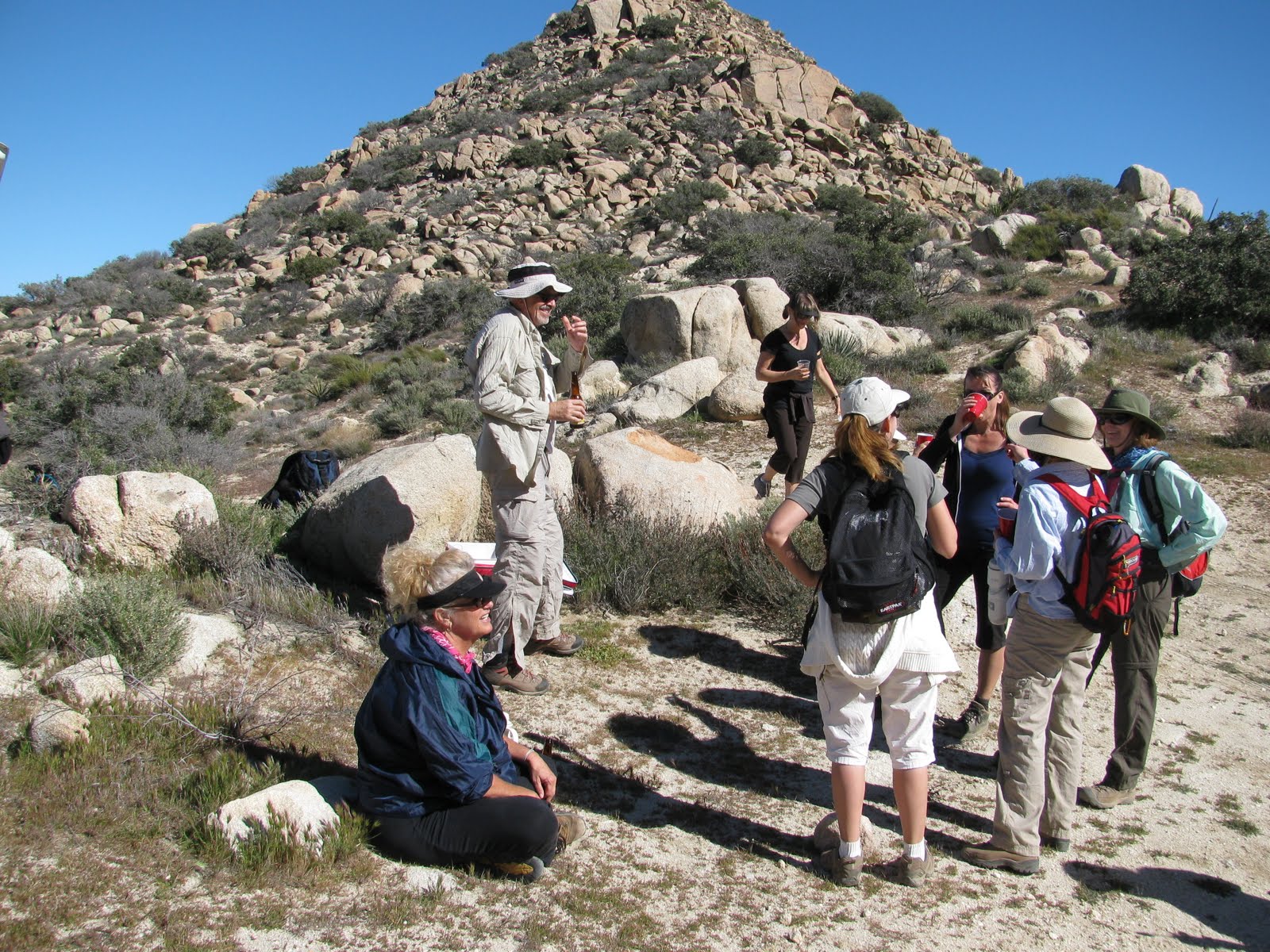
Finally, a cold beer at the end of the hike. Like I said, it's a cool group.


All's well that ends well. But next time no leaving the emergency kit back in the car.

Thursday, October 14, 2010

Some Boots Don't Stop Walking

Patty and I are just back from walking 200 miles of the five hundred mile Camino de Santiago pilgrimage across northern Spain.


When she gets over her jet lag, she's going to write about our trip, with maybe a few interjections from the West Coast sister. Two hundred fifty thousand pilgrims from around the world stream across northern Spain every year and we met our fair share.

A young red-bearded Scotsman told me he had been walking Europe for three months, and after he got to Santiago he was going on to Finistrae at the "world's end", then turn south to Portugal. "I don't know if I can stop walking", he said.

At the cathedral plaza in Santiago de Campostela, I met an Italian man in his 60's, Luigi Cianti, who had given away his fortune of $7 million fifteen years earlier and started walking. He had walked everywhere, including thirty one times across the Camino, and was indeed the Guinness record holder for number of completed Caminos. I googled him and it was for real.

We could relate to this. After the first hundred miles getting broken in, you feel you could walk infinitely. Maybe walking a hundred miles should be a requirement for high school graduation, or getting married, or, better still, running for office.

Sunday, May 09, 2010

On Foot in San Diego: Rancho Santa Maria de los Pensquitos

My project to locate and walk the thirty San Diego ranchos listed in my Ranchos of San Diego County book is moving slowly. My friend, Pat, said she was tired of opening up the blog and seeing Kathy and Louis’ garden, so it’s time to get some writing done again.

I have walked Rancho Santa Maria de los Penasquitos just a couple miles south of my house many times since coming to San Diego, but I had to check it out again this week after the Union Tribune reported the Easter Sunday earthquake caused the artesian well to more than double its output. More on that later.

The canyon preserve is an idyllic six mile walk end to end through one of the largest urban parks in the US, about 4000 acres in all.


I have walked here with coyotes in early morning, watched the hawks on the hillside, given wide berth to snakes. When I first started walking the canyon twenty years ago, I could feel completely away from civilization. These days housing developments have been allowed on the ridge line.


A stream flows east to west across the canyon, crossing midway through rock cliffs (Penasquitos means "little cliffs") with a substantial waterfall in springtime.


I wasn't able to climb around for a picture of the falls, but there were other points of interest in my viewfinder.


You're walking a lot of history across this beautiful little canyon. The eastern part of the canyon was part of the first San Diego land grant, made by the governor of Mexico to the comandante of the Presidio, Captain Francisco Maria Ruiz, in 1823, one league in all (4439 acres), now the burg of Rancho Penasquitos. Before the Captain's grant, the land was used by the Mission padres for sheepfarming and orchards, and before them by Kumeyaay Indians going back 7000 years. Captain Ruiz asked for additional land and in 1834 he was given another league that extends westward almost to the I-5 and is most of our canyon.

The Captain was already in his 60's when he got this original land grant. He had a house in Old Town near the Presidio, but built a one room adobe house on the eastern end of the preserve for his visits to the ranch. When he died in 1839, the bachelor Captain passed the rancho to his grandnephew, Francisco Maria Alvarado, who lived both in Old Town and at the rancho with his family.

Francisco gave all his land to his son, Diego, who took over ranch operations in 1857 and built his house and ranch buildings at the western end of the canyon. Some ruins still stand but are enclosed by chain link making a good photo impossible. When I can resurrect one of my photos of the ruins from 20 years ago I will post as an addendum.

Francisco's beautiful daughter and Diego's sister, Estafana, married George Alonzo Johnson, a gringo from New York City. Read here for a fascinating personal account of Mr. Johnson's adventures before he met Estafana. After marrying Estafana, the couple bought property from Diego in the eastern end of the canyon to build their adobe, a wonderful house with veranda facing west across the canyon. What a view! Too bad the inheritance practices in those days gave all the land to the male heir, and Estafana had to buy her father's land back from Diego.

Three walls of the original adobe were incorporated into the new house, and the Johnson-Alvarado is the one standing today.


The front porch,


and back veranda facing the sunset.


Other history lives here in the canyon. The main road from Old Town San Diego to Yuma went through the canyon in the early to mid-1800's. In mid-December 1846 the 300 Army of the West soldiers surviving the Battle of San Pasqual were led through the canyon by General Kearny on their way to San Diego. Our guy, Mr. Johnson, fell on some hard financial times and the canyon was bought in 1880 by Colonel Jacob Shell Taylor, founder of Del Mar, who was going to sell it as subdivisions for development! Lucky for us, the bust of the late 1880's when the transcontinental rail failed to materialize for San Diego squashed that plan and the canyon continued as a working ranch for many decades, as late as the 1960's.

Back to the reason for this week's trek to the canyon, the artesian well just to the side of the Johnson-Alvarado adobe, inside this shelter.


The day after the Mexacali earthquake last month, water volume doubled from the well, likely from new fractures in the rock mass just below the ground.


A few more earthquakes like that and I could have my own personal hot springs right here in Del Mar.

Sunday, March 21, 2010

On Foot in San Diego: Secret Canyon Revisited or What a Difference a Day Makes

Five of the "six missing hikers" returned this weekend to Secret Canyon, entering from the end of the 16 mile hike we were unable to complete after becoming boxed in a canyon by rain swollen creeks. We were curious, all except our kick boxer Wayne who felt he didn't need this corrective emotional experience and opted to a game of tennis. Two of our rescuers, Chris and Jessie, sister and daughter of Linda, and Linda's dog, Harley, joined us. They needed a corrective emotional experience of their own after that night of worry and searching.

I won't bore the reader with the beauty of the area,


or the beauty of the sunny day.


We found the spot where we spent the night spooned to conserve body heat as the temperatures dipped into the low thirties soaked by intermittent downpours, straw pallet still on the ground, and hung out for about an hour.


We found the overgrown left fork in the trail that would have taken us above the creek, hidden by a pile of branches and grasses grown up from the recent rains.


We found the "swimming hole" landmark we had been searching for,


and hung out some more.


Chrissy Cekander, one of our black belt karate kicking sheriff rescuers.

As a special treat Kathleen pointed out some native miner's lettuce that kept the nineteenth century gold miners in this area from getting scurvy, a trick they likely learned from the Indians.


A newspaper from the miner's day would had said about this outing "a good time was had by all". All life's traumas should find closure this easily.